How gender-sensitive education is improving teaching and learning in schools
Creating a conducive learning environment for girls and boys

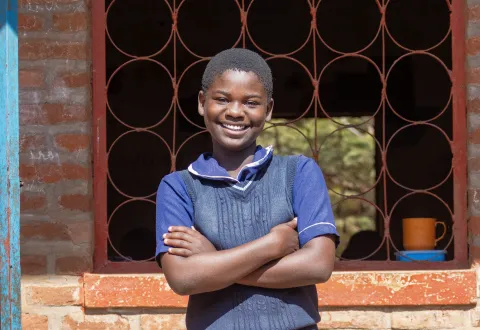
19-year-old Hajila Issa recalls being very timid when she started her first year of secondary school at Machinga Community Day Secondary School (CDSS). She grew up in Nayuchi village in Machinga where girls were often discouraged from enrolling in school. In addition, Machinga CDSS used to be known for male learners finishing top in class.
"I remember when I just finished my last year of primary school, some of my friends laughed at me for continuing with my education. Some of them already had babies, and they would say school is not for girls. They prefer to be married and having a child and would say to me that I would gain nothing from school."
Hajila ignored them and she started the first year of secondary school with a bang, finishing number one in her second term. However, she noted the negative comments from the boys when this happened.
"They were laughing and saying how can a girl be number one. They weren't happy at all."
Hajila managed to maintain her good grades up until the third year of secondary school, the same year UNICEF Malawi introduced the gender responsiveness training for teachers at the school with financial assistance from UNICEF's global thematic funds.
The training aimed to support the Ministry of Education in improving the gender responsiveness of the teaching and learning systems and promoting the development of gender-transformative education systems to enhance girls' learning experience. Over 400 secondary school teachers in various districts in Malawi have benefited from the training, which has helped them ensure their teaching methods are more gender-sensitive.
UNICEF Education Specialist, Heinrich Rukundo, says; "Our goal is to improve the capacity of headteachers and teachers to implement gender-responsive training in schools, ensuring that teaching and learning practices in classrooms respond to the needs of girls and boys. In addition, teachers are now empowered to better assist learners experiencing bullying and gender-based violence."
Rukundo says that UNICEF acknowledges the contribution of the global thematic funding in promoting the gender-transformative education system and how it impacts students' lives, especially girls.
“Teachers' capacity development on gender-responsive teachings plays a critical role in improving girls' access and completion of secondary education. Teachers have also improved their classroom setup, for instance, grouping students with boys and girls sitting next to each other, encouraging girls to participate in answering questions, managing gender-related constraints to learning inside the classroom," Rukundo adds.
As a female student, Hajila has seen the fruits of the training and testifies that it has improved girls' morale at school.
"I remember sometime last year; the teachers called all the students for a meeting. During this meeting, they told us the importance of boys and girls working together and how to treat each other as equals.” Hajila explains.
“They encouraged the girls to work hard to get good grades and boys to support girls in achieving this. Now we find that boys and girls help each other with schoolwork, so we can all excel in learning. When we all excel in achieving better learning outcomes, our school's performance looks good too," Hajila adds.

One of the teachers at Machinga CDSS, Alexander Doctera alludes to the changes at the school to the commitment teachers have had in applying what was learned from the week-long gender-responsive pedagogies training.
“Now boys and girls sit together in class and are put in the same working groups,” he says. "Our work has been simplified, all the students need to learn at ease, and are more confident. The girls are now strong enough to compete with boys. The training also helped change my mindset. I can admit that I used to assume that boys do better than girls. I no longer think this way, they all have the potential to do well, and I continue to encourage them to do their best.”
One of the three female teachers at Machinga CDSS Enless Kondecha has similar sentiments.
"Previously, I thought there were certain subjects that only boys could thrive in. Now I know that is not the case, and I work to be a role model to the girls," she illustrates. "We've been taught to treat learners equally, regardless of their gender. We always make sure that the questions we ask in class target both boys and girls and that all of them are participating. We also use 'they' in examples we give in class rather than 'he' or 'she'. The schools’ girl's performance has improved massively."
For Hajila, she has transferred the knowledge on gender to her family and community to counter traditional and cultural practices. She's the fourth born in her family and the only girl who has gone as far as secondary school. In the last year of primary school, her older sister dropped out of school and got married, and her younger brothers are all in upper primary school.
"People in my home and community are slowly changing their ways of thinking. My mom used to ask me to do household chores in the morning before going to school and not give any chores to my brother. This has changed now; we divide the chores. My brother even knows how to cook nsima (the main staple food in Malawi)," she describes with a wide grin. "Girls in my village also get to school on time just like the boys, because we're not consumed with chores anymore."
Hajila aspires to be a nurse in the future. "I hope to pass my exams with 12 points and go to college to achieve my dream of providing quality health services to people," she says.