Home schooling: How Bettie is coping with school closures
The impact of COVID-19 on education
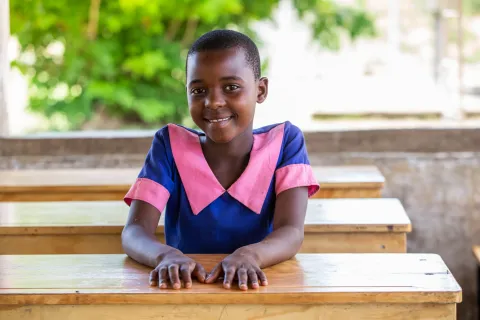
Before the Coronavirus broke out, a normal weekday for Bettie, 17 years old, would start like this: Her alarm would wake her at 4 a.m. She would perform a few household chores before cooking a meal she would later eat for lunch. She would also boil water to take a bath as it would be too cold otherwise.
At 5.30 a.m. she would dress neatly in her uniform of a brown skirt, white shirt and a green sweater. Her aunt would then take her to school, 25 km away. If her aunt was unavailable, she would ride the bus.
That was then. The form 3 student at Mkwichi Community Day Secondary School in Lilongwe can’t go to school now. All schools in Malawi have been closed since late March to prevent the spread of COVID-19. Millions of Malawian school children have been forced to stay home, and, in many cases suspend their formal education.

With confirmed cases of the virus increasing each day, it is unclear when the situation will normalize and allow students return back to school. Home learning is the only viable option for students like Bettie, keeping them engaged and acquiring new knowledge is essential to ensure that their study skills are maintained.
Learning at home and the challenges
However, for Bettie, not only has the lockdown disrupted her daily routines but also extended her academic calendar. As an aspiring nurse, the delay means she will not be able to complete her schooling as planned.
“I can only watch from afar and do nothing,” says Bettie, “I like science subjects, particularly biology and mathematics. I want to be a nurse one day and help people. But at the moment my dreams are on hold.”
Nevertheless, Bettie has devised a home study timetable which she follows religiously. She studies in the morning, afternoon and the evening. Whenever she isn’t doing household chores, she buries herself in a book.
Whenever she isn’t doing household chores, she buries herself in a book.

But like many students, Bettie isn’t able to access online lessons1 at home because she doesn’t have a computer or access to the internet.
“Since schools were closed, I have not been in touch with my teachers, friends for study circles and I don’t have a mobile phone. It would greatly help me if I had a laptop or any device that would enable me to access video lessons.”
For Bettie and other students like her who don’t have access to technology, reading books and notes taken from when they were in class is the only option to continue acquiring new knowledge and skills.
Bettie laments that even though books are the best she can do, it’s better to be at school where teachers can help students like her grasp the content.
“I continue to read books because I want to gain new knowledge and refresh my memory, but it is different from being taught by a teacher. Some of us grasp new topics better if there is a teacher to help us than when we are reading by ourselves,” she said.
However, Bettie is determined not to let anything to shatter her dreams. For now she will stick to her books and do her best to complete her studies. Not even coronavirus will stop her from becoming a nurse.

In Malawi, almost 8 million school-age children attending pre-primary, primary and secondary education are home since 23rd March 2020. Most of the girls and boys do not have access to the internet, books or supplies, and the support system necessary to continue learning at home.
With support from Education Cannot Wait, UNICEF has rolled out the Emergency Radio Education Programme for primary students and online learning for secondary school students in collaboration with the Government of Malawi and other partners. This ensures that students will continue to learn at home as they wait for the schools to reopen.
UNICEF and its partners are constantly striving to find new and innovative solutions that offer interim solution to keep millions of children in a positive education routine. This includes preventing the most vulnerable children from falling behind and supporting governments to scale-up home learning options.
1The Malawian government, UNICEF and Telekom Networks Malawi recently launched a free online remote learning platform.