Eat, play, love: Early childhood development brings hope for a bright future
Early moments matter

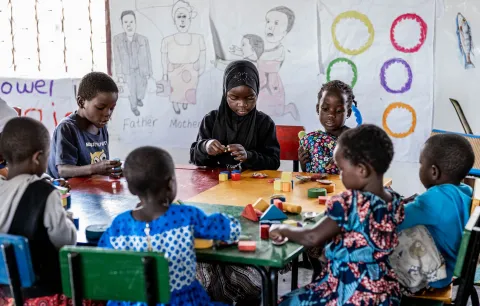
Chagunda Community Based Childcare Centre (CBCC) is a small shed on the side of a dirt road in rural Salima. On the weekend, the structure is used as a church, but from Monday to Friday’s it’s where 145 children from age two to five spend the majority of their time as beneficiaries of early learning.
Angela Kwereza, 23, is one of the trained caregivers at the CBCC. She knows the importance of early stimulation for children between zero to five years old.
“At the centre we teach children how to count from one to ten, we do fun physical activities for their age to keep them fit, and we also do simple quizzes with them to accelerate their thinking, which also contributes to their brain development,” says Angela who also has a three-year-old daughter that attends the CBCC. Apart from her work at the CBCC, she and other caregivers also work in the community.

“When we work in the villages, we come across children who have never been to a CBCC. We tell parents that as soon as a child turns two, it’s vital to send their children to a CBCC as it helps them make friends, interact with others, and boosts their intelligence,” Angela illustrates.
The benefits of early childhood development (ECD) interventions are abundant. Early learning is the foundation of a child’s journey to becoming a productive adult, and every stage of education that follows relies on its success. It’s also beneficial for children to be in a child-friendly environment to interact and learn from others. Quality CBCC’s plays a significant role in providing this.
Mercy Steven has worked at Chagunda CBCC for a year. Despite her short time there, she confidently boasts about how their work is positively impacting children in the community.
“We have parents congratulating us on the great work we are doing for the children that contribute to their learning and being able to develop socially. The kids are learning so much at a young age. They know their vowels and can write them, as compared to some standard one learners who missed early learning and aren’t able to do what children who went to a CBCC can do.”

Currently, over 22 children are set ready to enroll in primary school for the 2022 school year. The CBCC committee mobilizes the contributions from the community, for example, flour, maize, beans, and soya, to provide nutritious porridge for children every morning at the CBCC.
The caregivers are encouraged to make toys from locally available resources for children to play with. “We stitch dolls for them and also give them clay to make their own play materials,” Mercy adds.
With play being an essential aspect of early childhood development, Mercy’s fellow caregiver, Angela, also makes sure to practice what they preach at CBCC by playing with her toddler at home.
“I give her plastic bottles to play with sand, we play games together with a ball,, and I also talk to her a lot, and she’s able to grasp what I’m saying and responds, I know this is good for her growth,” says Angela.

Care for Child Development
Care for Child Development is an early childhood development technique that integrates health, nutrition, education, and child protection when caring for children.
Currently eight months pregnant, Angela applies care for child development to her unborn child.
“My husband always rubs my pregnant belly to interact with our unborn baby. He enjoys it so much and has already given the baby a name. Him rubbing my belly shows love to our unborn baby and helps her to become familiar with her father. My husband also helps me cook and makes sure I eat food from the six food groups. Sometimes he’ll pick mangoes for me from a nearby tree to make sure I am healthy. He also accompanies me to pre-natal checkups at the health centre,” a bubbly Angela describes.
“I also conduct door-to-door visits in the village where I have talks with pregnant mothers. I tell them to do the same as I’m doing: eat food from the six food groups to make sure the unborn baby is healthy, make sure their husbands sing and talk to their unborn babies and rub on their stomach too for the baby’s familiarity.”
As for the mothers with newborns, Angela encourages them to show the babies love and play with them as it builds trust and boosts early stimulation. Exclusive breastfeeding is equally crucial.
“I share with the mothers the importance of the first milk that babies get as soon as they are born. When my baby is born, I will provide the first milk immediately to develop our bond and breastfeed her exclusively from then onwards to make sure she’s well-nourished,” explains Angela.

Early Moments Matter campaign
With funding from UNICEF Finland, UNICEF Malawi, and the Ministry of Gender, Community Development, and Social Welfare, launched an Early Childhood Development campaign, also known as ‘Early Moments Matter’ and M’mera Mpoyamba’ in the local language Chichewa.
The yearlong campaign aims to create greater awareness about the importance of healthy brain development in the earliest years of life, increase investment in ECD programmes, policies, and services, and support parents and caregivers to give all children the best start in life.
Everyone has a part to play in promoting ECD. Mothers and caregivers such as Angela, set an excellent example as they practice raising this awareness in their communities as part of their day-to-day lives.
“I wish I went to a CBCC when I was younger, but I never had the opportunity. I bring my child to the CBCC because I know it will help her to have a bright future,” she says. “I love my job as a caregiver because I know I am doing my part in making a positive contribution to the lives of children in our village, which can eventually lead to the development of our area.”