Community steps in as new funding model transforms Mndinda Health Centre
Mndinda community leverages the UK - UNICEF Direct Facility Financing to build staff housing and improve response to maternal and child emergencies.

Tucked deep within the forested hills of Ntchisi, 24 kilometres from the district’s town, Mndinda Health Centre stands as a lifeline for thousands—yet one stretched dangerously thin.
For years, the facility has struggled with chronic staffing shortages, particularly among nurse midwives, leaving surrounding communities vulnerable during night-time and emergency situations.
Serving more than 12,800 people, the health centre operates with only three nurses. Two live on-site, while the third commutes long distances daily due to a lack of staff housing. Her late or exhausted arrivals often delay critical care, with children and critically ill patients most affected.
Determined to address this challenge, the surrounding community mobilised to construct an additional staff house so all three nurses can live within the compound and respond more quickly to emergencies.
Under Traditional Authority Mndinda, community members contributed cash, moulded bricks, gathered sand, and hired a local builder. The nearly completed house now stands as a symbol of collective effort and resilience.
This rare mobilisation was strengthened by the UNICEF-supported Direct Facility Financing (DFF), funded by the UK’s Foreign, Commonwealth and Development Office (FCDO).
Through the DFF, UNICEF provided operational funding and capacity-building support that revitalised the health centre management committee (HCMC)—a group of community and facility representatives responsible for ensuring services at the facility are accountable and responsive to local needs.

Beyond the DFF grant, the HCMC rallied the community to raise an additional MK5 million to match the MK5 million provided by FCDO, demonstrating local ownership.
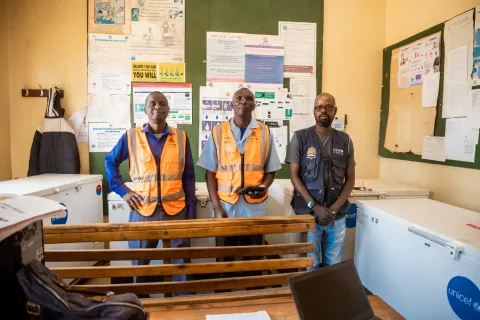
Titus Banda, Chairperson of the 19-member HCMC, said the committee identified staff accommodation as a major barrier to quality care during their DFF orientation earlier in 2025.
“Children and other patients were not getting timely care. Some went home without receiving any help,” he said. “We realised the solution was to build a house so the nurse could stay close by.”
After consultations with district health authorities, the committee was advised that additional accommodation was required before more staff could be deployed. Chiefs quickly rallied their communities, contributing money, bricks, sand, and labour.
Flexible DFF funding allowed the HCMC to reallocate resources from less urgent items, such as chairs, to essential building materials including iron sheets, timber, and nails.
Banda believes the new house will significantly strengthen service delivery in an area often avoided by health workers because of its isolation and difficult terrain.

Senior Group Mndinda expressed pride in the initiative, recalling the years before the health centre existed, when expectant mothers delivered in the hills or on long journeys to the district hospital.
“This is our own initiative. We will see it through. The benefits are enormous—this house will address the long-standing staff accommodation gap that has strained emergency care for years,” he said.
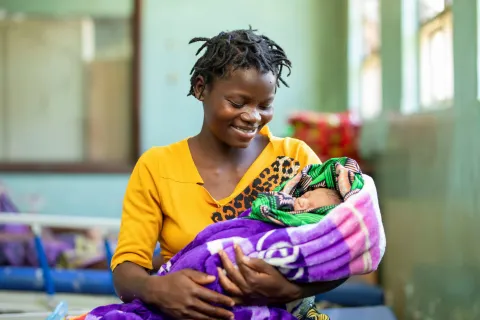
Expectant mother Theresa Petulo, admitted for her third child, shared her relief: “Knowing the nurse will be close by makes me feel safe.”
Nurse midwife technician Walinase Mdumuka said night-time emergencies are especially challenging.
“We are only three nurses, and one stays far away. Delays are common—worse during the rainy season,” she said. “Having a house within the compound will make a huge difference.”
The facility handles around 10,000 cases annually, including an average of 25 deliveries each month.
Sten Mbanje, the medical assistant and facility in-charge, described the DFF support as transformational.
“The approach allows us to identify and respond to our most pressing needs,” he said.