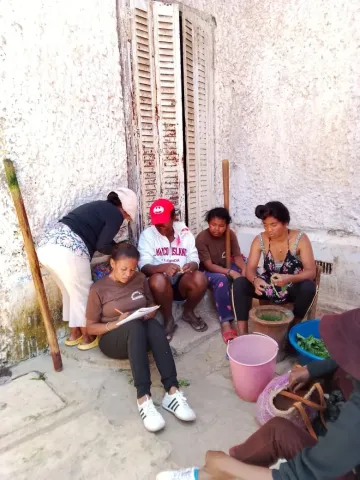
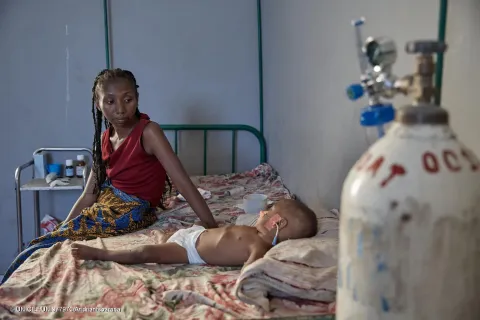
Community workers are working to improve the health of people in Sahevo.
Primary healthcare is more accessible to people living far from health centres thanks to community workers.

RANDRIANARISON Madiarilala, aged 46, is a community worker who lives in the village of Sahevo, in north-western Madagascar. As well as being a farmer, she is married and the mother of six children. The village of Sahevo is located 20 km from the designated basic health centre and has a population of 718 people.
According to RANDRIANARISON Madiarilala, “the population suffers significantly due to the distance to health centres and insecurity. It is a three-day walk to reach the town. As a result, people only visit the health centre on market days. The health services available to the population are limited to vaccination campaigns or mass distribution of medicines.”
Following the adoption of the new community health approach by the Ministry of Public Health and the release of new documents such as the Community Activities Package guide and the community health programme implementation guide, the Betsiboka region was the first one to implement them. This led to the recruitment and training of community workers and agents. It is within this framework that the village of Sahevo has been benefiting from community health activities since January 2024, including monitoring and promoting the development of children under five, caring for sick children, home visits to women, community awareness-raising, and referral to the health centre for vaccination.

RANDRIANARISON Madiarilala, aged 46, is a community worker in the Sahevo fokontany. She is about to return home after attending the monthly meeting and submitting her monthly activity report for October 2024.
According to her, “the population suffers significantly due to the distance to health centres and insecurity. It is a three-day walk to reach the town. As a result, people only visit the health centre on market days. The health services available to the population are limited to vaccination campaigns or mass distribution of medicines.”
RANDRIANARISON Madiarilala was elected by the local community to serve as a community worker at the village level, and she accepted the role. Following her training on the community package in May 2023, she carried out community awareness-raising, organized care for sick children, made home visits to pregnant and breastfeeding women, identified children needing vaccination, and monitored and promoted children’s healthy growth.
“The training I undertook enabled me to acquire the skills needed to fulfil my role as a community worker. At the end of the training, I received a comprehensive kit containing supplies, equipment, medicines and various written materials to help me carry out my duties effectively and raise my visibility within the community. Today, I am proud to be able to serve my family and care for my community by combating common diseases, such as malaria and acute respiratory infections. Their trust touches me deeply and motivates me to continue my commitment with even greater determination.”
She prepares monthly activity reports and presents the key findings at the monthly meeting of community workers.
According to RANDRIANANTENAINA Paul Roger, the village chief, the local community is grateful to RANDRIANARISON Madiarilala for her many efforts to improve their health.
Thanks to financial and technical support from UNICEF, the new community health model has been effectively implemented across the four districts of the Betsiboka region since January 2023, including training for stakeholders, supervision and monitoring at all levels of the health system, monthly meetings and quarterly reviews. This has helped to reduce cases of diseases such as malaria, acute respiratory infections and diarrhoea, and consequently the mortality rates among children under five and women.