Access to safe water transforms life in Ha Khoali
Bringing dignity, health and opportunity to a mountain village in Lesotho

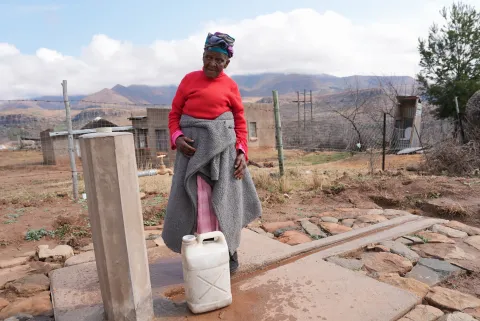
For many years, the small village of Ha Khoali, perched high in the hills of Lesotho, faced daily struggles to access safe water. Families relied on unprotected sources, often shared with livestock, exposing residents to serious health risks, including waterborne diseases that frequently leave children and the elderly ill. Women and girls bore the brunt of the responsibility, spending countless hours each day walking long distances over steep, rocky terrain to fetch water, often carrying heavy containers that left them physically drained.
This arduous task left little time for household chores, farming, or education, limiting opportunities for both personal and community development. Even the elderly, who could barely manage the harsh landscape, were forced to contribute to this daily struggle, highlighting how the water scarcity affected every member of the community. The lack of clean water touched every aspect of life from preparing meals and washing clothes to ensuring hygiene and caring for young children and families living under constant uncertainty, never knowing if they would have enough to sustain their homes, maintain their health, and keep their children safe and nourished.
Despite the hardships, Chief Shoaepane’s leadership helped the community persevere. He encouraged neighbors to support one another, to share the limited water resources, and to protect what little water they could find. Yet he knew that true, lasting change required more than resilience, it required access to safe, reliable water. That change finally came with the Metsi-A-Lesotho Rural WASH Project, supported by the Government of Lesotho, the European Union, and UNICEF. The impact of the project has been transformative. Standpipes and protected water sources were installed throughout the village, bringing clean water within easy reach of every household.
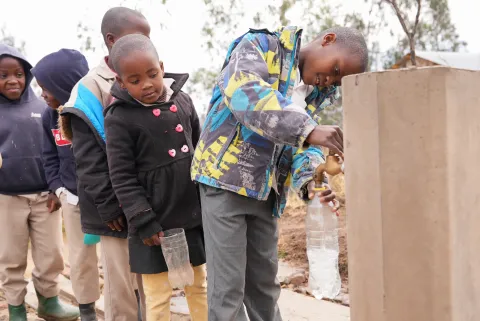
Children now attend school without the exhaustion of long treks to unsafe wells, arriving ready to learn and participate. Women have more time for family care, farming, and income-generating activities. Hygiene practices have improved significantly, leading to a reduction in waterborne illnesses that once plagued the community. The village now experiences a rhythm of life that was unimaginable just a few years ago.
“We are very happy with this project,” Chief Shoaepane says with pride. “My community greatly appreciates this sustainable development. The sicknesses that were caused by unclean water will now be a thing of the past, because we finally have access to safe water. It has truly changed our lives.”
The Chief stresses that water is only the first step toward full community well-being. “Personally, I appreciate the improved hygiene in the community, and we wish that sanitation and hygiene could also be strengthened in the villages. I am very happy that schools now have access to clean water and sanitation facilities. The next step is to ensure that households have proper toilets, so we can achieve full and overall hygiene in the community. This is essential for the health and dignity of every family.”
For the people of Ha Khoali, clean water represents far more than convenience. It is a source of dignity, health, and opportunity. Under Chief Shoaepane’s careful guidance, the village now has a foundation for a sustainable and hopeful future, one where children can learn without interruption, families can thrive, and the next generation can grow up with the promise of a better life, free from the daily struggle for water.
Metsi-A-Lesotho Rural WASH is a transformative initiative supported by the European Union, UNICEF, and its partners, aimed at providing safe, clean, and sustainable water, sanitation, and hygiene (WASH) facilities to rural communities, schools, and healthcare centers across Lesotho. It focuses on restoring and improving existing water supply systems while building new ones, ensuring that 250 rural communities, 125 schools, and 15 healthcare facilities gain access to the necessities of water, sanitation, and hygiene.