A lifeline of clean water
Mathabo’s story from Ha Khoali

High in the rugged hills of Thaba-Tseka district lies the small village of Ha Khoali, where a modest Early Childhood Care and Development (ECCD) centre stands. Though it accommodates only seven children, this school has been a lifeline for the community, nurturing the youngest learners and giving them a chance to dream beyond the mountains that surround their homes. For years, the centre has stood as a symbol of hope, showing that even in the most remote areas, education can take root.
In Ha Khoali, the ECCD centre is more than a classroom, it is a place of safety, nourishment, and hope. But its strength depends on the most basic of resources. Safe water not only protects children’s health but also gives them the chance to focus on learning, to play freely, and to grow with dignity. For the children here, water and education are inseparable foundations for a brighter tomorrow.
For as long as she remembers, ‘Mathabo Monaheng, a 38-year-old teacher of Early Childhood Care and Development (ECCD) from Ha Khoali village, has lived without reliable access to clean water.
“I grew up in this village without water,” she recalls. “If I am 38 years old now, it means it has been almost 38 years that we have never had access to clean water at home.”
Before the Metsi-A-Lesotho Rural WASH, by the Government of Lesotho with the support of the European Union and UNICEF, daily life at Ha Khoali was defined by hardship. Families, including children, would walk long distances to fetch water from unsafe wells located in steep and dangerous terrain. The journey was exhausting, often taking several hours each way, and exposed everyone to risks of injury or accidents. During droughts, the water they colleted was frequently contaminated, leading to illness and further challenges for the community. This daily struggle for water consumed time and energy that could have been spent on education, work, or caring for the family.
“For us women, it was especially difficult,” says ‘Mathabo. “We would leave as early as 4:00 in the morning and sometimes return only around 11:00. We would spend hours waiting for the water to slowly collect, and during drought seasons, the water was often not clean. This delayed everything, household chores, washing, and even preparing meals for the ECCD children at school. Sometimes we had to make tough choices, like whether to use the little water we had for cooking or for washing. It was exhausting, both physically and emotionally, because we knew our children’s health and education were being affected. By the time we returned home, the day was almost gone, and there was little energy left for anything else.”
The struggle was not just physical but emotional too. The uncertainty of whether there would be enough clean water each day brought constant stress. Parents worried about the health of their children, and teachers like ‘Mathabo faced challenges in ensuring that school meals were ready on time. This struggle for water was a reminder that education and well-being cannot be separated from the most fundamental human needs. For the people of Ha Khoali, the arrival of the Rural WASH programme brought more than water, it restored dignity, safety, and the chance for children to truly embrace the promise of education.

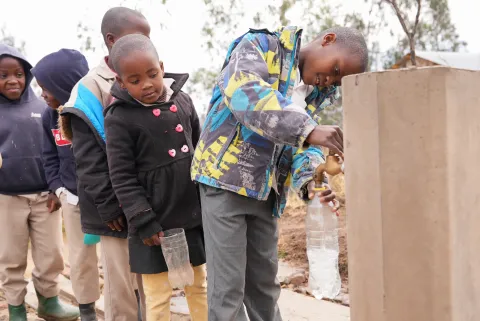
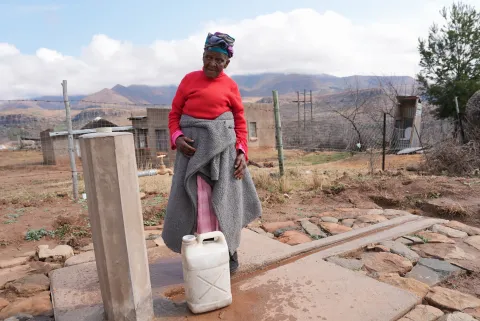
Today, the story is different. Thanks to the Rural WASH initiative, Ha Khoali now has access to safe and reliable water. Standpipes have been installed in the community, making it easier and safer for families to collect water close to home.
“It has changed our lives completely,” says ‘Mathabo with a smile. “Now it is easy to access clean water. Our daily chores are done on time, and I can prepare food for the ECCD children without delay.”
Beyond convenience, the community has embraced a strong sense of responsibility to protect this new resource. “We are very appreciative, and we are protecting it,” explains ‘Mathabo. “Even our children are not allowed to play near the standpipes. It is part of our commitment to safeguard the water for sustainability.”
For ‘Mathabo and the people of Ha Khoali, clean water is more than a basic service; it is dignity, safety, and an opportunity for a better future.
Metsi-A-Lesotho Rural WASH is a transformative initiative supported by the European Union, UNICEF, and its partners, aimed at providing safe, clean, and sustainable water, sanitation, and hygiene (WASH) facilities to rural communities, schools, and healthcare centers across Lesotho. It focuses on restoring and improving existing water supply systems while building new ones, ensuring that 250 rural communities, 125 schools, and 15 healthcare facilities gain access to the necessities of water, sanitation, and hygiene.