How Sierra Leone integrated learners’ needs into its National Digital Learning Strategy
with the Learning Passport responding to key youth priorities

From Digital Divide to National Strategy
Access to quality education remains a significant challenge for many children and young people in Sierra Leone. The digital divide – unequal access to devices and the internet – deepens existing inequalities, especially for learners in rural and marginalized communities, limiting their opportunities to learn, connect, and grow. Latest data from the World Bank shows that only 21 percent of Sierra Leoneans use the Internet, highlighting critical barriers to digital learning.
UNICEF is proud to work closely with the Government of Sierra Leone and partners to bridge this divide through inclusive digital solutions. Our vision is simple: every child and young person, no matter where they live, deserves a fair chance to succeed.
In 2024, the Ministry of Basic and Senior Secondary Education (MBSSE), with support from the World Bank, EdTech Hub, Foreign, Commonwealth and Development Office (FCDO) and UNICEF, commissioned a Digital Learning Landscape Analysis. This study identified the main barriers to digital learning in Sierra Leone.
The findings are clear: many schools and students lack reliable internet connectivity, access to devices, digital literacy skills, and locally relevant content. These findings laid the foundation for Sierra Leone’s first National Digital Learning Strategy, built around four pillars: Connectivity, Computers, Capabilities, and Content – known as the 4Cs.
A vision built with and for young people
What makes this Strategy truly powerful is that it was developed not through a top-down approach, but with young people at its heart. One part of this participatory process was UNICEF’s Amplifying the Voices of Youth (AVOY) initiative, which gathered youth perspectives through multiple channels.
First, AVOY used U-Report to collect data on young people’s top priorities and learning preferences and challenges regarding digital learning. U-Report is UNICEF's free social messaging tool that allows young people to speak out on issues that affect them by answering polls, sharing opinions, and engaging in conversations. It empowers adolescents and youth to influence decisions and policies that affect their lives and communities. Over 3,800 respondents across Sierra Leone (29 percent girls and 71 percent boys) participated in these polls, providing a broad overview of the challenges youth are facing in accessing digital learning.

In addition to the U-Report polls, AVOY facilitated in-depth discussions with youth networks, including the UNICEF Advisory Group, Youth Led Action, START Catch-up Girls in ICT, Safe Space, and HSSA. These group discussions – which included both in-school and out-of-school youth, with 68 percent girls and 32 percent boys participating – allowed for deeper exploration and validation of the poll findings.

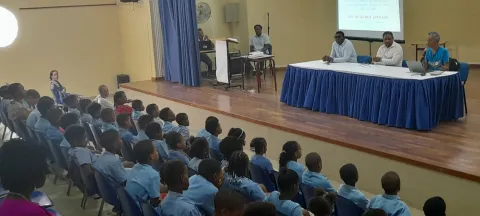
Together, the data from U-Report and insights from these youth discussions were combined to create a comprehensive youth-informed policy brief, reflecting a well-rounded and representative youth perspective. On April 10, 2025, this brief was presented in a dedicated session to Hon. Conrad Sackey (Minister of Basic and Senior Secondary Education), and Hon. Salima Bah (Minister of Communication, Technology and Innovation). The session concluded with interviews that highlighted the government’s strong commitment to youth-led change.
“Young people should be an integral part of the conversation - all of what we are doing at the Ministry in terms of our digital technologies is to serve young people. And if we don’t know what their needs are we’ll provide them with the wrong solutions” - Minister Sackey
“Connectivity in Sierra Leone should be a basic human right. Similar to how we think about access to education, access to healthcare, access to housing, access to food, we should also think about access to connectivity as a basic human right” - Minister Bah

Below is a summary of the key needs identified by young people during this engagement, and presented to the Ministers:

The National Digital Learning Strategy has since been officially launched and is now publicly available. It highlights the Learning Passport as a key platform for delivering quality, inclusive digital learning across the country.
Transforming access through the Learning Passport
The Learning Passport is at the core of UNICEF’s digital education agenda in Sierra Leone. It provides curated, curriculum-aligned content, and digitized past national exam papers.
The digitization and open access to past national exam papers on the Learning Passport has been transformative. Once difficult to find and often costly, these exam papers are now openly available, promoting transparency and equity. This has helped level the playing field for students preparing for national exams – a fact reflected in an 800 percent increase in platform usage, demonstrating the strong demand among young people for this resource.
“[Learning Passport] is helping me to answer difficult questions that I have not been able to answer. It also helped my children to pass the recent BECE exams with appreciable aggregates.” - 45 year-old male parent from a rural are in Sierra Leone
Also, in direct response to youth demands, UNICEF and the Ministry of Communication Technology and Innovation (MoCTI) are working together to zero-rate the Learning Passport platform, to eliminate data costs the previously restricted access for many learners. This will allow all students, no matter their location or circumstances, to freely access quality digital learning resources. To reach even the most remote and underserved areas, UNICEF is preparing to deploy an offline version of the Learning Passport to 30 schools in 2025, so children and youth can benefit even where internet connectivity is limited or unreliable.
"Poor network and high data costs keep young people from fully benefiting from digital learning." - Sierra Leonean Youth
Looking ahead: Scaling with purpose and partnership
Sierra Leone’s digital education transformation is a powerful example of what can be achieved when governments, communities, partners, and youth unite around a common goal. Bridging the digital divide goes beyond technology – it opens doors to opportunity, equity, and a brighter future for every learner.
UNICEF remains deeply committed to this journey, working closely with the government and partners to build an education system that empowers adolescents and young people to lead the future. While challenges remain, ongoing collaboration and shared commitment will ensure Sierra Leone’s efforts will not only transform education within its borders but will also serve as an inspiring model for the region and beyond.
Inclusive digital education for all can only be achieved through strong partnerships and shared commitment. We invite governments, the private sector, civil society, and communities to join UNICEF in expanding and creating equitable, accessible digital learning opportunities for every child and young person!