This Money Helps Us Survive
from the scene of UNICEF’s Cash Transfer Program in Sanamxay

Although it is still early in the morning, the school grounds at the Khang Village in Sanamxay district in Southern Laos have become a haven of excitement. Women arrive on foot or motorbike from all over the village and the neighboring communities, many with their newborn babies. Some with older kids too.
The center for today’s activity is the school canteen. This time, however, the canteen is not serving food to students. Instead, money will be distributed.
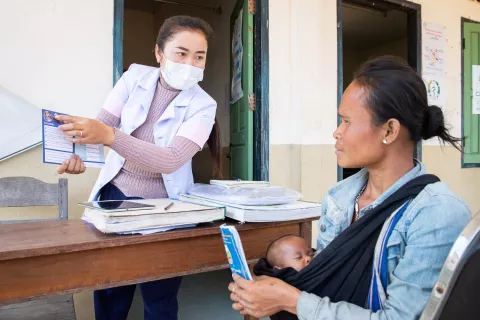
Every two months, clerks from UNITEL, a Laotian mobile network operator, come to the village to do cash transfers to beneficiaries of Mother and Early Childhood Grant (MECG). The program is led and coordinated by the Ministry of Labour and Social Welfare and supported by UNICEF Lao PDR with its partner, the Australian Government.
Unitel, a private enterprise, was chosen as a partner to the program since it has a wide network of offices in the country, and it has its own mobile money payment system, U-money. Unitel handles the cash distribution. The beneficiaries can choose to get the grant either as cash or as U-money.
The school canteen might seem an unlikely place for the cash transfers. It certainly doesn’t look like a bank. It’s just a big, open-walled hut with iron sheet roof, wooden tables, and ages old, battered stools. Chickens run around on the earthen floor. But nobody minds. It’s the money that counts.
More and more beneficiaries arrive. Mostly young women but some men too. The beneficiaries – pregnant women and mothers with newborn babies – can choose one intermediary to pick up the money if they cannot come themselves for a reason or another. The fact that so many of the women come themselves speaks on its part how important they consider the program.
The Unitel officers take their time to check meticulously everyone’s identity, but no one complains about the long wait. Because many of the women have difficulty reading and writing, they press their thumbmark to the documents instead of a signature when all is set.

The Beneficiaries Get USD 26 Every Two Months

One or the first to get her grant is 19-year-old Lae Xayyasone. Her first child was born one month ago.
“I am very excited! This is my first instalment,” she says. The cash transfer is 150,000 kip (USD 13) per month and given every two months in instalments of 300,000 kip. She already has a clear plan, what to do with the money.
"I will put the money in the village bank and save it for the baby. It is the money for the baby, not for me. It feels good to save money. I can use it when the child is older, and we need extra money. Maybe when the child is about three years old.”
In general, the idea of the grant would be to use the money during pregnancy and when the baby is still an infant, but the cash transfer is unconditional, so beneficiaries are free to use it as they wish. It is also universal - all pregnant women and those with newborns (maximum 12 months) in the selected districts are eligible to get the cash transfer, regardless of their financial status.
Lae Xayyasone says she works at her family’s rice and cassava fields. She adds that her brother is the local head of the village, which means she comes from one of the more influential and better-off families in the village. That explains why she is able to save the money.
Maryam Abdu, the Chief of Social Policy Monitoring and Evaluation, Lao PDR, who has come to monitor the implementation of the program, explains why the grant is not targeted only to the poorest families: “The universal method has been proven effective. It makes the management of the program more straightforward. Poverty rate in this district is high and thus targeting only the poor would only make the administrative cost of the project higher.”
It would take a lot of extra effort to choose just certain families from the potential beneficiaries. It would also create tension in the village if some families would get the grant and others not. Studies show that most beneficiaries of unconditional cash transfers use them wisely according to their varying needs, and the transfers cause improvements in multiple domains such as nutrition, mental health, and savings.
There are not exactly rich families in this area in Attapeu province. All the villagers are small-scale farmers who toil a modest living from their land. Some families are just a little less poor than the others. One can be sure the money goes to those in need.
The Cash Transfer Protects Against Unexpected Setbacks
In the developing world, margins to be able to save some money or get into debt are small. A sudden financial setback push the family to fall into poverty. That’s the story of Mr. Boudsany, one of the few men at the scene.
He accompanied his wife, and while she is inside the canteen to get the money, he is waiting outside and taking care of their son, 5-month-old Mac.

“He is healthy now, but it was not an easy childbirth. We had to rush to the provincial hospital where my wife had a caesarean section. We had to pay 3,5 million kip (USD 300) to cover the hospital bill,”
That’s a lot of money in a country where the GDP per capita is USD 2,670 a year and farmers often earn less than that. Fortunately, Boudsany’s family receives money from the MECG program, which helped them to cover the hospital bill.
Whereas the basic visits to the local health centers in Laos are very cheap, the residents must contribute and pay for the bigger medical procedures.
Before I Didn’t Have Enough Money to Buy Food

As the day progresses, more and more women arrive to collect their grant and the waiting time grows longer. Amongst the women and babies are two boys, 4-year-old Tonnam and 3-year-old Arnoy. Even they wait patiently. In fact, they seem to have a blast. They climb on empty chairs and crawl under wooden tables, where they can explore the world from a very different angle. Look at it from the child’s point of view.
Tonnam’s smile is so wide that you wouldn’t easily guess his family is struggling in their everyday life.
“I am from a poor family,” explains his mother, 21-year-old Bounmy. “Normally I don’t have money to buy enough food. Thanks to the cash transfers, we have fared much better. The money has helped us survive. I feel so happy when I hold the (cash transfer) money in my hands.”
Unfortunately, this is their final instalment as the baby, her second child, is already almost 12 months old.
Bounmy says she just hast to try to survive as always. “As I don’t have my own field, I rent a small lot from other people. I pay them back by working for them. For salary, I only receive rice but not cash. Cash I can get by finding bamboo shoots in the forest and selling them. This year we started to cultivate cassava to get some extra income.”
Even if the cash transfers have helped her a lot, she is not planning to get more babies to get more grants. “I have two children. I don’t want more. It is so expensive to raise children,” she says.