Helping Resettled Villagers in Rural Lao PDR Through Cash Transfers
A cash transfer programme supported by UNICEF and Australia is helping mothers and their children recover from the 2018 flood disaster in Attapeu province.

The village emerges like a mirage from the dusty, sun-soaked plateau. The brand new, shining white town houses stand in perfect straight lines, side-by-side, in a stark contrast to the surrounding landscape. Some of the houses are still under construction but many have already been finished and families have moved in.
This is Dong Bak Mai Village, one of several villages that have been built to relocate the families who lost their houses and belongings following a flood disaster that took place in July 2018 in Sanamxay district, Attapeu province.
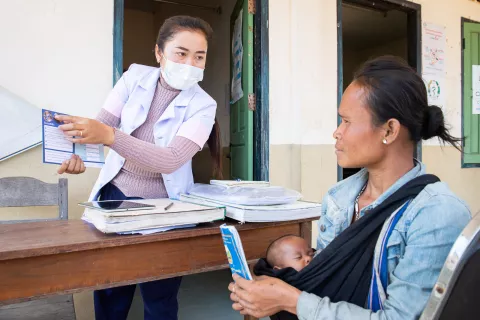
The tragedy is the reason why Sanamxay was chosen as one of the districts to pilot the Mother and Early Childhood Grant (MECG) programme, alongside Phouvong, which is likewise in Attapeu, and Nong district in Savannakhet province. The programme is led and coordinated by the Ministry of Labour and Social Welfare with support from UNICEF Lao PDR and Australia. Under the MECG initiative, pregnant women and women with newborns receive bi-monthly cash transfers of 300,000 LAK (roughly USD 26) to help them access key health and nutrition services.
One of the beneficiaries is 23-year-old Timmalay Khongkeo. She moved to her newly built home in Dong Bak Mai village three months ago. In her arms, she holds her two month-old baby and always closely following her is her two year-old daughter, Tukta.

“I like this house. It’s big. Much better than the temporary one where we had to live after our house was destroyed,” Khongkeo says.
She has already received her first two instalments of the cash transfer. “With the first instalment, I bought diapers and clothes for my baby. With the second instalment, I bought a mosquito net which cost 50,000 LAK. The rest of the money I saved. I keep it in the case we need it at some point, such as if the baby gets sick or if we face other unexpected expenses,” she explained.


With the freedom of choice provided by cash transfers, the mothers are able to use the money in the best way possible for their children according to their unique situation. In the case of Khongkeo and many other women in Sanamxay, it is possible to save at least part of the grant, while in other target districts of the programme the money primarily goes toward buying food and other essentials.
“So far, I have taken out cash. But with the next instalment I will try the U-money as I have been advised to,” Khongkeo noted.
U-money is a mobile money payment method offered by Unitel, a telecommunications company. The users can save money to their phone accounts and use it in shops that accept payment via U-money. They can also turn U-money to cash at one of the Unitel offices located throughout the country.
Khongkeo says she usually spends her time working at her cassava farm. However, the cash she receives has helped enable her to stay home for longer period of time to be with her children. That is especially important as after the relocation of her village, her cassava farm is now almost 15 kilometers away.
“I plan to stay home until my baby is one-year-old,” she notes.