Amid the chaos, the stones and the sand, Guatemalan survivors start anew
On 3 June 2018, the Fuego volcano in Guatemala erupted leaving a devastating scenario.

Escuintla, Guatemala. On Sunday, June 3, 2018, shortly before 11 o’clock in the morning, Gricelda Santiago Sánchez heard the explosion of the Fuego volcano; the eruption seemed loud. But she had lived there many years and others had been worse. And yet, her maternal instinct told her to be watchful. She lived in the San Miguel Los Lotes village, in the Department of Escuintla, just 31 miles away from Guatemala City.
After 3:00 pm, Gricelda heard a new explosion, but it was different; there was greater activity. She alerted her two sisters and taking her seven-year-old son Felipe Neftaly and her nephews Alexander and Omar, she ran to some coffee plantations scaling the mountain. As soon as they could, they flung themselves into a small opening in the ground and that saved their lives. Some of their neighbors and friends ran towards the highway, but it was impossible to escape the pyroclastic flow -mixture of volcanic gases and hot solid material- descending from the volcano. It razed and buried the entire community under 10 feet of boiling mud, stones and sand. That day, Gricelda lost her mother-in-law, friends and neighbors.
“I ran as fast as I could, I was so scared,” said 7-year-old Felipe Neftaly, with a mournful look, lowering his head, as he held on to his mother’s hand.
Transfer to shelters
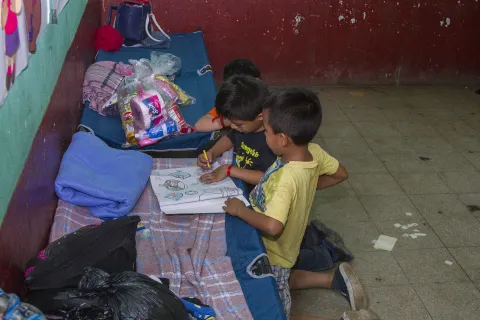
Survivors were transferred to temporary shelters located within Escuintla schools. Now Gricelda cohabits with her sisters, nephews and nieces, grandparents and other family members in room 18 of the José Martí School. They have lost all their material assets and now depend entirely on the help they can receive.
Their first nights have been spent sharing the same improvised bed in the classroom, where only hours before the desks were ready for students to come back to school on Monday, June 4. But now everything has changed.
Help is arriving, but it’s not enough
Gricelda accompanied the children to receive shoes donated to the shelter by a private company. Only 1,500 pairs of shoes were available for ages 4 - 12. Felipe Neftaly, Alexander and Omar were able to secure the donation, but there was no time for celebration. They would have to stand in a new line to get personal hygiene products and then in another line for lunch.
In the afternoon, the lines continued. The information does not reach everyone at the same time, so those that do not pay attention let an opportunity pass to receive the attention they need. Elmer Quintanilla, Gricelda’s brother-in-law, wonders whether in 2 weeks, with the World Soccer Cup in full swing, they will still be remembered.
Many people throughout the country have gathered food and supplies to help the victims. But it’s not enough. The Government of Guatemala is doing everything possible to respond to this emergency and the people affected, but the complexity of the tragedy has made it necessary for the Government to formally request the support of the international community.
Around 650,000 children and adolescents live in the areas affected by the eruption of the Fuego volcano in Guatemala. UNICEF, in coordination with the Government, the United Nations System, Non-Governmental Organizations, the private sector and other partners, are working to provide essential support and services to the most vulnerable. Urgent response actions include the need to provide psychosocial support to affected children and their families; support family reunification for separated children; ensure the protection of children in shelters; provide water, hygiene and adequate sanitation; have friendly spaces for children; support proper nutrition for children, emphasizing the benefits of breastfeeding for babies; and ensure that education is not interrupted so they can return to school as soon as possible.