

All children learn in Mexico
UNICEF Country Office
- Español
- English
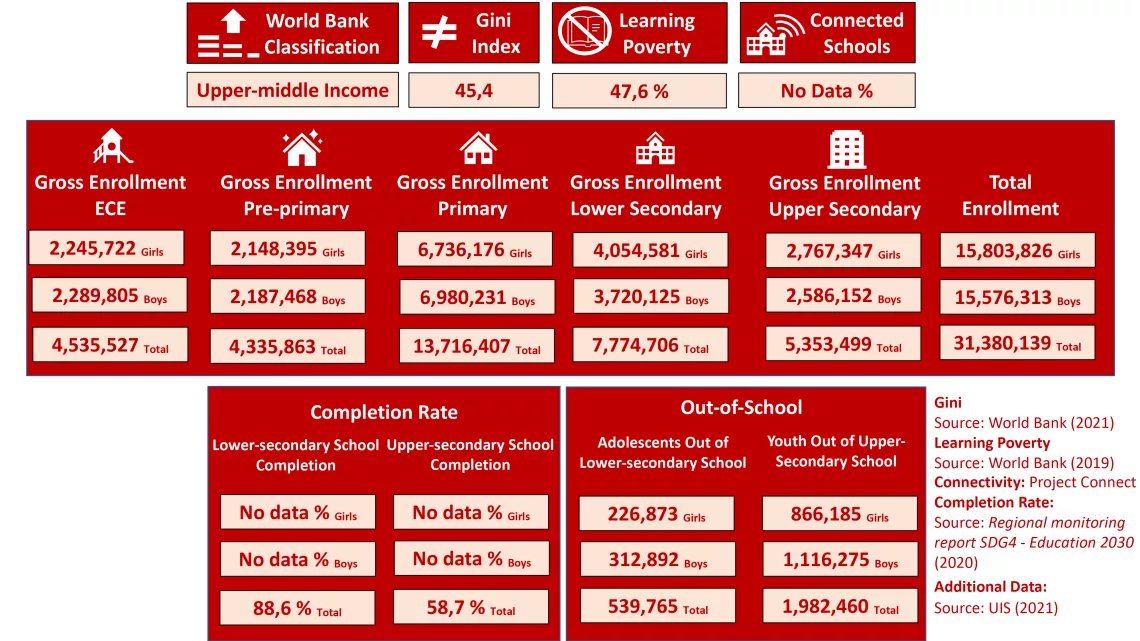
Mexico in Numbers
We work to ensure that children and adolescents have greater access to equitable, inclusive, and quality educational opportunities that promote development, better learning outcomes and the acquisition of skills for life and work. We work with a life-cycle approach, that is, from early childhood education through adolescence, to strengthen successful educational trajectories.
Our emphasis is on children and adolescents from the most vulnerable and excluded populations, such as migrant and indigenous children, as well as girls and adolescents.
We encourage the transformation of harmful social beliefs and behaviors, such as gender stereotypes, by promoting life skills and STEM capacities through education and the participation of girls and adolescents in decisions that may affect their safety, well-being and development.
What do we do?
We collaborate with the government at the federal and state levels and our partners in non-governmental, community-based and civil society organizations, as well as the private sector, to support the education system in providing quality learning opportunities for all children and adolescents in Mexico. Our lines of work include the following:
Improving access to and quality of early childhood education
- Strengthening the quality of early education by applying quality standards, supporting training and professionalization of educational personnel
- Generating data on gaps in coverage of early education
- Strengthening preschool children’s socio-emotional skills
- Promoting increased demand for preschool education through the C4D campaign.
Strengthening the fundamental skills of children and adolescents who are behind in their learning and supporting learning recovery
- Disseminating and implementing the "Teaching at the right level" methodology through learning camps and teacher training.
Literacy and bilingualism
- Implementing the Literacy and Bilingualism program for indigenous children to improve their literacy learning achievements in their mother tongue and their second language with a bilingual and multigrade pedagogy.
Promoting digital learning and educational innovation:
- Supporting digital learning platforms (Passport to Learning and MateMATIA) to help adolescents catch up in mathematics, communication, English and natural sciences.
- Supporting teacher training in using technologies for educational innovation (under development).
Promoting life and employability skills among adolescents:
- Training teachers and adolescents (especially girls) in STEM skills.
- Developing a framework and materials to support life and work skills for Mexico's dual model.
Data and information
- Collecting data and managing information on students, teachers, management staff, school infrastructure, safety, hygiene, and the availability of water and sanitation.
Promoting inclusive education for children and adolescents on the move with both long-term solutions and humanitarian aid, with emphasis on early childhood education and basic education:
- Generating information on the gaps and obstacles children and adolescents on the move face to access education.
- Facilitating coordination among multiple stakeholders.
- Providing training for teachers, educational authorities and the general public on migrant children’s right to education.
- Developing a regional policy to facilitate validation and recognition of migrant children’s previous studies.
- Developing school access protocols at the state and federal levels.
- Providing early childhood and basic education interventions to children and adolescents in shelters.
- Implementing pilot experiences in schools and childcare centers to support the inclusion of children on the move.
Preventing and addressing violence in schools:
- Generating evidence on the different types of violence in school environments and how they affect children and adolescents.
- Schools for Equality Program (ESCAI) for violence prevention, including gender-based violence.
WASH in schools
- Generating data on WASH services in schools, including menstrual hygiene management.
- Facilitating inter-sectoral coordination.
- Developing materials and training teachers.