“Water Is Life”: Solar-Powered Borehole Transforms Lives in Gunjiya Village in Garissa County
Providing sustainable, solar-powered water systems

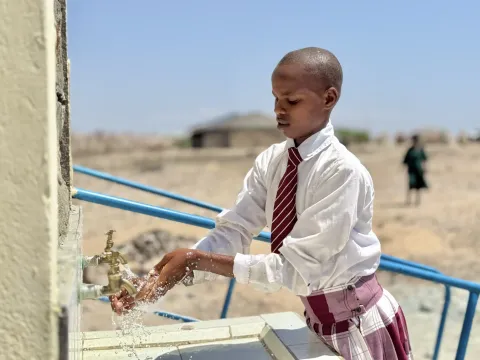
In Gunjiya village, in arid northeastern Kenya, water was once a daily struggle. Today, water is reliable and accessible, bringing new life to the community.
Although a borehole had been drilled by the county government in 2024, raising hope among residents, it remained unusable. Without a reliable water source, families were forced to walk long distances, up to 5km, in search of water, often relying on unsafe open sources. The journey was exhausting for women and children who were most often tasked with fetching household needs. Water points were marked by long queues, occasional conflict, and constant exposure to waterborne diseases because the water being collected wasn’t always clean. For many, costly water trucking was the only alternative, an option few could afford.
Gunjiya and its surrounding villages are home to an estimated population of over 3,000 people, who live in what is known as Kenya’s ASAL (Arid and Semi-Arid Lands) region. Here, water is essential not only for drinking and household use, but also for sustaining livestock, such as cattle, goats, sheep, camels, and donkeys, that form the backbone of the community’s livelihood.
“We women used to walk very far to find water,” recalls Gini Hussein, a community member. “It was tiring, and sometimes the water we found was not safe. The routes we passed were not safe for women and girls either.”

The situation worsened with repeated droughts and flash floods, which disrupted livelihoods and deepened water scarcity.
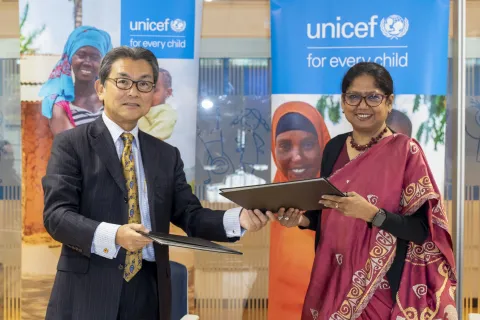
Then, a significant shift began to take place. Through funding from the Government of Japan, and with support from UNICEF and nonprofit Peace Winds Japan, in collaboration with the Garissa County Water Department, the once-unusable borehole was transformed into a sustainable, solar-powered water system, bringing renewed hope to the community.
A solar pumping system and submersible pump were installed, along with an elevated tank tower fitted with two 10,000-litre tanks to ensure efficient storage and distribution. Pipelines were connected to newly established community water points, bringing clean, safe water closer to households. Animal water troughs were also constructed, ensuring access for both livestock and wildlife.
“Water is now easily available in our village,” says the area chief, Abdirahman Rashid. “We no longer struggle the way we used to. Since the borehole started functioning, water trucks have disappeared.”
Makahil Hilowle, a respected elder and chairman of the community’s Water Users’ Association (WUA), which manages the borehole, has witnessed the transformation firsthand.
“This project has changed our lives,” Makahil says. “Before, when water trucks failed to come, people drank unsafe water and many fell sick. Now we have clean water from the borehole, and we believe diseases will reduce. The water is a bit salty, but we are hopeful that the salinity will improve over time.”
For women and girls, the change has been profound. Access to water within the village has reduced physical strain, improved safety, and restored dignity. Livestock, central to the community’s survival, are also benefiting.
“We no longer walk long distances to fetch water,” says Gini. “Now we have time for our families and other activities. Our children can focus more on their education.”
“Our animals now have water at the community points, and with the construction of troughs, access has improved even more,” Makahil explains. “This is very important because this is our source of livelihood.”

To ensure sustainability, 10 members of the WUA have been trained in borehole management. In addition, the borehole and solar panel compound has been fenced off to protect the system from damage, ensuring continued access to clean water for years to come.
“We thank Peace Winds, UNICEF and the county water team for remembering our community,” says Makahil. “After the droughts and floods, this support has brought us hope.”
The area chief adds that with reliable water and training in agriculture, the community can begin small-scale farming, reducing reliance on distant markets and strengthening food security.
With funding from the Government of Japan, UNICEF, in partnership with Peace Winds Japan, have supported integrated WASH interventions across the arid Garissa and Turkana counties.
This includes the equipping and rehabilitation of four solar-powered boreholes, providing safely managed water to over 12,000 people, as well as the distribution of WASH non-food items including buckets, jerrycans, soap, and water purification tablets to more than 21,000 people, alongside hygiene promotion activities.
In addition, WASH services have been strengthened in seven schools and one health care facility, improving access to safe water and sanitation for children and patients. Capacity-building efforts have also been central to the intervention, with training provided from a number of local to the Water Resource Users’ Associations (WRUAs) on system management and sustainability, community health promoters and public health officers. These efforts contribute to more climate-resilient WASH services in drought-affected communities.

The Gunjiya borehole project illustrates how sustainable, solar-powered water systems can restore dignity, strengthen resilience, and improve lives. However, further investment is needed to scale up sustainable water systems, hygiene promotion, and essential WASH services to reach more vulnerable populations.
UNICEF will continue working with communities and partners to expand sustainable and climate-resilient WASH services to those most in need.