More Water, More Life: Griftu’s Lifeline in Wajir
Bringing fresh water in a region severely affected by climate change

As the sun rises over Griftu, a village in Wajir County, Kenya, it casts a warm glow across the land, perhaps a small sign of hope in a place where drought has shaped daily life for many years. Here, like in many other places in Northeastern Kenya described as Arid Semi-Arid Land (ASAL) - water isn’t just a resource, it’s the pulse of survival.
For Meimuna Ismael, a 24-year-old mother in a bustling homestead of 23 people, located in Bulla Kurman, mornings once meant a two-kilometre trek in 40-degree heat just to fetch water. The water connection to the homestead dried 5 years ago due to increased population that over stripped the capacity of the main water source for their community.
“On many days, we had to carry the jerrycans on our backs, since we couldn’t afford to pay for a donkey or a handcart to transport the water,” she says, her voice steady but tinged with the memory of constant exhaustion from the daily chore.
“Five jerrycans cost Ksh.100, ten cost Ksh. 200. It was never enough,” she adds. Her family’s need for safe drinking water and water for cooking was difficult to sustain. Meanwhile their clothes stayed unwashed, dishes piled up, and the idea of planting a garden seemed like a distant dream.
But in June 2025, everything began to change.

The “More Water, More Life” project, a partnership between the Wajir County Government, Kenya’s Ministry of Water, the UNDP Resilience Hub for Africa and UNICEF, brought a new water supply system to Griftu. The project is more than a borehole. It provides a lifeline for over 9,200 people and nearly 5,000 livestock, bringing fresh water and a promise of relief in a region severely affected by climate change.
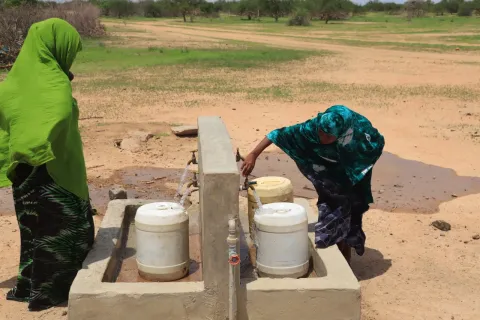
At the heart of the project is a 454-meter-deep borehole, one of the deepest in East Africa. The drilling site was selected following a groundwater-mapping study, conducted by UNDP and UNICEF, which identified a reliable water source. A solar-powered pump with a back-up generator draws six thousand litres of water every hour, supplying two 60,000-litre steel tank towers. From these tanks, water is distributed to a water kiosk for families, a tanker filling station, and livestock troughs. The whole water supply system is fenced, well-lit, and guarded at night, with an access road and parking for ease of access. The fence, lights and guards ensure this precious community resource is well-protected at all times.
In addition, the borehole system is connected to Griftu’s existing water network by a 3.2-kilometer-long pipeline, managed by the Wajir Water and Sewerage Company (WAJWASCO).
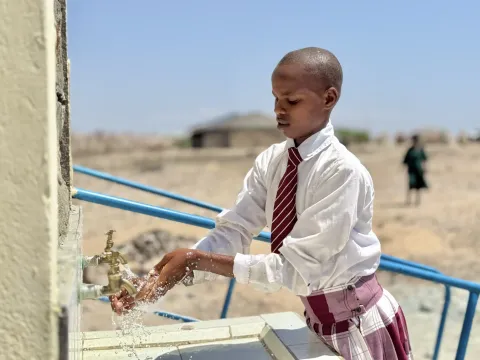
For Meimuna, having ready access to clean water is life-changing. “When we heard water was available, we were so happy,” she says, her eyes watering as she describes the day the tap near her home was opened. “We finally had enough clean water for me and my family. We even washed our clothes and cleaned our utensils. For the first time, I thought about planting and growing crops to provide extra and nutritious food for my family.” A water tap within her homestead replaced the long walks and heavy loads, freeing hours for her to dream beyond survival.

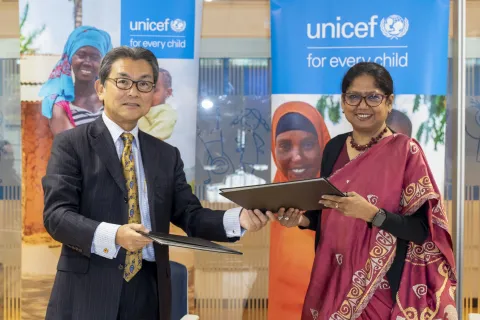
During the project’s official launch, it was evident that the initiative was already having a strong impact.
H.E. Ahmed Muhumed Abdi, Wajir’s Deputy Governor, sees the project as a critical resource for the county. “It’s an honour to host this type of infrastructure in Wajir,” he says. “Already, thousands are benefiting, including our livestock. This water will continue to support livelihoods for years to come. The county is committed to oversee the system in close collaboration with WAJWASCO to ensure all-year round supply of safe water for communities.”
The project is designed for lasting change. From its launch in June 2025 until February 2026, the project will train WAJWASCO staff to operate and maintain the water system. The training includes maintenance, monitoring tariffs for households and livestock use, and capacity -building for WAJWASCO’s board members to ensure long-term viability through strong governance and management. The project also provided a dedicated four-wheel-drive vehicle to ensure WAJWASCO staff can respond to and address maintenance issues in a timely manner.
“While building this system matters, keeping it working is just as important,” says Shaheen Nilofer, UNICEF Kenya Representative who attended the event. “Communities and local governments must protect this water source. It is their precious lifeline.”
The project’s first phase is completed, and a second phase promises additional boreholes and connections to schools, health centres, and outlying villages within the area.

“This isn’t just about water today; it’s about resilience tomorrow. We want Griftu to be a model,” says Zeynu Ummer, Director of the UNDP Resilience Hub. “Water can spark progress for pastoralist communities across Africa, helping them thrive despite climate challenges.”
As the sun continues to shine brighter on a new day, Meimuna no longer dreads the dawn. Instead, she envisions endless possibilities of a renewed way of life. “I don’t want to lack water again,” she says, her voice full of hope and anticipation of better days ahead.