UNICEF Champions Ethical Standards in Child-Focused Reporting

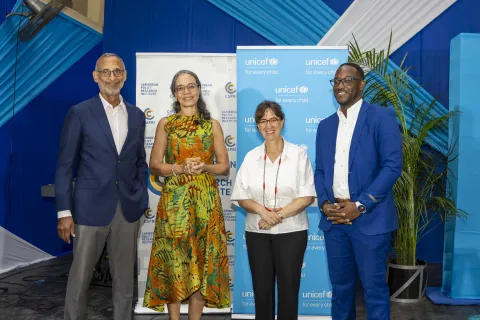
KINGSTON, March 13, 2026: The United Nations Children’s Fund (UNICEF) has underscored the vital role of journalists and media professionals in safeguarding the rights and dignity of children at a workshop on ethical reporting. The organization partnered with the Caribbean School of Media and Communication (CARIMAC) and the Press Association of Jamaica (PAJ) to host the Media Workshop during National Journalism Week on March 8.
Speaking at the opening session, Olga Isaza, UNICEF Representative, emphasized that reporting on children is not just another assignment, but a responsibility rooted in the Convention on the Rights of the Child. “Children are not simply small adults; they are individuals with distinct rights, capacities, vulnerabilities, and voices of their own,” she said. “The way they appear in a headline, an image, or a post can shape how they are seen by their communities, and even by themselves, sometimes for a lifetime.”
Ms. Isaza reminded participants that UNICEF’s guidance places the child’s best interests at the centre of every editorial decision. She urged journalists to be mindful of privacy, identity, safety, and emotional well‑being when covering sensitive stories and reinforced that children depend on adults, including media professionals, to represent them thoughtfully and dignity.
The workshop, titled ‘Ethical Reporting on Children’, forms part of UNICEF’s collaboration with CARIMAC to strengthen professional standards in reporting. Dr. Patrick Prendergast, CARIMAC Director noted that ethical practice must rest on fairness, balance, integrity, and truth. He reminded journalists that “nothing comes before preserving dignity…nothing sits above the rights of the child to a safe, healthy, and secure environment nor their right to privacy and confidentiality.”
Emphasizing the unique responsibility journalists carry when reporting on children, Dashan Hendricks, President of the Press Association of Jamaica, welcomed the initiative. He also drew attention to the poignant account shared by Newton Douglas, Director of Policy, Planning and Evaluation at the Child Protection and Family Services Agency, which illustrated the devastating consequences that irresponsible reporting can have on a child’s life.
Mr Hendricks added that while many Jamaican newsrooms already exercise caution, such as withholding names or avoiding identifiable images, ethical considerations “go even deeper,” especially given children’s lasting digital footprints.
The workshop brought together journalists, lecturers, students, media practitioners and child‑rights advocates for a day of dialogue, practical exploration of case studies, and capacity‑building. UNICEF encouraged participants to adopt at least one tangible improvement in their reporting practices, reinforcing that even small adjustments can make a meaningful difference in a child’s life.
Participants described the session as enlightening and thought‑provoking particularly the presentations delivered by Kaye-Ann Parke, Legal/Policy Manager at the Office of the Children’s Advocate who outlined Jamaica’s legal framework and Donna-Marie Rowe, UNICEF Communications Specialist who presented UNICEF’s guidelines. The participants requested similar sessions in the future to further strengthen child-focused reporting.
Building on the success of this year’s event, UNICEF reaffirmed its commitment to collaborating with CARIMAC and other universities and to ensuring that a dedicated media workshop becomes a consistent feature of National Journalism Week.
Media contacts
About UNICEF
We support government and non-governmental partners to promote and fulfil the rights of children, especially the most disadvantaged. Across more than 190 countries and territories, we work for every child, everywhere, to build a better world for everyone.
For information about UNICEF and its work, visit www.unicef.org/jamaica.
Follow UNICEF on Twitter, Facebook, Instagram and YouTube