Jamaica Strengthens how Public Spending reaches Children
UNICEF and CAPRI launch report

KINGSTON May 18, 2026: UNICEF Jamaica, together with the Caribbean Policy Research Institute (CAPRI) has launched Room for Improvement, a landmark report examining how public resources for children are allocated and whether they translate into real outcomes.
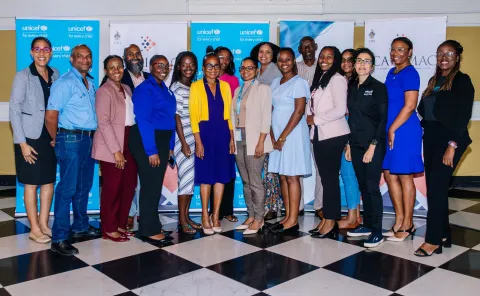
The report, presented at Wolmer’s Boys’ School Auditorium recently (May 14), finds that while Jamaica makes strong and sustained investments in children, the country does not yet have a clear, consistent way to track how those investments reach children or measure their impact.
Public spending on children, particularly in education and social protection, is comparable to that of higher‑income countries. However, a key finding is that it remains difficult to determine how much of this spending translates into direct services and outcomes for children.
“This study starts from an important premise: Jamaica has made a sustained effort to invest in its children,” said Olga Isaza, UNICEF Representative, “but the system does not always make it clear how much of that investment is actually reaching each child and with what results.”
The analysis, prepared by CAPRI using nine years of official budget data from 2017/18–2025/26, provides one of the most comprehensive pictures to date of how Jamaica invests in children across sectors. It highlights that while key programmes, such as education spending and PATH, have been sustained, the current information available to decision-makers does not consistently show how these investments translate into services for children or whether they are reaching those most in need.
As Dr Diana Thorburn, CAPRI Director of Research explained, the central issue is not the level of investment, but the lack of precise information on what is working and for whom. “The evidence tells a very clear story: Jamaica’s financial commitment to children is significant and, by international standards, competitive, but the results on the ground are not keeping pace,” she said.
Why this matters
The absence of clear tracking creates an accountability gap between what is allocated, what is spent, and what children experience. Without stronger visibility, decision-makers cannot fully assess whether spending is aligned with children’s needs or delivering the intended impact.
A key message of the report is: “What we cannot see, we cannot manage.” Currently, there is no routine system to track child-focused spending across government, and budget data are generally not disaggregated by age, disability, or location.
The report identifies practical steps to strengthen public financial management for children, including:
- Introducing systems to tag and track child-focused spending
- Publishing data on programme coverage, costs, and results
- Strengthening reporting and accountability mechanisms across sectors
These measures aim to ensure that investments are visible, traceable, and linked to outcomes.
The findings come at a time when Jamaica’s child population is shrinking, making each child’s development even more critical to the country’s future. “The return on investing in children is rising and so is the cost of failing them,” Ms Isaza noted.
For UNICEF, this snapshot provides a technical foundation for the Ministry of Finance, the Planning Institute of Jamaica (PIOJ) and social sector ministries to move towards a national system for tracking public expenditure on children as a routine part of the budget cycle. “Countries that have taken this step have been better able to protect social spending in times of fiscal constraint precisely because they can demonstrate what works and where adjustments are needed,” added Ms Isaza.
UNICEF and CAPRI emphasised that the report is not a critique, but a tool to strengthen decision-making across government and partners. “This is not a failure of intent. It is a structural gap. And it is fixable,” the UNICEF Representative pointed out. With the right systems in place, Jamaica can better align spending with its commitments and ensure that every dollar invested in children delivers real results.
About the Report
Room for Improvement analyses nine years of public expenditure across eight sectors: education, health, social protection, child protection, nutrition, public safety and security, housing and infrastructure, and recreation, culture and sport, applying UNICEF’s Child‑focused Public Expenditure Measurement framework to assess how spending supports outcomes for children in Jamaica.
Media contacts
About UNICEF
UNICEF promotes the rights and wellbeing of every child, in everything we do. Together with our partners, we work in 190 countries and territories to translate that commitment into practical action, focusing special effort on reaching the most vulnerable and excluded children, to the benefit of all children, everywhere.
For more information about UNICEF and its work for children in Jamaica, visit www.unicef.org/jamaica.