Two Journalists Step Up for Children
Corey Robinson & Jovan Johnson receive UNICEF Media Award

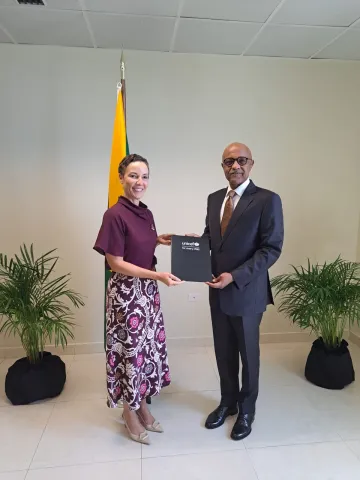
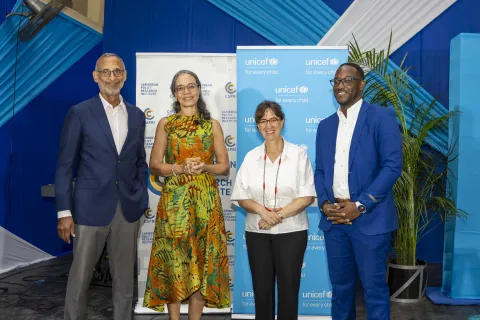
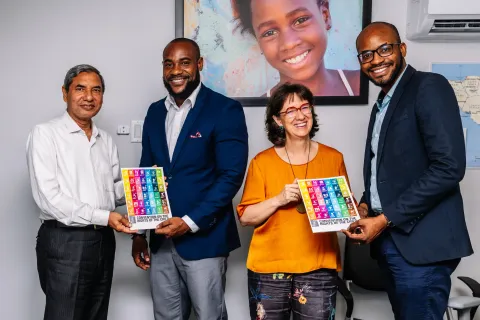
KINGSTON March 16, 2026: When journalism moves beyond headlines and into the lives of children, it can change how a nation sees the young. That is the shared commitment of the work that earned joint recipients, Corey Robinson and Jovan Johnson, UNICEF’s media award for excellence in reporting on children’s rights.
Their pieces, Empty Classrooms and Shattered Innocence, combined rigorous evidence with powerful storytelling, that drew national attention to urgent issues affecting the development and wellbeing of children while amplifying their voices and lived experiences.
Both reporters describe their work as a duty, not just to inform, but to protect children, and to push for policy that keeps them safe and learning.
Jovan says his Empty Classrooms series began with a telling conversation with teachers who warned that dwindling school populations in deep-rural communities were masking serious questions about the quality of education and long-term outcomes for children. That conversation, and a period of volunteering in a small school, prompted deeper questions.
He began examining how demographic shifts, including migration patterns, economic opportunities and rural development, influence children’s access to education. Jovan frames the series as a platform for a data-driven national discussion. “Empty Classrooms ultimately centres on a child’s right to an education,” he explains.
For Corey Robinson, whose reporting explored the devastating impact of violence on children, journalism is a way to shed light on the long-term effects of community violence and trauma on young lives and to ensure these realities are not ignored, so that support and opportunities can reach these children as they grow.
Corey stresses that reporting on children carries extra responsibilities: protecting identities, rigorous fact-checking, and ethical care because our “stories endure” and will be read by the children involved later in life.
Both reporters combined first-hand interviews, careful inclusion of data and extended time in the communities they covered. That mixture of evidence and empathy is what made the pieces powerful enough to bring national attention to two different crises: the slow erosion of educational opportunities signaled by empty classrooms and the invisible harm that follows children in violent environments.
Their reflections point to two clear calls to action: policy must be inclusive and journalists must continue to centre children’s rights in reporting.
Corey Robinson and Jovan Johnson exemplify what it looks like when reporters step up for children. Their work is a reminder that strong journalism can be a powerful tool for advocacy and when a country takes action, children will benefit.
Media contacts
About UNICEF
We support government and non-governmental partners to promote and fulfil the rights of children, especially the most disadvantaged. Across more than 190 countries and territories, we work for every child, everywhere, to build a better world for everyone.
For information about UNICEF and its work, visit www.unicef.org/jamaica.