Iraq Explores Micro-Credentials to Expand Skills and Employment Opportunities for Youth
National stakeholders gather in Erbil and Baghdad to explore flexible learning pathways that connect education, skills and employment
- English
- العربية
Erbil and Baghdad, Iraq, 1 September 2026 – Senior government officials, education leaders, employers and development partners gathered in Erbil and Baghdad to explore how micro-credentials can strengthen Iraq’s technical and vocational education and training system and better prepare young people for a changing labour market.
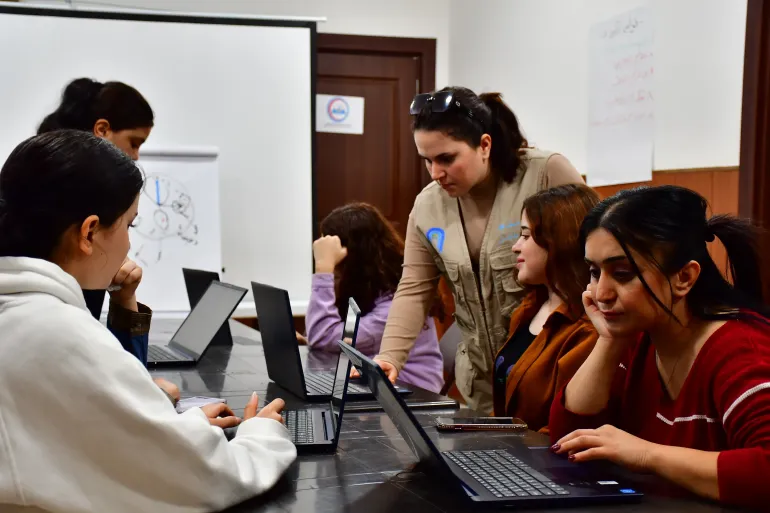
The workshops, jointly organized by UNICEF and the International Labour Organization (ILO), in collaboration with UNHCR, brought together stakeholders from across Iraq to examine how short, flexible and recognized qualifications can help learners acquire in-demand skills, improve employability and support lifelong learning.
Opening the events, representatives of the three UN agencies highlighted the need to help young people learn the skills they need and make education and training easier to access, meeting labour market needs while expanding opportunities for young people and vulnerable populations, including refugees and asylum-seekers.
ILO introduced global trends and emerging practices in micro-credentials, showing how they are practical, easy to verify, and mobile, and can be combined into larger qualifications. Discussions focused on how these credentials can complement existing education and training systems while responding more quickly to changing economic demands.
“As economies and labour markets continue to evolve, micro-credentials provide an innovative mechanism for learning in a way that is flexible, portable and trusted. When designed effectively, they can complement formal qualifications and help individuals continuously develop relevant skills,” said Ruby AlSalem, Country Coordinator, ILO Iraq.
UNICEF shared its work to help young people move from learning to jobs. It also showed how short, certified courses can connect education, skills training and employment. Participants discussed the importance of designing quality, inclusive and labour-market-relevant credentials that recognize competencies, support progression and expand opportunities for young people.
“Young people in Iraq need flexible learning opportunities that build skills for today’s labour market,” said Christian Skoog, UNICEF Representative in Iraq. “Micro-credentials can help bridge education and employment, improve employability and support vulnerable youth to realize their potential.”
UNHCR stressed the need to help refugees, internally displaced people, returnees and host communities gain practical skills. It noted that short, recognized certificates can help show the skills that many refugees already use in the local economy, often through informal work. These certificates can also support people who return to their home countries by helping them prove their skills and find jobs or further training. Participants agreed that flexible and recognized certificates can help more people access learning, livelihoods and economic opportunities.
Together, ILO, UNICEF and UNHCR shared useful views on how short, skills-based courses can help young people in Iraq move from learning to work. Their contributions focused on education, vocational training and job opportunities.
The workshops also examined key building blocks for a national micro-credential ecosystem, including quality assurance, accreditation, recognition mechanisms and institutional arrangements to support implementation at scale.
Participants included senior officials from the Ministries of Education, Higher Education and Scientific Research, and Labour and Social Affairs from both the Federal Government of Iraq and the Kurdistan Region of Iraq, alongside Technical and Vocational Education and Training (TVET) specialists, university representatives, accreditation experts and training providers.
The workshops concluded with agreement on a roadmap to advance the pilot initiative, including establishing a National Technical Working Group to guide the design, governance, and integration of micro-credentials within Iraq’s national education and training system.
ILO, UNICEF and UNHCR reaffirmed their commitment to supporting the Government of Iraq in strengthening skills systems, expanding pathways to more inclusive opportunities for young people and vulnerable populations through innovative approaches to learning and certification.
About the PROSPECTS partnership
The Partnership for Improving Prospects for Forcibly Displaced Persons and Host Communities (PROSPECTS) is a groundbreaking partnership funded by the Government of the Netherlands. It brings together the International Finance Corporation (IFC), the International Labour Organization (ILO), UNHCR, UNICEF, and the World Bank with the collective goal of improving the lives of forcibly displaced persons and their host communities.
Media contacts
About UNICEF
UNICEF promotes the rights and wellbeing of every child, in everything we do. Together with our partners, we work in 190 countries and territories to translate that commitment into practical action, focusing special effort on reaching the most vulnerable and excluded children, to the benefit of all children, everywhere.
For more information about UNICEF and its work for children, visit www.unicef.org.