

Tech Bets, Emergency Response
Tech Bets for an Urban World

Emergency Response
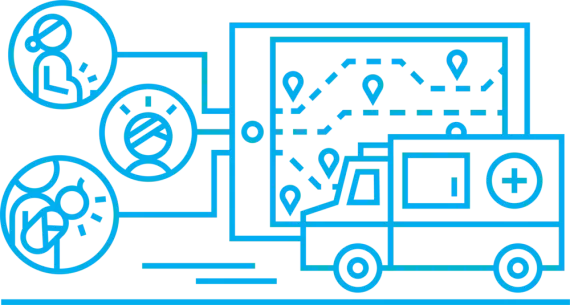
Platforms that link people to the full range of public and private emergency response services through one interface, matching people in urgent need with the closest and best equipped vehicles and mapping their routes to-and-from the incident.
Potential Market Size (by 2022):
70-90 Billion USD; 2-3 Billion Users
THE CHALLENGES
In developing countries, road traffic injuries are the number one cause of death for people aged 15 to 29, and among the top three for 5-to 44-year-olds
Private companies lack incentives to serve people with lower incomes.
Traditional emergency services business models means that high income patients are more attractive: they are able to seek care earlier, often live closer to hospitals, are less likely to default on payments, and are less likely to be turned away by a hospital. In cities like Nairobi, ambulance companies operate at 20% utilization rather than lowering their prices.
Weak infrastructure hampers dispatch.
The poorest residents of cities often live furthest from the hospitals and in densely populated areas which are hard to access by road. Meanwhile, women rely disproportionately on effective emergency response: 300,000 women died last year during response pregnancy or childbirth.
Centralized “911” systems are expensive.
Advanced dispatching technologies commonly used in developed nations are costly and require a high level of ongoing investment and management.
The opportunity for emergency response is wide. The value chain consists of many different components necessary to other urban value chains, such as traffic navigation systems, police and fire units, and disaster awareness and response systems. The following use case presents the market size of emergency response for health specifically, but encompasses much more.
Source: “Fact Sheet: Road Traffic Injuries” World Health Organization 2017, “Nairobi by Numbers: the Emergency Facts” Capsule 2016
THE NEEDS
The value chain for emergency services is broken at nearly every step
Low income individuals spoke of a poorly functioning and highly disorganized emergency system–from who to call, to how an ambulance finds the patient, to the quality of care someone receives. The desire and need for emergency care is huge, but many don’t know how to tap into it or trust it will work for them.
In emergencies, patients make critical financial trade-offs
In many countries, before calling an ambulance, patients and their loved ones are often forced to work out whether they can afford it. Some people turn to taxis as the cheaper option. Others are skeptical that an ambulance has the equipment and staff to make it worth the additional cost. Reducing the financial burden associated with receiving emergency care is critical to increasing access.
Trust is key.
Trust is currently low, because so many emergency services are underperforming. Many people do not believe that ambulances save lives, even though the evidence is there that a well-functioning system can significantly reduce mortality. Patients need to know that ambulances will arrive, be properly equipped, and that they are free or affordable.

"One of the biggest needs here are ambulances. A woman gave birth in the street just this morning because she couldn’t make it to the hospital."
John, 36, Nairobi

"If you take an ambulance to the hospital there will be no more money to pay for care."
Rashida, 46, Nairobi

"People rely on their ‘taxi guy’ more than an ambulance in an emergency now. You have a relationships with ‘that guy’ and you know he will take you regardless of how much money is in your pocket at the moment."
Carlos, 29, Nairobi

"Sometimes I will get into the ambulance and use google maps to figure out where to go. But then my data is out and we have to make so many stops along the way asking people."l."
Chelsea, 38, Nairobi

"People don’t believe they can pay for them so they don’t call."
Maggie, 21, Nairobi

"You call for an ambulance and they ask you where you live, when you tell them they hang up. We are poor but deserve to be treated like people!"
Rose, 43, Nairobi
GLOBAL MARKET POTENTIAL
Emerging market revenue could be 70-90B USD, covering 2-3 billion people. If Governments subsidized memberships, then revenue would grow with coverage
Potential Revenue
in Billions (USD)
addressable market

Potential Users
in Millions
people

Assumptions
Based on Nairobi market:
- 5-10 USD per year per membership
- Ability to pay of 50% to 75% (assuming maximum 25% of current out-of-pocket health expenditure)
Extrapolated to global, taking country populations and adjusting for:
- Urban population
- GDP per capita (PPP)
- Internet usage
Extrapolated to 5 years time using projected figures for the year 2022
5 yrs time with even more access for BoP
See above, except with:
- Increased uptake to 80-90% of population
- Reduction of 10% in membership costs
WHEN IT WORKS
Emergency response technologies meet user needs when they...
Match patients to the closest appropriate ambulance.
Are easy to access, even for those who live in hard to access areas.
Have a centralized number to call (or application to use) in an emergency.
Provide well-equipped ambulances to address patient’s urgent need.
Manage fast dispatch and referral to appropriate facility.
Use enhanced navigational tools to ensure accurate and timely service.
INNOVATOR STORY
Flare
Flare is an emergency response matching platform founded in Nairobi by Maria Rabinovich and Caitlin Dolkart in 2016.
Flare matches multiple ambulance (and other emergency service) providers in Nairobi with people in need.
Using real-time tracking of ambulances and fire engines, and location data from customers, Flare can ensure its members get the closest ambulance that meets their needs. They also ensure that patients arrive at a hospital which is ready to accept them.
Flare's consumer-facing hotline has been live since December 2017. Since then, they have done 500+ life-saving rescues and reduced response time to a 21 minute average and to as fast as 6 minutes in parts of Nairobi
“Why can Kenyans get an Uber in minutes and order food delivery in less than an hour but not get an ambulance?”
Caitlin Dolkart, Flare Co-Founder
Flare is also looking to expand to other African cities and would like to offer a B2G option to expand coverage of ambulances.
Founded: 2015
Based in: Nairobi
Employees: 20+
Subscriptions: In beta
Revenue: Undisclosed
Total Investment: Undisclosed
Investment Stage: Seed
Business Model: Combined B2C and B2B

NAIROBI'S MARKET POTENTIAL
The next generation emergency service provider market is very young in Kenya.
The Customers
End User:
Patients, ambulance companies and health service providers
Who pays?
Patients (either through a membership/insurance option), businesses (who want to provide cover for their employees), insurers (to purchase cover for their members,) or Governments (who want to provide access to members of public insurance schemes)
Investment to Date
USD 0.5 Million
The Players
(Excl. individual ambulance companies)


The Nairobi Market
Urban Addressable Market
Calculated based on 50-75% uptake based on ability to pay for 5-10 dollar yearly membership
1.5-2.5 Million members
Directional Revenue Potential
Based on total addressable market purchasing subscriptions of 5-10 USD per year
USD 12-15 Million
USER STORY

Chelsea is a long-time ambulance driver who lost his first Nairobi patient because he couldn’t navigate to the hospital, and the ambulance didn’t have equipment to stabilize the patient.
Since moving to Nairobi to head the ambulance department at Neema Hospital, Chelsea has improved equipment quality, personnel training, and ambulance availability. He’s now in discussions with a new ambulance service that connects patients, who become members of the service, to the closest ambulance and a facility that is equipped to handle their particular emergency.
“From one hospital to another, it can take 2 hours. But with better navigation, I will know the best roads to take.”
“If this service can get medical care to patients as quickly as possible it will give people a centralized number to call. That’s really needed.”
He also emphasized that many people rely on friends and taxis to take them to the hospital because many can’t afford the cost or the wait time. But Chelsea believes that a service committed to working through the barriers will be a game-changer.
UNLOCKING GROWTH
To catalyze the market, global tech players could use their strengths to...
Support innovators by providing capital. This field is early in its development and requires a long period of upfront investment in provider contracts and advertising.
Advocate for Governments to subsidize membership. Building political will and providing evidence for regulatory changes that would allow B2G models to proliferate would ultimately help ensure that this model reaches the true BOP and would ensure the greatest impact and unlock additional revenue streams.
Champion industry standards. There is little room for error in providing emergency services. Tech players should be part of a conversation to ensure minimum standards are preserved across markets, while ensuring the innovation can continue in this sector.
Support innovators through tech transfer. Innovators can keep costs low if they don’t have to reinvent the wheel. Sharing best IP, practices and models would allow innovators to build out their brand and business model in local markets.
For example, Google’s investment in Google Maps already allows innovators to develop emergency services applications, without having to build the underlying mapping software.
To unlock demand, local innovators need to develop products that...
Offer payment models that meet the financial needs of low income customers. To develop payment options that appeal to low income audiences local innovators should prototype different payment methods with a core group of beta testers to understand what does and doesn’t work well before going to scale.
Connect emergency response products to existing insurance options. Local innovators who are able to do this make the value proposition much more valuable. When emergency response insurance or membership is connected to other health insurances, patients ultimately benefit.
Have a strong presence in communities. Community leads and other touchpoints for timely service are needed as these areas are often not mapped or don’t have adequate roads for most vehicles to travel through. This will help build trust in communities as well (see note below).
Build trust in ambulances. Patients need to experience value for money and the public needs to understand the value of ambulances in order for them to operate effectively. Local innovators need to be smart about the messaging and advertising they conduct and have presence physically in communities. They also need to ensure minimum standards are maintained across the fleet of ambulances.
Utilize technology to fix gaps in the value chain. It’s clear there’s a significant role for technology to play in improving emergency services in many global markets. Local innovators should utilize technology to create a centralized number, use matching algorithms to connect patients to the nearest and most appropriate ambulance, utilize tech for quicker dispatch and appropriate facility referral, and link navigational tools to ensure accurate and timely response.
To realize the potential of every child, UNICEF could...
Help open doors for emergency response innovation by convening innovators, Government and funders to explore opportunities for collaboration in potential early adopter cities.
Work with Governments to explore integrating emergency response technologies in public health systems. UNICEF works closely with public health systems and can help advise on the choice, procurement, and implementation of emergency response innovation.
Help strengthen the evidence for new emergency response systems. Using digital technologies to run ambulance systems is a new concept in most cities, and UNICEF can work with innovators to demonstrate its value and impact.
Help develop minimum standards. UNICEF can contribute to the conversation around minimum standards for emergency care and transport to help ensure a fair playing field for innovators.


