Theory of Change for Child-Lens Investing
Explore how UNICEF’s Theory of Change for Child-Lens Investing maps pathways for investors to improve outcomes for children and scale impact across the investment ecosystem

How could Child-Lens Investing scale, and what role can investors play?
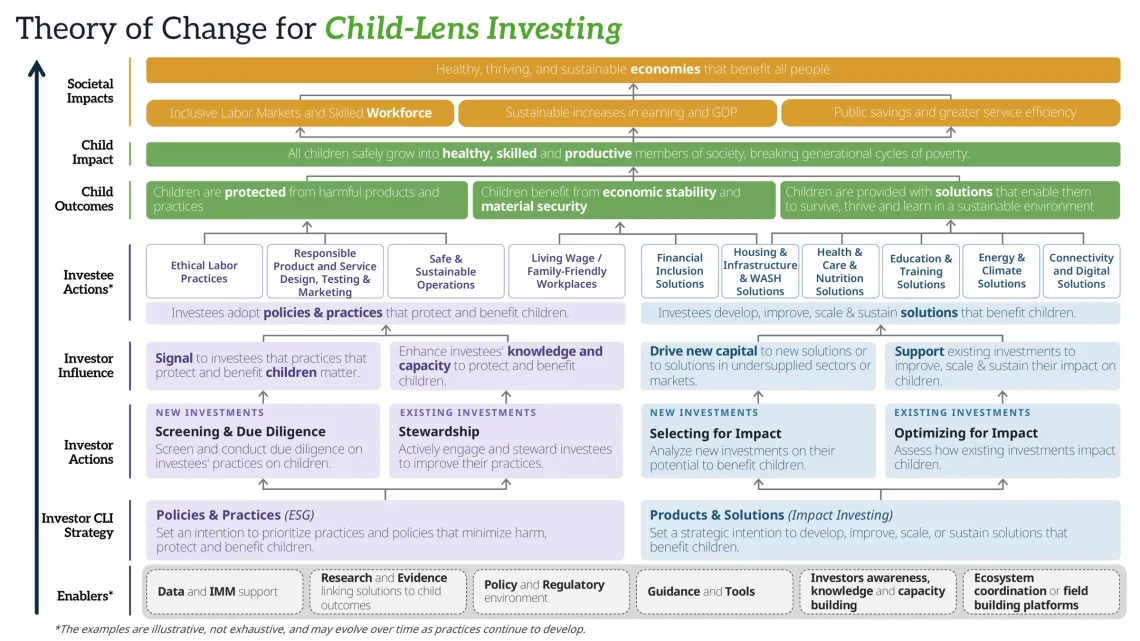
To explore this question, UNICEF and its partners developed a Theory of Change (ToC) for Child-Lens Investing, which serves as the anchor for this discussion. The ToC sets out a hypothesis for how investors’ actions and influence can contribute to improved outcomes for children, mapping the pathways through which children can be protected from harm, their well-being enhanced, and broader societal benefits generated over the long term.
Grounded in the Child-Lens Investing Framework and informed by investor feedback, it reflects both current practices and future opportunities, providing a shared reference point for understanding how CLI can be implemented and scaled across the investment ecosystem.
The ToC is not fixed, but serves as a guide for action and learning, mapping the different pathways investors can take to integrate a child lens, and the potential outcomes of those choices for investees and, ultimately, for children.
At its core, the ToC identifies two main entry points for investors looking to adopt a child-lens approach.
- Policies and practices: how investors influence the operations of investees to protect children.
- Products and solutions: how investors allocate capital toward goods and services that benefit children.
Policies and Practices: influencing how companies operate
The first pathway focuses on how investors can influence investees to adopt policies and practices that protect and benefit children.
Through screening and due diligence, investors can signal that child-related considerations are material factors in investment decision-making. Gaps and areas for improvement identified during the assessment phase for new investments can be addressed throughout the portfolio phase through active stewardship and ESG action plans. This enables investors to engage portfolio companies in strengthening their policies and practices over time.
Together, these levers can influence a wide range of issues, from labour conditions and environmental impacts to digital safety and family-friendly workplaces. This pathway offers a broad entry point for many investors, because these considerations apply across sectors and asset classes.
To enable this, investors need better data and practical guidance, particularly to support consistent screening, reporting, and effective engagement with investees.
Products and Solutions: directing capital toward impact
The second pathway focuses on how capital can be directed toward products and services that benefit children. Here, investors can act in two complementary ways.
By selecting for impact, they can channel capital toward new solutions or scale and sustain existing solutions that address children’s needs. Through optimizing for impact, they can work with existing investees to strengthen, scale, or sustain their positive impact over time.
These approaches can support a wide range of sectors, from financial inclusion and housing to healthcare, education, and climate-related solutions.
Advancing this pathway requires stronger evidence on what good products or services for children are, better data on areas of need, and improved tools for measuring and managing impact. For example, the EdTech for Good framework is a comprehensive tool developed by UNICEF Digital Education and the Global Learning Innovation Hub that defines what an inclusive and impactful education solution looks like through five pillars.
What this means for children
Together, these pathways contribute to three key outcomes.
- Children are protected from harm, through stronger policies and practices that reduce exposure to unsafe or exploitative conditions.
- Children benefit from greater economic and material security, as investments improve the conditions in which they and their families live.
- Children gain access to solutions, from healthcare and education to nutrition and childcare, that enable them to survive and thrive.
Policies and practices play a key role in protecting children from harm, and contribute to improving children’s overall well-being and long-term societal outcomes. Similarly, products and solutions drive access to services and help advance children’s well-being and long-term social impact. Ultimately, both pathways contribute to improving children’s overall well-being and long-term societal benefits. Supporting children’s well-being today contributes to stronger human capital, more resilient economies, and more inclusive growth in the future.
As investors engage with these pathways, test different approaches, and share their experiences, the ToC will continue to evolve through new evidence, insights, and shared learning. In this way, it serves as a guide and a foundation for collective learning across the field.
Please also see: Using Child-Lens Investing (CLI) to influence investees’ policies and practices