Supporting Humanitarian Innovation, from Pilot to Scale
Unlocking the potential of promising solutions in collaboration with the Norwegian Humanitarian Innovation Programme

After drought killed all but 10 of her goats, Ebla Salat Abdi, went to a UNICEF distribution centre in Garissa, Kenya, in search of support. When she arrived, instead of receiving a standard set of water, sanitation and hygiene (WASH) emergency supplies she was able to choose the items she and her nine children needed from a list.
“I picked a jerrycan, bucket, water treatment chemicals and soap,” says Ebla. Being given choice as part of a UNICEF project aimed at providing customized emergency kits left Ebla feeling empowered and overjoyed. “[It] gave me the chance to pick items that I really needed,” she says.

Efficient, effective solutions
UNICEF’s ‘Kits that Fit’ initiative enables people like Ebla to have a say in what they need to survive, beyond the contents of a generic emergency kit that may not be appropriate for a specific context. Rooted in accountability and two-way communication, the initiative was made possible by an ‘Innovation Lab’ grant from the Humanitarian Innovation Programme (HIP) of Innovation Norway, a Norwegian government agency.
The UNICEF Office of Innovation (OOI) helps improve how humanitarian assistance is delivered by co-creating to discover, iterate and scale technological solutions and approaches – including Kits that Fit. But the ambition of greater efficiency and effectiveness in accelerating progress for children is made possible through a diverse network of partners.
HIP grants have supported seven UNICEF projects since 2022:
- Virtual safe space for girls and women
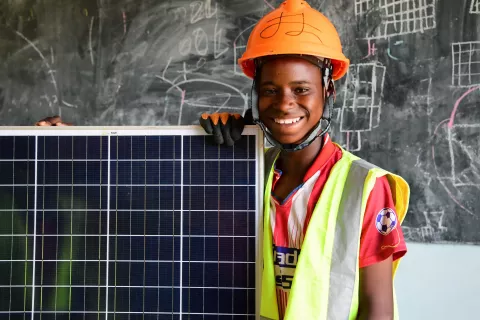
- Solar panels for schools, health centres and WASH facilities
- Optimized supply chain for malnourished children
- Inclusive humanitarian response for children with disabilities
- Identifying child malnutrition with 3D computer vision and AI
- Improving child diet through egg powder production
Scaling for impact
This support has ensured success in addressing a range of humanitarian challenges with innovative, scalable solutions, accelerating impact for millions of children around the world and ensuring innovation is at the heart of UNICEF's responses.
Kits that Fit, for example, has so far reached over 1 million people with tailored emergency kits and has gathered feedback from 1 million more; Laaha, a virtual safe space used by more than 1,500,000 girls and women is currently available in 13 languages and has been adapted for users with low digital literacy skills and poor connectivity to tackle Gender Based Violence (GBV) including Technology-Facilitated GBV; and Project Alpha, which provides solar panels for schools, health centres and WASH facilities in humanitarian settings, has a pipeline of countries across Africa, Asia and the Middle East that means people will have access to reliable, consistent solar energy.
“Innovative partnerships help catalyze an ecosystem of partners that do not traditionally engage in the humanitarian space,” says Marc Kaeraa, UNICEF Innovations Portfolio Manager. “With support from Innovation Norway, we are closing the gap between humanitarian action and innovators specialized in tech fields who can help apply new approaches to accelerate results for children.”