Doubling Down on Digital Public Goods in Kazakhstan
How an edtech startup is bringing digital skills to educators in Kazakhstan and beyond

Across Kazakhstan, a quiet digital transformation is underway. With support from UNICEF, the country is emerging as a regional leader in digital public goods (DPGs)—open source technologies that are designed to be freely used, adapted, and scaled to advance the Sustainable Development Goals.
This growing ecosystem is not only strengthening national digital infrastructure; it’s also unlocking local innovation. The latest standout example is CodiTeach, an education technology platform helping teachers gain the skills to teach coding—even if they’ve never written a line of code themselves.
Across Kazakhstan and beyond, coding is becoming a part of standard academic curricula, yet many teachers have not been trained to teach digital skills. This gap leaves both educators and students at a disadvantage. CodiTeach addresses this challenge head-on by offering a step-by-step digital curriculum that helps teachers build their coding skills while guiding their students. Designed specifically for educators, the platform provides structured lesson plans, interactive tools, and ongoing support to bridge the digital skills divide.
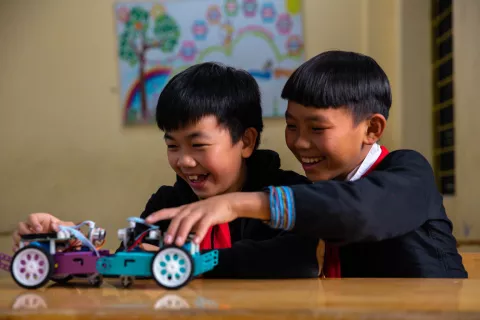
CodiTeach is part of the larger CodiPlay ecosystem, which includes a mobile app and hands-on robotics kit. While students explore programming through interactive tools, teachers follow along through a dedicated Learning Management System (LMS) that includes guided exercises, instructional videos, and project-based code experimentation. By giving educators the tools to teach confidently, CodiTeach is making digital learning more accessible—and more effective—for everyone in the classroom.
Its recognition as a certified digital public good (DPG) marks a significant milestone—not just for CodiTeach, but for Kazakhstan’s growing DPG ecosystem. This achievement didn’t happen in isolation. Since 2021, UNICEF has worked closely with the government as they embed DPGs into national strategies, strengthen institutional frameworks, and support local innovators in meeting global open source standards.

Kazakhstan’s DPG journey has also been defined by a strong focus on inclusion. UNICEF has supported the development and certification of Accessible Kazakhstan, a platform that maps accessible public infrastructure for persons with disabilities and special needs; Ozim, a mobile app supporting parents of children with developmental delays; and Okulab, a blended learning platform for teachers working with students with special needs. These digital tools are helping to ensure that no one is left behind in the country’s digital transformation.
Through technical assistance, policy advocacy, and hands-on support for startups and ministries alike, UNICEF has helped establish a strong foundation for DPG adoption in the country. This includes co-developing a government function to accelerate DPGs, building capacity across ministries and universities, and ensuring that girls and young people are actively engaged in designing and deploying digital solutions.
“Achieving DPG status is a significant honour and lends credibility to CodiPlay's solutions, associating them with UNICEF's initiatives. This recognition has facilitated connections with numerous schools in the surrounding region, and having DPG status has increased trust among investors and institutions.”
Zhanadil Taldybaev, Founder, CodiPlay
Since becoming a digital public good, CodiTeach has expanded from six to 13 countries, with schools—particularly public institutions—embracing the platform to train teachers and build foundational digital skills. In Kazakhstan alone, it has reached 200 schools, and the team is actively working to expand partnerships in Angola, Zimbabwe, and the MENA region. Looking ahead, the upcoming Codi Academy—developed with university partners—aims to scale training globally through a free, open source curriculum.
CodiTeach is more than a coding tool—it’s a reflection of Kazakhstan’s national commitment to open, inclusive digital transformation. UNICEF’s support is helping turn that commitment into action: by strengthening systems, unlocking local talent, and ensuring the next generation of solutions—like CodiTeach—can reach the learners who need them most.