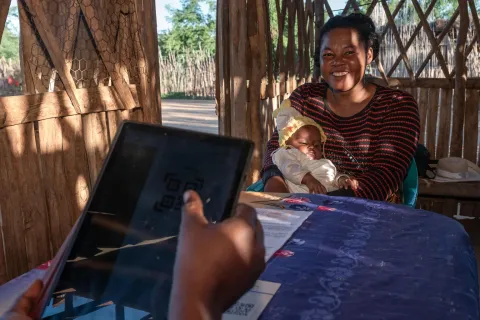
HOPE Annual Report 2025
HOPE - Humanitarian cash Operations and Programme Ecosystem

Highlights
Introduction
In an increasingly complex humanitarian landscape marked by conflict, displacement, climate shocks, and economic instability, the ability to deliver assistance rapidly, securely, and at scale has become more critical than ever. Cash has emerged as one of the most effective and dignified forms of assistance, enabling vulnerable families to prioritize their own needs while restoring choice, protecting access to essential goods and services to children, and strengthening local economies.
At the center of UNICEF’s digital cash delivery ecosystem is the Humanitarian cash Operations and Programme Ecosystem (HOPE), a suite of digital solutions designed to support accountable, risk-informed, and people-centered cash assistance delivery. HOPE enables secure management of recipient’s personal data, strengthens transparency and oversight across cash operations, and streamlines payment delivery to ensure assistance reaches the right people at the right time.
Throughout 2025, HOPE continued to demonstrate its value as a critical digital public good supporting humanitarian response and social protection programmes globally. During the year, the platform facilitated the delivery of USD 228 million in cash assistance and incentives, reaching 9.3 million individuals across 1.4 million households. From emergency cash assistance in conflict and disaster settings to large-scale payments for frontline workers delivering essential services, HOPE enabled governments and UNICEF Country Offices to operate with greater speed, accuracy, and risk awareness.
HOPE’s adoption continued to expand in 2025, with additional Country Offices onboarding the platform, including Senegal, Sierra Leone, Zimbabwe and Mozambique. This growth reflects increasing confidence in HOPE as a scalable and adaptable solution capable of supporting a broad range of humanitarian cash transfer and social protection programmes.
HOPE Platform Enhancements in 2025
Throughout 2025, HOPE underwent enhancements focused on strengthening operational efficiency and expanding interoperability across cash transfer operations.
Biometric Face Recognition technology was introduced to strengthen identity deduplication processes. This capability reduced the risk of duplicate registrations and irregularities and enhanced the integrity of assistance delivery by ensuring support reached the intended recipients. A collision detection feature was also introduced that allows import of data from government digital systems while ensuring existing records in HOPE are unique.
The platform received automation upgrades in reconciliation between HOPE and global Financial Service Providers (Western Union and Moneygram), as well as integration with SAP VISION (UNICEF's ERP) to retrieve Fund Commitment information that supports financial decision making. Data management and targeting functionalities were further strengthened through enhancements to Programme Periodic Data Updates (PDU), a feature that facilitates the collection of dynamic data points (e.g.: attendance tracking, nutritional values tracking) online and offline after registration.
In parallel, HOPE underwent a major backend API refactoring to a REST-based architecture, improving system performance, simplifying maintenance, and strengthening the platform’s scalability for future growth. User and permission management were also redesigned to provide programme-level role assignment and more granular access control, improving governance and operational security across implementations.
Open Source and Digital Public Good Recognition
On 22nd April 2025, HOPE was officially certified and listed in the Digital Public Goods Alliance’s Digital Public Goods Registry. This recognition reinforces HOPE’s position as a durable, open, and interoperable platform operating under sustained stewardship. It also strengthens the return on investment for the humanitarian and social protection community by enabling countries and partners to reuse a shared digital solution, reducing implementation costs and accelerating the delivery of efficient, accountable, and risk-informed assistance.
Global User Engagement and Strategic Planning
In October 2025, the HOPE Global User Workshop convened representatives from 15 Country Offices to align on strategic priorities for 2026–2027. Participants agreed to prioritize development of the Country Workspace to track and accelerate data cleaning, Risk Dashboard to maintain overviews of risk exposure in different parts of the delivery chain, Beneficiary Portal to provide self-access to personal recipient’s data and grievance redressal enhancements.
The workshop reinforced UNICEF’s commitment to collaborative governance, continuous improvement, and user-centered innovation in the ongoing evolution of the HOPE platform.
Commitment to Continuous Improvement
As humanitarian crises grow in scale and complexity, UNICEF remains committed to strengthening HOPE as a trusted and scalable Digital Public Good for humanitarian cash transfers and social protection programming. Through continued investment in interoperability, analytics, identity verification, automation, and operational oversight, HOPE will further enhance the speed, transparency, security, and accountability of assistance delivery, enabling governments and humanitarian actors to reach vulnerable populations more efficiently and at greater scale.