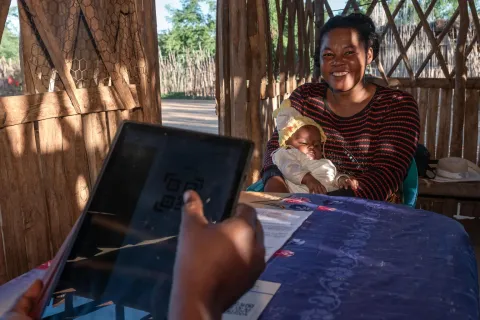
In Angola, a digital solution is helping frontline workers deliver vaccination campaigns
Empowering frontline vaccinators through digital solutions

Every time a nationwide polio vaccination campaign ended in Angola, Steve Macheso, UNICEF Angola’s Immunization Specialist, knew what would happen next.
His phone would start ringing.
“The questions would start coming in,” Steve recalls. “Not about the vaccines or the campaign results, but about payments.”
The calls were understandable. Across Angola, thousands of frontline workers had spent days travelling between communities, mobilizing families and helping protect children from polio. Once the campaign ended, many wanted to know when they would receive the payments for their work. For frontline workers, these payments are an important part of the support they receive for the time and effort invested in reaching communities.
Each vaccination campaign reaches all 21 provinces and involves thousands of frontline workers requiring accurate registration and payment information. Behind every payment was a long chain of administrative steps. Lists arrived from across the country, banking details were verified, and staff spent days reconciling information before payments could be made.
For a UNICEF team supporting nationwide campaigns, the process consumed staff time that could otherwise be spent supporting programme delivery and the vaccination response.
“It wasn’t only about processing payments,” Steve says. “It was about supporting the people delivering these campaigns and maintaining confidence in the whole process.”
A challenge shared across the team
Steve was not the only one facing this challenge. For Carla Chingo, a Programme Associate supporting campaign payments, the work often meant reviewing large beneficiary lists, verifying thousands of banking details and helping resolve data issues before payments could move forward.
Despite ongoing efforts to improve the process, preparing payments for thousands of frontline workers remained time-consuming. In some cases, payments took months to complete, leaving frontline workers waiting long after campaigns had ended while UNICEF teams responded to a growing number of payment-related inquiries, creating frustration for frontline workers and additional pressure on UNICEF teams.
Faced with the same challenge campaign after campaign, colleagues across UNICEF Angola partnered with UNICEF’s Global Cash Hub to find a better way forward.

Finding a better way forward
Together, UNICEF Angola and UNICEF's Global Cash Hub developed a new digital workflow using KoboCollect and UNICEF's Humanitarian Cash Operations Ecosystem (HOPE), adapting the approach to the needs of nationwide polio vaccination campaigns.
The new workflow, powered by HOPE, UNICEF's Digital Public Good for humanitarian cash assistance, improved beneficiary registration and verification, reducing the manual checks and reconciliation work that had previously delayed payments. Instead of relying on multiple rounds of manual data collection and verification, the new workflow enabled information to be captured and checked digitally from the outset.
Within a matter of months, the new digital workflow had been adapted nationwide, with more than 300 users trained across 21 provinces and 326 municipalities, ahead of the next nationwide polio campaign.
Using KoboCollect and HOPE, frontline workers were registered digitally, allowing key information, including banking details, to be verified much earlier in the process. Better data quality from the outset significantly reduced the manual verification work that had previously required so much staff time.
The new approach was first used during Angola’s nationwide polio campaign in April 2026. More than 20,000 frontline workers were registered through the new digital workflow, enabling more than US$1 million to be paid to frontline workers. Nearly 19,000 frontline workers received their payments within approximately two months, compared with up to nine months in previous campaigns.
For Carla, the impact was immediate. “The new approach has reduced the workload significantly,” she says. “It has allowed us to focus more on supporting the programme.”
When change became visible
One of the most meaningful results was not reflected in the numbers, but in the conversations that followed the campaign. For years, discussions following vaccination campaigns had often focused on payment timelines, but this time, the message was different.
“People started saying, ‘UNICEF has improved. UNICEF is paying faster,’” Steve recalls. “That was the moment I realized that we were making a difference.”
After years of struggling with payment delays, the conversations had finally changed. Frontline workers were receiving their payments faster, and the teams supporting them could focus more of their time on delivering results for children.
The improvements were also reflected in the quality of the data received, according to Carlos Lopes, a Programme Associate supporting payment processing. “The information we receive is now much cleaner and easier to process,” he says. “Most banking details are captured correctly from the start, which has significantly reduced the time spent reviewing and correcting data.”

More time for what matters most
For Frederico Brito, Chief of Health and Nutrition at UNICEF Angola, the initiative marks a significant advance. “This is a new step in the digitalization of our payment processes. It helps us maintain accountability and transparency while reducing the burden on staff.”
UNICEF Angola and UNICEF’s Global Cash Hub continue to refine the approach for future campaigns, building on lessons learned from the first nationwide rollout.
But for Steve, the biggest lesson is a simple one. “Vaccination campaigns depend on thousands of frontline workers,” he says. “If we want them to focus on reaching children, we need to make sure we’re supporting them properly.”
Behind every successful vaccination campaign are thousands of people working to reach children and communities across Angola. By making it easier to register and pay frontline workers in a timely and risk informed manner, UNICEF Angola is helping ensure they receive the support they deserve, while reducing the administrative burden on the teams supporting vaccination campaigns, allowing the people behind every vaccine to focus on what matters most: protecting children from polio.