Taking birth registration to children
Community mobilization by the Ministry of Justice and Human Rights of Guinea-Bissau brings services closer to communities, with the support of traditional authorities, education and health sector

- English
- Portuguese
Today is a different day for Zandonaide Cabral. Instead of being in his office at the Civil Registry Office of the Mansoa Delegation in the Oio region, the legal technician is working outdoors. By the side of the main road and under a tree to seek shelter from the hot sun of Guinea-Bissau, surrounded by dense vegetation, Zandonaide is registering the births of the children of the village of Njhanhe.
The technician is participating in the latest community mobilization activity organized by the Ministry of Justice and Human Rights to ensure the birth registration of all children, bringing justice services closer to citizens. The strategy involves putting civil registry staff in motion, several times a year, to reach the most remote and inaccessible villages in all regions of the country, using motorcycles. In a backpack, Zandonaide brought the necessary materials for a productive day of work: the birth registration book, birth certificates, stamps, and pens.
At the end of the workday, he is pleased. Just today, Zandonaide registered 39 children aged 0 to 7 in the village of Njhanhe. Considering the long distance between the village and the nearest civil registry office, the lack of roads, and the difficulties in the transportation of the people of Njhanhe, we can assume that these 39 children would not exist in the eyes of the law and the state of Guinea-Bissau if not for the efforts of the justice sector to reach all citizens, with support from UNICEF and funding from the Italian Agency for Cooperation and Development. Data from 2019 (MICS) shows that only 36% of Guinean children under 1 year old have a birth registration.
Tomorrow, Zandonaide will do the same in another community of the Oio region. The civil registry official strives to visit as many villages as possible during the 12 days of community mobilization. This is a regular initiative that happens in all regions of Guinea-Bissau throughout the year. Under the leadership of the civil registry services of the Ministry of Justice and Human Rights, areas where communities face difficulties in accessing basic social services are identified, and technicians are deployed.
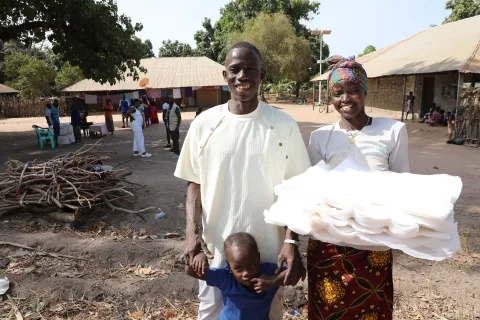
In Cacheu, a region bordering Oio, Sona and Malam Seidi are satisfied with this service. They registered their six older children the last time the justice technician visited the village of Ingoré. Now, they benefit again from the current community mobilization in Cacheu and register their twin couple, Sene and Sana, of only 8 months old.
In the village of Ingoré, the civil registry official set up his temporary office under the big tree in front of the house of the Régulo, the king of the community, according to traditional power, to be seen and noticed by everyone. With the support of the ruler, who has mobilized the community in recent weeks, all parents are informed about the importance of civil registration, and children in the community up to the age of 7 will be registered.
In Guinea-Bissau, the birth registration of children up to 7 years old is free. Parents can register their children by presenting the voter card as an exception, as most adults do not have civil identification documents (ID cards).
"The goal is to remove barriers, simplify the process, and ensure the creation of a generation with a legal identity, capable of enjoying the benefits and services guaranteed by law and asserting their rights".
The support of traditional and community leaders is essential for the success of the community mobilization, considering the power of influence of these figures, especially in rural areas. In the village of Bafatá Oio, back in the Oio region, the Régulo Braima Saliquenha Turé, the traditional ruler of the community, personally took on the responsibility of calling the entire community in advance.
When the civil registry official arrived, the parents were already prepared and waiting to register their children. The majority had their voter cards in hand and knew the necessary steps to take. Regulo Braima also helped organize the community. As the village of Bafatá Oio is extensive and densely populated, he created a division: some families, previously informed, would register births in the morning, and the remaining ones in the afternoon.
"This service is very important," says the ruler. He mentions that he was already aware of the importance of birth registration because his son works in the health center as a community health agent and passes on this information. Braima Turé has consistently urged the inhabitants of the village of Bafatá Oio to register the births of their children when they visit the health center, which is a few kilometers away. To simplify and bring the service closer to the community, the deputy conservator of the Oio region, Abdulai Saidi, gave the Regulo Braima Turé the contact information of the conservators and civil registry officials in the region. This way, the ruler can directly refer his community to the responsible officers of the nearest civil registry office or request a new visit from the civil registry official when there is a considerable number of children needing to be registered in the village.


Aua Sisse is also having a different day. Instead of being in the kindergarten, the 6-year-old girl is in front of the Mansore Basic School in the Oio region, waiting to be registered. The kindergarten teacher, Laminé Turé, made a list of students who had not yet been registered and asked parents to be present today, ready to receive the visit from the civil registry official. Now, in front of all parents, mothers, and children, the teacher takes attendance and helps organize the queue for registration. Most of his 70 students are present.
In these efforts for community mobilization, the identification of unregistered children has made a difference, and the education and health sectors have been good allies. In 2022 alone, 35% of all newborns received birth certificates, mainly in health units, according to data from DHSI2 (births in 2022) and RapidPro from the Ministry of Justice and Human Rights.
At the Caliquesse Health Center, serving the Cacheu region, health technician Júlio Uanhé explains the importance of registering children to all mothers who brought their babies for vaccinations.
"Children without registration are more vulnerable to any form of violence and exploitation because they lack state protection, and they cannot have an identity card or nationality", - Júlio says.
Epifania Pereira, 29, who brought her one-month-old daughter Augusta for vaccinations, says she will immediately call her husband to register the child together.
The leadership of regional justice and civil registry services, the involvement of various sectors of society, and the community and social mobilization carried out with traditional authorities have shown that it is possible to overcome physical obstacles and bring services to children. With funding from the Italian Agency for Cooperation and Development, UNICEF is aiming for a significant increase in the registration rate and continuous capacity building at the national level.
In Cacheu, now in the village of Burné, Vanuza and Gilberto await their turn to be attended by the civil registry official, more than 15 kilometers from the nearest registry office. The line is long, and while waiting, the young couple discusses what name to register for their only child, who is already 1 year old. The father insists on giving him the name Emanuel Gilberto Biagué, and the mother does not want the child to have the same name as the father. Both agree that the most important thing is for the child to have a registration, a name, and an identity.