Protecting Families, Saving Lives:
How Partnership Made Guinea-Bissau’s National Mosquito Net Campaign Possible and Successful

- English
- Portuguese
Every pregnant and lactating woman, every child, every family member should be able to sleep safely through the night, protected from malaria. Yet in Guinea-Bissau, malaria continues to threaten that simple right. In 2025 alone, 114,000 malaria cases were reported, and more than 220 people lost their lives, including 45 children under the age of five. Behind each number is a family, a community and a future affected by a disease that can be prevented.
That is why the National Long-Lasting Insecticidal Net Distribution Campaign, a.k.a. MILDA Campaign matters. It is not simply a distribution exercise; it is one of the country’s most important public health operations and a powerful example of what can be achieved when national leadership, technical expertise, financing, logistics, digital innovation and community engagement come together around one shared objective: protecting people from malaria.

One of the most effective ways to prevent malaria is the correct and consistent use of insecticide-treated mosquito nets. According to the National Malaria Indicator Survey 2023, 87 per cent of the population and 88 per cent of children under five slept under an insecticide-treated mosquito net the previous night. However, with approximately 84 per cent of the population currently sleeping under mosquito nets, Guinea-Bissau remains below the regional target of 95 per cent.
Closing this gap requires more than delivering mosquito nets. It requires reaching every household, including the most remote communities; ensuring that families know when and where to collect their nets; and reinforcing the message that using a mosquito net correctly every night can save lives.
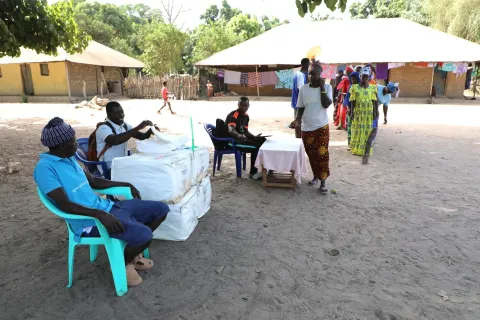
Conducted every three years, the MILDA Campaign is the largest public health operation in Guinea-Bissau. The 2026 campaign distributed more than 1.2 million mosquito nets to over 400,000 households across the country, including families living in hard-to-reach areas.
Such an operation does not happen by chance. It requires detailed planning, reliable supply chains, trained teams, clear communication, strong data systems and close coordination among national institutions, development partners and United Nations agencies.
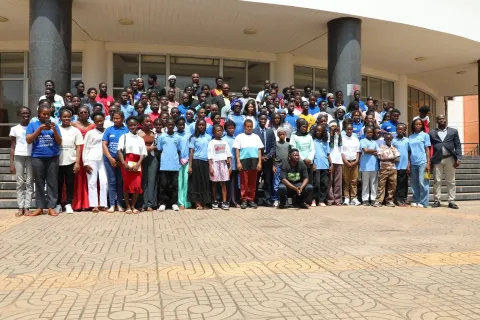
The campaign is led by the Ministry of Public Health through the National Malaria Control Programme (PNLP), with financing from the Global Fund and operational and logistical support from the United Nations Development Programme. The campaign also benefits from technical and normative guidance from the World Health Organization, logistics support through the World Food Programme, and community mobilisation and Social and Behaviour Change support from UNICEF. Together, these contributions mobilised more than 3,000 people across the country and turned a complex national operation into a coordinated public health response.
During distribution, households presented vouchers that were digitally scanned before mosquito nets were issued according to family size. This approach strengthened organisation, transparency and efficiency, helping teams monitor progress and respond more quickly to operational challenges.
One Campaign, Complementary Strengths
The strength of the campaign lies in the way each partner brought a distinct capability to a common national priority.
As Principal Recipient of the Global Fund malaria grant, UNDP played a central role in planning, financing and implementation. It managed the resources that supported the campaign, contributed to the procurement and distribution of more than 1.4 million insecticide-treated mosquito nets through approximately 1,400 distribution points, and worked closely with the National Malaria Control Programme (PNLP) to organise and finance training for campaign workers and supervisors across all regions.

A defining feature of the 2026 campaign was the nationwide use of digital tools for the first time. Building on household pre-registration and national demographic data from the Fourth General Population and Housing Census, UNDP helped introduce systems that improved planning, traceability and real-time monitoring. This digital approach strengthened accountability and enabled campaign teams to track implementation more closely.
Logistics were equally critical. To move mosquito nets across the country and position them closer to communities, UNDP leveraged WFP’s logistics infrastructure, renting warehouse capacity in Bafatá. WFP also supported quality assurance by monitoring loading operations, verifying dispatched quantities and tracking potential losses, an essential contribution in a country where distance and access constraints can determine whether services reach families on time.
UNICEF’s contribution focused on people, the families who needed to know why, when and how to use the mosquito nets. Through Social and Behaviour Change interventions and partnerships with community radio stations, UNICEF supported the dissemination of messages on distribution dates, collection points and procedures, while promoting the correct and consistent use of mosquito nets every night.

WHO provided strategic, technical and normative support throughout the campaign. Drawing on scientific evidence and international standards, WHO supported the Ministry of Public Health in aligning the campaign with evidence-based malaria prevention and control strategies. WHO also promoted the use of quality data for decision-making, and supported the integration of the campaign into the broader national malaria control programme.
Partnership That Delivers Results
The MILDA Campaign is a reminder that partnership is most powerful when it is practical, coordinated and focused on results. More than a mosquito net distribution exercise, it shows how shared leadership and complementary expertise can translate national commitment into protection for millions of people.

Most importantly, the campaign brings the country closer to a future where every family has access to malaria prevention and every child has a better chance to sleep safely, grow healthily and thrive. That is the value of collaboration: when institutions work together with purpose, coordination and trust, they do not simply distribute mosquito nets, they help save lives.