The Importance of Vaccines
in the Recovery of Malnourished Children.

- Español
- English
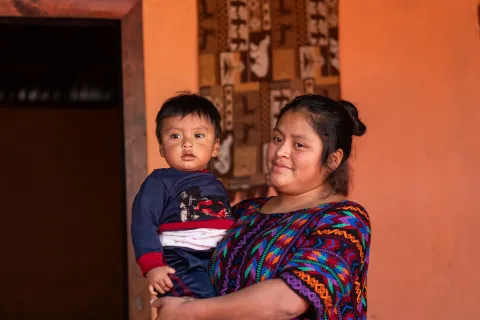
San Pedro Carchá, Alta Verapaz – “My heart is happy because they came to visit my son,” says Rosario from her home in San Pedro Carchá, a rural Indigenous community located about four hours from Guatemala City. A municipal health team came to her doorstep to follow up on the health of her one-year-old son, Mynor. A few weeks earlier, a routine check-up at the local health post had raised concerns: he was underweight and required immediate intervention to prevent his growth from being affected.
To help improve his health and nutrition, Rosario received nutritional supplements and an important medical recommendation: during that same visit, her son should receive the vaccines that were still pending in his immunization record. “I went to the health center and my son was weighed (...) they gave me all his vitamins, ‘chispita’, and zinc, and he received all his vaccines,” Rosario recalls. Following the guidance of health personnel, she also complemented the treatment with nutritious foods available in her community, such as leafy greens, beans, and eggs.
Rosario’s story reflects an urgent public health priority in Guatemala, where one in every two children under the age of five suffers from chronic malnutrition. This rate, the highest in Latin America, is far more than an alarming statistic—it is a reality that compromises both the present and future of children. Malnutrition weakens the immune system from early childhood and dramatically increases vulnerability to severe complications from respiratory and gastrointestinal infections.
In regions such as Alta Verapaz, characterized by geographical dispersion and structural barriers to accessing basic services, the combination of poverty and malnutrition exposes families to life-threatening risks. Globally, UNICEF reports that for more than 200 years, vaccines have protected children and families, saving more than 150 million lives in the last 50 years alone. That is equivalent to six lives every minute, every day, for decades.

The Cycle of Illness and Weight Loss
Delays in vaccination schedules not only leave children vulnerable to infectious disease outbreaks, but also hinder their nutritional recovery. Vivian Salomon, Health Specialist at UNICEF Guatemala, explains the critical dynamics at play in this context: “When poverty, malnutrition, and incomplete vaccination schedules converge, children face a greater risk of contracting diseases, experiencing more severe illness, and requiring hospitalization.”
This situation triggers a harmful cycle that affects children’s physical and cognitive development. Each episode of illness—whether acute or prolonged, such as respiratory or gastrointestinal infections—causes a rapid loss of weight and energy. In turn, this weight loss contributes to worsening malnutrition, further weakening the immune system and increasing vulnerability to new infections.
“Each episode of illness leads to progressive weight loss, perpetuating the cycle of malnutrition and increasing the risks to children’s survival and development,” Salomon warns.
An Integrated Response at the Community Level
In this context, Guatemala’s Ministry of Public Health and Social Assistance (MSPAS), with technical support from UNICEF, is implementing an integrated early childhood care model. This approach aims to improve the quality of health services, strengthen cold chain systems to ensure the proper storage and preservation of vaccines, monitor children’s growth and development, and work closely with communities to promote their care and well-being.

In practice, this means providing close follow-up for every child. Juana Tiul Chub, a nurse at the health post serving the Chicó area, explains that the medical team develops monthly plans to identify children at risk of malnutrition. Based on this information, health workers leave health facilities to conduct regular home visits, providing direct support to families.
“Home visits allow us to closely assess the health and nutritional status of children and their families. We also review vaccination records to ensure they are complete and up to date for the child’s age,” she explains.
During these visits, health personnel ensure that children receive zinc and micronutrient powders (commonly known as “sprinkles”) as recommended, and administer key vaccines that help prevent diseases such as pneumococcal infections and measles, mumps, and rubella (MMR). “This is part of the work we carry out as the Ministry of Public Health and Social Assistance,” she adds.
This strategy aims to bring health services closer to communities, overcoming geographic and cultural barriers. For Salomon, delivering care directly to households and providing clear, reliable information helps combat misinformation and encourages families to continue medical treatment. “We explain why vaccination is important. Sometimes people think we are simply giving an injection, but in reality, we are preventing diseases and helping children grow up healthy and strong,” she emphasizes.
Prevention at Home: Habits That Support Recovery
Evidence and experience from health facilities show that when childhood immunization is systematically integrated and prioritized, children experience greater stability in their nutritional recovery. In this context, vaccines are not merely a complementary intervention; they are an essential shield that allows children to absorb nutrients without the setbacks caused by recurrent infections. “Complete and timely vaccination is an essential tool for protecting children from malnutrition. Vaccines save lives,” concludes Salomon.
For Rosario, the ongoing support of health workers and the guidance she received in her native language have also profoundly transformed the preventive practices she follows at home. Today, she not only makes sure to take her son to the health center for monthly growth monitoring visits, but has also established strict hygiene measures to prevent infections within the household.
“I wash and bathe them every day (...); I wash their hands and give them a cloth to dry them so they do not touch anything dirty,” Rosario explains. In addition to strengthening hygiene practices, she has changed her family’s eating habits, prioritizing home-cooked meals over processed foods. “I no longer go to the store to buy cookies (...) I give him nutritious food so he can grow and become strong.”

The results are visible. As she watches her son regain his appetite, eagerly ask for his meals, and steadily improve his health, Rosario sees firsthand the impact of proper nutrition combined with timely immunization. “I can see that my son is growing and recovering from his illness. I no longer feel that my child is suffering,” she says.
Rosario’s story is not an isolated success—it is the result of a system that made the decision to reach her where she lives. UNICEF works alongside the Ministry of Health to reach every remote community in Alta Verapaz, training health personnel, strengthening the identification and registration of children with missed vaccinations, and supporting communication in Indigenous languages. These efforts help transform a home visit into a meaningful opportunity for change.
Because restoring immunization coverage is about more than completing a vaccination record—it is about ensuring that every child can grow up without a preventable disease compromising their right to health.