San Cristóbal Verapaz Certified as an ECOFAM Municipality, Free of Environmental Fecal Contamination
The Ministry of Public Health and SESAN, with support from UNICEF and the European Union, certified San Cristóbal Verapaz as an ECOFAM municipality, contributing to improved health for children and their families.
- Español
- English
Alta Verapaz, Guatemala, December 3, 2024. The municipality of San Cristóbal Verapaz has been awarded the certification for the Elimination of Environmental Fecal Contamination (ECOFAM) by the Ministry of Public Health and Social Assistance (MSPAS) and the Secretariat for Food and Nutrition Security (SESAN), supported by UNICEF, the European Union, and partners such as Helvetas Swiss Cooperation and ADRI.
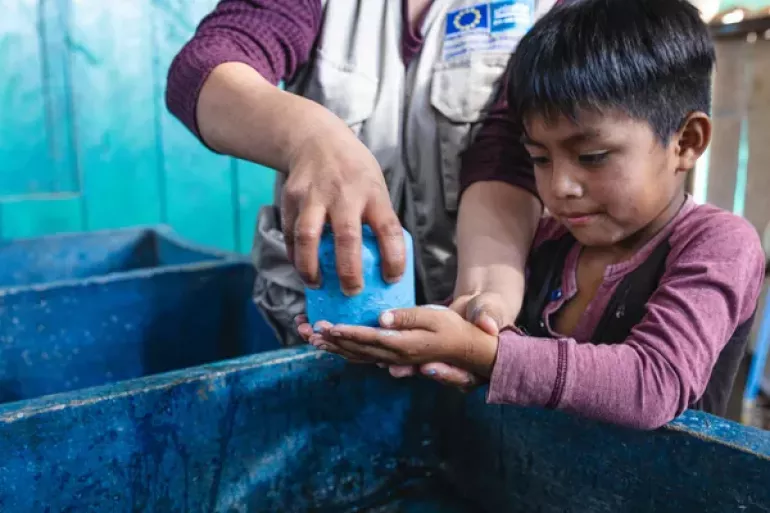
This achievement makes San Cristóbal Verapaz the eighth municipality nationwide to receive this recognition. The 85 rural communities in the municipality, with over 55,377 residents and 9,846 households, have significantly improved access to safe water and handwashing facilities. Notably, 3,118 individuals who previously practiced open defecation have built their own sanitary facilities using local resources, and more than 2,859 families improved existing infrastructure.
Inadequate sanitation and hygiene adversely affect public health, particularly for vulnerable families and children.
"Malnutrition is one of the main challenges facing children in Guatemala. Ensuring access to safe water, hygiene, and sanitation is essential for prevention. These are fundamental rights, and we all share the responsibility to fulfill them. I commend the families, communities, and leaders of San Cristóbal Verapaz for this important milestone and thank the Ministry of Health, SESAN, and the European Union for supporting this innovative and sustainable initiative,” said Manuel Rodríguez Pumarol, UNICEF Representative in Guatemala.
Nationally, 55% of households discharge wastewater directly onto the ground, lacking proper drainage systems, which increases the risk of gastrointestinal diseases among children. Approximately 3% of the rural population practices open defecation, with some municipalities reporting rates as high as 30%.
Through a joint UNICEF-European Union project in collaboration with the Ministry of Health and SESAN, over 1,300 communities have been certified, benefiting approximately 580,000 people, including more than 252,600 children.
Additionally, as part of community action plans, families have initiated self-construction and infrastructure improvement projects, enabling around 15,400 families to build their own latrines using local materials. These efforts are guided by principles of privacy, safety, dignity, and sustainability, meeting basic sanitation criteria.
Media contacts
About UNICEF
At UNICEF, we advocate for the rights and well-being of every child, everywhere, in all that we do. Together with our partners, we work in 190 countries and territories to turn this commitment into practical actions that benefit all children, focusing especially on reaching the most vulnerable and excluded worldwide.
In emergencies, UNICEF protects children's rights by providing swift and effective responses. In collaboration with UN partners and humanitarian organizations, UNICEF leverages its unique rapid-response capabilities to alleviate the suffering of children and their caregivers.
Learn more about UNICEF Guatemala and our work by following us on: Facebook, Instagram, Twitter, YouTube, Tik Tok, Linkedin y Medium