Eye Health & Lead Poisoning: Ghana's Kohl Story
A mother in Northern Ghana uncovers the danger of traditional eye makeup linked to lead poisoning and fights for community awareness.

Agnes, a mother of three from Sangbaa in the Tatale-Sanguli District of Northern Ghana, full of the love and concern that many mothers feel for their children. Her ultimate priority is the health and well-being of her children, yet recently, she has been burdened with worry for her youngest, Rhoda, who will turn two in a few months.
Rhoda's struggle with allergic eye disease has turned Agnes's world into one of anxiety and determination.
When Rhoda was born, she was a picture of health—an energetic and bubbly baby girl. But as Agnes observed Rhoda growing up, she noticed a stark difference between Rhoda’s eyesight and that of her two other children. At just one year old, Rhoda would frequently rub her eyes, tears flowing as she battled the pain and frustration that came with her condition.
For a mother, witnessing her child in distress is a heart-wrenching experience, and Agnes felt deep pain as she watched Rhoda suffer.
Desperate to relieve her daughter’s pain, Agnes embarked on a relentless quest for solutions. With mounting fear and anxiety, her search led her down a troubling path when she decided to use Chilo, a substance that many in her community use for cleansing the eyes and enhancing beauty, as a cure.
Chilo is the traditional name for kohl, cherished for generations, yet it carries an insidious danger, one that Agnes would soon learn about.

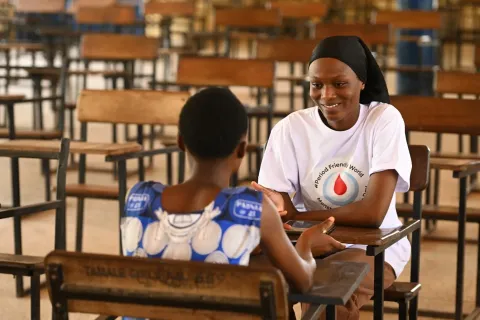
Upon applying Chilo to Rhoda's eyes, Agnes soon realized that rather than helping, it seemed to aggravate her daughter’s condition. Worried and confused, Agnes sought medical help, leading her to the Sangbaa CHPS (Community-based Health Planning and Services) center where she met the community midwife Sophia, one of the health workers in the Tatale-Sanguli district trained by UNICEF on the prevention of lead poisoning through the Ghana Health Service.
Ever since Sophia’s participation in the training, she has been an advocate for women in her community on staying safe against lead poisoning and was instrumental in convincing Agnes to avoid the use of the traditional eye liner (Chilo) on her daughter Rhoda.
Sophia explained that Chilo contained lead, a poisonous element that has adverse effects on children and pregnant women. For pregnant women, lead exposure poses risks such as anaemia and premature labour, while children may face a future marred by stunted growth and cognitive impairment.

Sophia, unable to manage Rhoda’s condition, eventually referred Agnes to Zabzugu Hospital. There, Agnes met an ophthalmologist who diagnosed Rhoda’s condition, offering a glimmer of hope for treatment. With medication in hand, Agnes started to see an improvement in Rhoda’s eyesight. The joy of witnessing her daughter's healing journey filled Agnes with relief, yet the shadows of concern remained.
What the community has long accepted as a harmless medicinal and beauty tradition is now the focal point of Agnes's advocacy. This time, her mission goes beyond her family.
It affects the health of everyone around me, as men, women, and children apply it, so I want to help them.
Engaging with fellow mothers and community leaders, Agnes confronts the deeply entrenched beliefs that have led many to trust in Chilo’s safety for generations. Yet the resistance she faces is disheartening. People cling to traditions fervently, insisting that their ancestral practices cannot be harmful.
Still, Agnes recognizes the vital role community leaders, traditional rulers, and especially grandmothers play in influencing mothers’ choices.
Her hope is to spread awareness among these influential figures, helping them to understand the hidden dangers of Chilo. She dreams of a day when mothers will no longer see it as a medical and beauty enhancement but as a risk to their own and their children’s health.
Agnes is deeply grateful to community midwife Sophia for the training that has led her to make informed decisions about her children’s health. She hopes other mothers make such decisions, leading to a healthier future for every child in Sangbaa.
Agnes' story reminds us of the importance of collaborative efforts between UNICEF, the Ghana Health Service, and various partners. In particular, the Clarios Foundation's contributions through the Healthy Environments for Healthy Children Program are dedicated to creating a healthier future for every child in Ghana.