The journey was long and physically demanding. We moved across vast water bodies, hiked through isolated areas, and navigated difficult terrain. But once we arrived, the scenery did not disappoint. Afram Plains is breathtaking. It is a land of striking natural beauty, with expansive views, open skies, and quiet waters. Nature has truly blessed this place.
But behind the postcard-perfect backdrop lies a stark reality, one many of us rarely see. As we met with residents and visited communities scattered across the islands, the challenges became clear: access to health services, quality education, clean water, and birth registration remain significant hurdles. In many areas, infrastructure is poor or non-existent. For communities living in such isolation, even the most basic services can feel out of reach.
To put this into perspective: an average of 68 percent of children in the Eastern Region are classified as multidimensionally poor – meaning they lack access to essential services and opportunities across several areas of life, not just income. Among the youngest (ages 0–4), the rate is even higher, at 78.3 percent. Rural communities are hit hardest, with 73 percent of residential areas having no health facilities – the very places that often facilitate birth registration.
Moreover, 70 percent of rural residential areas lack basic schooling infrastructure, leading to low attendance and retention, particularly for girls.


Day 1: Engaging with Regional Coordinating Council - June 23, 2025
On June 23, I accompanied the representative and team at the Eastern Regional Coordinating Council in Koforidua. Here, we met with the Regional Coordinating Director and representatives from key directorates, including Health, Education, and the Births and Deaths Registry.
These initial discussions offered a view of the regional landscape and the interconnected systems that influence service delivery. Moving on to the Regional Health Directorate, we delved into persistent challenges, particularly around maternal mortality and the availability of essential health commodities.
Our conversation focused on service delivery at the community level, especially through Community-based Health Planning and Services (CHPS) zones
To get a clearer picture of the logistical issues, the team visited the Eastern Regional Medical Stores, the hub for receiving and distributing health supplies across the region. Conversations here underscored the importance of coordination, timely delivery and equitable distribution, especially to remote areas like the Afram Plains, where access can be unpredictable and often impacted by seasonal changes.
Later that afternoon, we engaged with officials from the Births and Deaths Registry. We focused on why the Eastern Region continues to grapple with some of the lowest birth registration rates in the country. Our discussions unearthed various systemic and community-level barriers, from inefficient data systems and financial bottlenecks to low public awareness and limited access to registration services.
The day concluded with a warm welcome at the Regional Education Directorate, where the representative and team met with Mrs. Ivy Asantewa Owusu (PhD) and her team. We explored the intricate links between education access, school enrollment, birth registration and child protection. The reflection turned to the unique challenges faced by children in underserved districts, especially in Afram Plains North and South, where infrastructure deficiencies and long distances to school often discourage attendance.
As the first day came to a close, the team remained struck by the complexities of issues facing the Eastern Region. It’s a place of stunning beauty yet mired in challenges that require urgent attention and collective action. The journey was just beginning, and we looked forward to uncovering more stories and insights in the days ahead.


Day 2: Beyond the Volta: Unveiling Social Barriers - Tuesday, June 24, 2025
The team continued to the community called Tease in the Afram Plains South, eager to connect with community members and frontline service providers. The road from Koforidua, the regional capital, led us through picturesque mountains and verdant landscapes, transforming what could have been a long drive into a scenic experience. We reached the ferry at Adawso around 11:30 a.m., setting off at 12:38 p.m. to cross the tranquil waters of Volta Lake.
The 45-minute ferry ride offered a moment of peace before we arrived at Achi Amanfrom and continued our way, finally reaching Tease by 2:15 p.m. Described as a challenging destination, Tease greeted us with its beauty and warmth.
In Tease, the representative engaged with the District Chief Executive, the Department of Social Welfare and Community Development, the Chief of Tease, and directors from various social sectors, including education and local government social welfare.
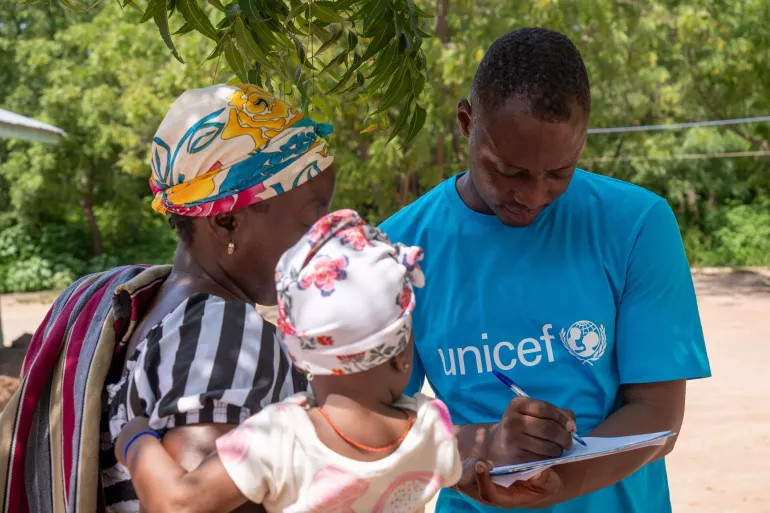
Here the discussions revolved around pressing challenges facing the district: low birth registration rates, difficulties in retaining health workers and teachers, limited access to essential health supplies, and barriers to education for children in remote communities. Three major issues consistently emerged: limited financing, mobility constraints, and chronic staff shortages across the social sectors.
While low birth registration stood out as a primary concern, it became evident that it was intertwined with other systemic barriers affecting healthcare delivery and educational access. With strong resolve, we looked forward to the next day, eager to delve deeper into the communities’ needs and aspirations.


Day 3: Deep Dive in Bumpata - Wednesday, June 25, 2025
Our journey continued Wednesday, June 25, when the team and I set out from Donkpokrom at 8:17 a.m., heading toward Bumpata, a small island fishing community.
After a 45-minute boat ride, we arrived in Bumpata, home to around 700 residents primarily engaged in fishing. Despite its rich natural resources, the community faces profound challenges: no access to electricity or internet service, a single functioning Community-Based Health Planning and Services (CHPS) compound and a school desperately lacking basic amenities.
Before meeting with community members, we toured the local school Bumpata DA Basic School, and the situation was disheartening. Classrooms were overcrowded and resources were minimal.
At the school we spoke with a teacher, Gabriel, despite the odds, he has been teaching here for seven (7) years, combining classes for over 60 students at a time. He expressed the difficulties he faces but remained unwavering in his commitment to providing education under dire circumstances. What struck me most was not just the community's struggles but their determination to build a better future.
In a later conversation with chiefs, teachers, health workers and a local pastor revealed a collective sense of ownership. In a place where one school serves six island communities and birth registration is low, the residents of Bumpata are not waiting for help; they are creating solutions.
They’ve constructed a local health clinic (CHPS compound, Community-based Health Planning and Services), are providing housing for teachers, and are now working toward establishing a police station to enhance safety. There’s a quiet resilience in Bumpata, a belief that change is possible when communities take the lead.
During the meeting, the community chief and the group expressed their deep appreciation for my visit, noting that it was the first time in their history that the head of a development organization had visited and engaged with them in a dialogue. While we were grateful for their kind gesture, it also served as a stark reminder of how forgotten and ignored these communities have been, and this realization weighed heavily on me.


Day 4: Journey to Dwarf Islands - Thursday June 26, 2025
On Thursday, June 26, we set off early, boarding our boat at 9:40 a.m. from Bruben for a 35-minute ride to the Dwarf Islands.
Before boarding the boat, the entire team put on my life jacket for safety and boots to walk through the shallow water along the riverbank. After we reached the shores of the lake heading into the next town, Kpatalizdzakope, we had to wait for the crew we came along with to offload motorcycles from the boat, as this was the only means we could commute to the neighboring town.
While waiting at the shore, our representative Osama, met Jacob, a 17-year-old student from Bruben DA Basic School. I joined and listened to the conversation, and he shared his struggles with commuting from his community to school. To access education, he had to move to Bruben, as there are no schools in his hometown of Sidi Kope. Currently, he is on vacation from school and has returned to his hometown, where he is working at the lakeshore to save some money before classes resume.
After a few minutes in our conversation with Jacob, we were informed by the group that the motorbikes had been successfully offloaded and that it was time to leave.
I then put on my helmet and held firmly the back metal of the motorbike as the rider started for us to move, uncomfortably on the back of a motorcycle, rattling along a bumpy road for a grueling 35 minutes. Every jolt was a reminder of how far we were from the familiar. But as we arrived, all that discomfort melted away.
We were met with a warm welcome that could only be described as quintessentially Ghanaian. The students at the local school had prepared a cultural dance in our honor.
Dressed in vibrant Atakpɛnti (a traditional attire of the Ewe people, the dominant tribe in the Volta Region of Ghana), the dancers moved gracefully to the rhythms of Bobobo, a popular Ewe dance. At that moment, the unfamiliar felt like home.
After our warm welcome at Kpatalizdzakope, we settled in and took in the beauty and warmth of the community. Soon after, we sat down with community members to have a deep conversation about the pressing issues they face.
One issue that stood out the most was their limited access to essential health services. We learned that Kpatalizdzakope and eight neighboring communities all rely on a single CHPS compound, staffed by only one health professional. This facility lacks many basic resources, and the nearest hospital is a two-hour boat ride away.
This stark reality was hard for the team to grasp. And for me particularly I found myself imagining how families live with such limited access to healthcare, especially during emergencies. I spoke with the health worker stationed there, who shared deeply personal stories about the daily challenges he faces in navigating the limited resources to provide the best care he can for the community.


Day 5 - Engagement with Faith-Based Organizations - Friday, June 27, 2025
On Friday morning, we set off for the regional capital, Koforidua. After a three-hour journey from Donkokrom, we arrived around 3:30 p.m.. We headed straight to the Regional Coordinating Council, where the representative and team met with religious leaders from the Islamic community, the Christian Council, and the Catholic Church. The purpose of this meeting was to engage in a deep discussion about issues affecting children, including birth registration, child labor, and education.
What stood out was the depth of knowledge these religious leaders already possess, particularly regarding the spiritual and cultural significance of naming and identity, as reflected in both the Quran and the Bible. However, while they recognize the spiritual importance of these practices, there is a pressing need for increased awareness of the legal and developmental significance of birth registration.
It will be essential to organize targeted discussions and orientations for these religious leaders, equipping them with practical tools and advocacy skills to champion the importance of birth registration and child protection.
By doing so, we can enhance community-level demand for these services and ensure that every child’s right to an identity, protection, and education is fulfilled.


Reflections - Context and Tailored Action Matters
Across all engagements in the Eastern Region, especially in the remote, hard-to-reach communities, one thing became clear: while many challenges are complex and longstanding, there are immediate opportunities, especially in the area of birth registration, that can yield quick and meaningful gains.
Witnessing the challenges of commuting in these areas and the tools and resources required for effective birth registration, it became clear how insufficient the support these communities receive is. If we are serious about improving birth registration rates, we must address these systemic barriers from the top down. With stronger coordination, targeted training, and adequate support, Ghana can transform what is currently a missed opportunity into a significant national victory.
Access to education also emerged as another critical challenge. While there is a need to empower communities to appreciate the value of schooling, physical access itself remains a significant barrier. Teachers are overwhelmed due to inadequate teacher-to-student ratios, forcing them to combine classes, which affects the quality of teaching and learning. Many teachers also lack the capacity to effectively teach essential subjects, further limiting students’ educational outcomes.
It was disheartening to learn that, for many children in these communities, education often ends at junior high school. With limited opportunities and pathways to encourage further education, many young people return to fish farming or remain at home after their junior high exams. Those determined to continue often endure long, unsafe commutes just to attend classes.
My colleagues and our representative emphasized the urgent need for context-driven policy. It's about truly understanding the ground realities and incorporating these voices into planning and budgeting. Ownership is crucial. These communities are already finding homegrown solutions, and with deliberate external support, they can achieve even greater progress.
As a first-time visitor, this trip was both eye-opening and grounding. The Afram Plains demand greater attention, investment, and care. From an advocacy perspective, this journey powerfully reinforced the need for continued support and crucially, listening rather than lecturing. These communities have a voice; they just need a platform to elevate and amplify their perspectives.
The journey may not be easy, but it's unequivocally worth taking. It's how we shed light on the real lives behind those picturesque landscapes and truly embody the principle of leaving no one behind, especially in the furthest-to-reach areas.