
Health for Every Child
UNICEF–EU Partnership in Action

Every child has the right to health. Yet preventable diseases, fragile health systems, humanitarian crises and climate shocks continue to put millions of children and women at risk. Guided by the UNICEF Health Strategy 2016–2030 and the European Union’s global priorities on global health, universal health coverage and humanitarian assistance, UNICEF and the EU work together to save lives, strengthen systems and protect child health—especially in the most vulnerable and crisis‑affected contexts.
What UNICEF and the EU deliver together
Saving lives through essential health services
EU‑funded UNICEF programmes expand access to life‑saving maternal, newborn and child health services, particularly through primary health care. In countries such as Angola, Ethiopia, Malawi, Sudan and Zambia, EU support enables integrated health responses addressing preventable mortality alongside nutrition and child protection.
Preventing and responding to disease outbreaks
The UNICEF-EU partnership plays a critical role in cholera, yellow fever and water‑borne disease prevention and response, often implemented jointly with WHO or PAHO. Programmes in Angola, Comoros, Ethiopia, Madagascar, Malawi, DR Congo and Ecuador strengthen surveillance, early detection and rapid response capacities—protecting children in fragile and climate‑affected contexts.
Health in humanitarian action
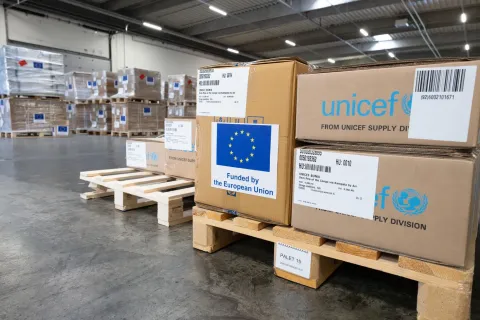
EU humanitarian financing enables UNICEF to deliver life‑saving health responses in emergencies, including conflict, displacement and natural disasters. In contexts such as Afghanistan, Yemen, Sudan, Syria, State of Palestine and Lebanon, health services are delivered alongside nutrition, WASH and protection—ensuring continuity of care across the crisis‑to‑recovery spectrum.
Strengthening resilient health systems
Reflecting a shared systems approach, UNICEF and the EU support long‑term health system strengthening, including:
- Primary health care reform and digitalisation (e.g. Egypt, Madagascar, Ethiopia);
- Health financing and insurance systems to reduce inequities;
- Supply chains and local production of essential health and nutrition commodities (e.g. Nigeria);
- Integration of health with WASH and climate resilience to reduce disease burden.
Equity, integration and the life‑course
EU‑funded health programmes prioritize women, newborns, adolescents and marginalized children, integrating health with nutrition, WASH, education and social protection—consistent with UNICEF’s life‑course and equity‑focused approach.