Meeting the families and health workers in the frontlines of drought
Over three days, I saw firsthand the desperation of families and the dedication of health workers in the face of a devastating drought in Borena Zone, Ethiopia.

It’s a strange feeling seeing a village abandoned by drought.
A place once bustling with people is now an empty shell scattered with the skeletons of dead animals.

I had spotted the village on my way to visit children and families affected by a devastating drought in Ethiopia’s Borena Zone, Oromia. The numbers are alarming. Three years of water shortages have affected over half of the 1.7 million population, forcing thousands of families to flee their homes. A community known for their abundant livestock and hospitality, now reliant on aid.
UNICEF is on the ground working with partners to support children suffering from malnutrition with lifesaving health and nutrition services. These are some of the families I met during my three-day trip.
Day 1
I visited UNICEF-supported Yabello General Hospital on my first day and was saddened to see their wards flooded with children suffering from severe malnutrition. Stick-thin babies, worried mothers, and overwhelmed health workers. Ware Abale, a nurse, told me about the scale of the problem.
“I have never seen such kind of drought in my entire life. It did not discriminate between rich or poor. It has left everyone with the same social status.”

While walking through the health centre, Ware told me that due to the drought situation, they are currently admitting three to five severe acute malnutrition cases per day. Many children, weakened by hunger, were now battling other diseases like malaria, pneumonia and diarrhoea.
“Previously we used to receive 8 cases per month, but now we receive up to 58 cases which has totally stretched the system,” Ware told me. “For us health workers, it’s mentally exhausting and frustrating at the same time. Some of the children that are coming here are swollen when they arrive, and we can’t even find their veins as they are too small. I can’t sleep at night. Sometimes I cry with the mothers when I see serious health conditions of children as if they are my own. At the same time, it is rewarding to be here and supporting mothers and children in my capacity.”
Day 2
I visited the IDP camp in Dubluk on my second day, which is now home to over 50,000 displaced people. When I arrived, there was a large queue of mothers waiting to have their babies checked for malnutrition. This was done as part of UNICEF’s ‘Find and Treat’ Campaign which supports health workers to detect and treat cases of child malnutrition early, particularly in hard-to-reach areas.

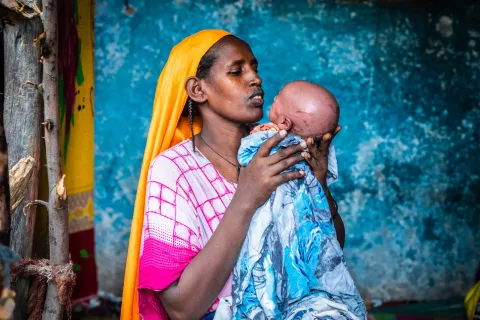
Amongst the crowd was Dabo Boru, a 22-year-old mother who had arrived early in the morning to find out the nutritional status of her one-year-old baby Wako Boru.
I saw a health care worker carefully measure the circumference of Wako’s arm with a UNICEF supplied band which helps health workers identify malnutrition. It was red which meant, baby Wako was severely malnourished and needed urgent treatment.
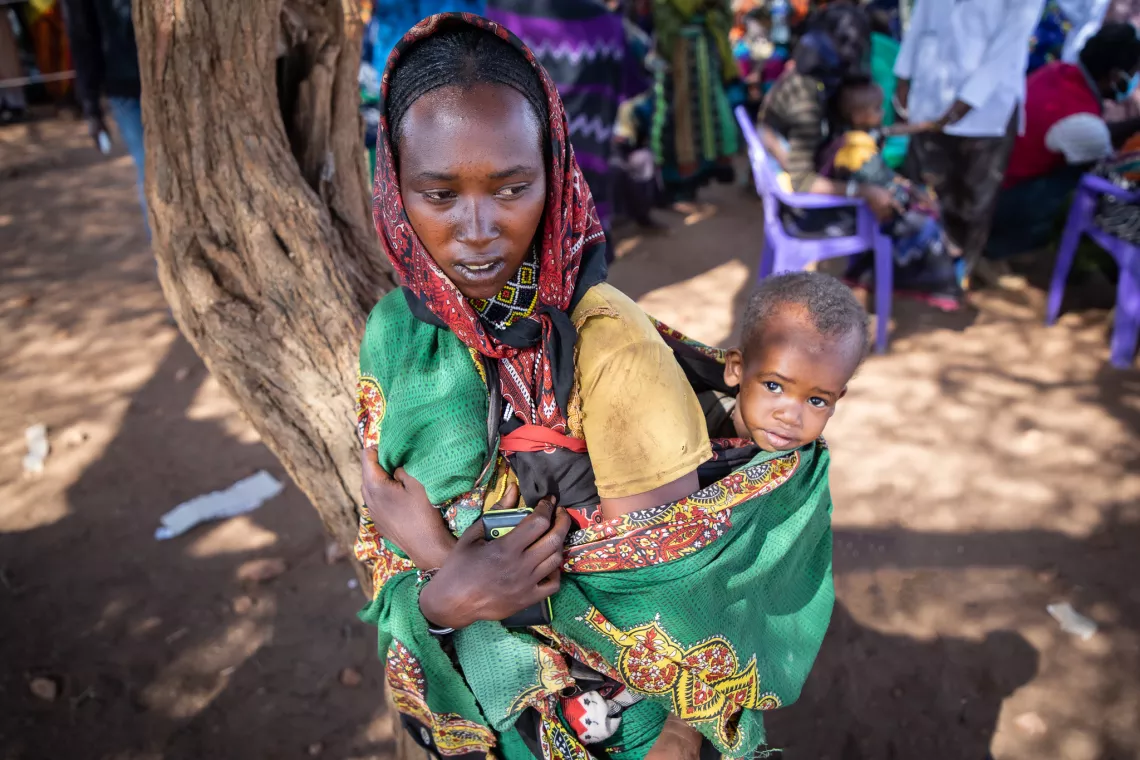
Dabo told me that she’d fled to Dubluk camp six months ago along with her husband, children, and neighbours .
“We had 28 cattle and all of them have died due to the drought. Since I came here, we are given soap for cleaning. We are also given food. Sometimes it’s delayed. Sometimes it’s not enough. We feel hungry all the time,” said Dabo.
A bit further down from where the ‘Find and Treat’ Campaign is taking place, there is another tent set up where three UNICEF-supported health workers are stationed and are providing health services to the IDP community. Roba Dida, Dawit Godana, and Rahma Hussien are busy attending to different treatment needs of children.

“We have been assigned to the IDP camp 6 months ago to support the current situation in the camp,” said Dawit. “Most children here are diagnosed with diarrhea and pneumonia. This is due to the poor sanitation situation causing preventable illnesses. We are trying our best to provide care and treatment to the IDP community by working tirelessly.”
Day 3
On my final day, I went to visit a village where mothers have taken MUAC training to identify early signs of malnutrition in their children. The family MUAC is focused on preventing malnutrition as mothers and caregivers are empowered to screen their own children and take action before it happens. The approach also helps to improve coverage of screening, and treatment services as well as detecting cases earlier and improving awareness of malnutrition.
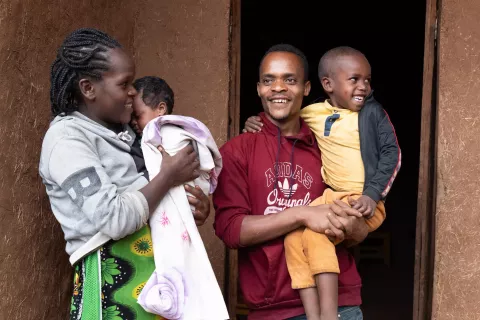
As I was walking along in the village, I spotted Tato Guyo, a 22-year-old mother carrying her 5-month-old daughter, Dessa Kiya.

“We are given the MUAC tape recently by the health extension workers. I check my child regularly and I know that if the MUAC is yellow, it’s a sign of warning. I breastfeed my child and give her boiled water sometimes. My daughter has never been sick.”
While in the Borena, I saw firsthand the pain mothers go through when their children get sick, as well as the pleasure seeing them get the right treatment and recover from their illnesses.
As a mother myself, I cannot imagine how I would react if I was in the same situation. The families I met are so strong and resilient. I was also able to witness the work of real-life superheroes - the health workers - who are working day and night to save children’s lives.
I wish all babies here were as happy and healthy as baby Dessa. Throughout the drought, UNICEF and partners have been on the ground supporting children and their families, but to save more lives, we urgently need your help.