New digital monitoring system in Somalia tracks lifesaving supplies of therapeutic food
The digital last mile monitoring system makes sure every box reaches its intended recipients

Garowe, Puntland, Somalia
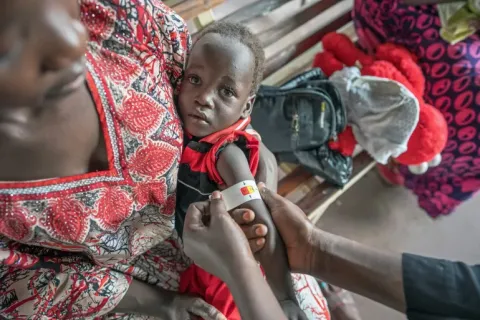
Amina Mohamed Nuur has known loss in her life. The Somali mother of 7, looks down as she recalls the 4 children she previously lost. That pain, prompted her to swiftly take action when her youngest, Saleebaan Abdi Aadam aged 17 months fell sick.
“He hasn’t been eating or sleeping well,” Amina said, “so I brought him here straightaway.” Amina is seen by Nurse Rahma, one of all female team at the Jilab clinic in Garowe, where Saleebaan is assessed and found to have severe acute malnutrition. He will need to take ready-to-use therapeutic food (RUTF) as treatment for his condition.
Amina has a difficult situation at home. Three months ago, she was living in the central region of Somalia, but conditions became very hard, due to poor rains and conflict, so she decided to leave and join relatives in Garowe. The journey with her seven children was not easy, taking three days, crowded into different transport. She finally arrived at her new home, and whilst she is grateful to be here, the space is small and she and her children are all crowded onto a square, woven mat on the floor.

Meanwhile across town Abdulkadir Muhyadin Mohamed, a warehouse officer with UNICEF partner Care International is logging dispatch of therapeutic food supplies in a new digital system.
“The last mile digital monitoring system is a web based simplified software enabling us to track supplies from the warehouse to the final destination. It’s very easy to use and enables me to know at any time how many supplies I have in my warehouse, how many have gone to health centres and how many are in other Care warehouses across the state of Puntland.”

And the tracking doesn’t stop there. After travelling a few kilometers by truck, the cartons of RUTF arrive at the Jilab health centre where the next stage of tracking and recording begin. Nurse Rahma carefully counts as each carton is carried into the store, ensuring any open carton is weighed first, to make sure it is complete. Once all are delivered, she enters the details (quantity, lot and waybill numbers) into the digital system, enabling Abdulkadir to see clearly that all have been delivered.
Thokozani Murape, UNICEF’s Regional Chief of Supply and Procurement in Eastern and Southern Africa, has been overseeing the launch of the system in Somalia:
“This new digital monitoring system is a game changer for Somalia, and a first for UNICEF in the world. It is enabling the team in Somalia to track lifesaving supplies of therapeutic food from the warehouse to the patient, making sure UNICEF is working efficiently with improved data visibility and reliability, and all supplies are ending up where they should be – in the hands of mothers and children,” said Ms. Murape.

Back in the out-patient room, and with the clear diagnosis, Amina is given enough sachets of RUTF to last until her next visit. What Amina doesn’t know is that she is an integral part of not only the digital last mile monitoring system making sure every box reaches its intended recipients, but also the OGOW digital patient record system. Another first for Somalia that is shifting patient records from paper based to App based, again leading to efficiency and preventing duplicate patient records. Using a tablet, the nurse enters the mother and child’s details, creating a unique identification number for the patient. Diagnosis and treatment are included, so that every time the mother returns to the centre, her record can be updated and reviewed. In addition, the system can send updated SMS and automated voice messages to the mother to remind her of appointments and checkups.
“There is less work for the health worker, and more time for the child. Record keeping shows us that when the mother is contacted consistently, and for her to come back to the health centre regularly, the data shows that the dropout rates decreased, and also the immunization rates increased,” said Khalid Awmusse, the OGOW health lead trainer.
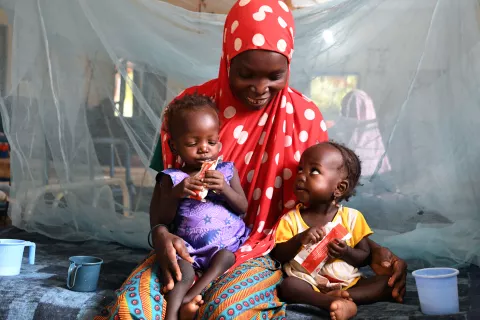
Back at home, Amina tells us of her worries for the future – being a sole provider for her children, and with no reliable work she has concerns about looking after her children. “I am only living for my children now. Making sure they have good health and go to school is the most important thing. Hopefully in the future they will succeed and be able to look after me.” She smiles and hugs her children, with Saleebaan sleeping peacefully on her chest.