Ending Child Marriage – Integration of Plans into National Budgets
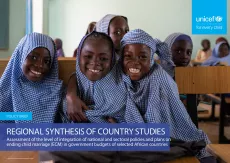
Regional Synthesis Report
Highlights
Child marriage is internationally recognized as a human rights violation committed on a vast scale. Yet over one-third of young women in sub- Saharan Africa were married before the age of 18. This report synthesizes the findings of studies in Chad, Mali and Nigeria in West and Central Africa and Ethiopia, Mozambique and Zimbabwe in Eastern and Southern Africa on the extent to which the countries’ plans to end child marriage have been integrated into the public expenditure plans.
The study was commissioned by the UNICEF Regional Offices in Eastern and Southern Africa and West and Central Africa under the auspices of the Spotlight Initiative to Eliminate Violence Against Women and Girls and the Global Programme to End Child Marriage which is generously funded by the Governments of Belgium, Canada, Italy, the Netherlands, Norway, the United Kingdom and the United States of America, the European Union through the Spotlight Initiative, and Zonta International. The study was undertaken by Mokoro Limited. The purpose of the study is to enhance the capacities of UNICEF staff and their government and civil society partners, to advocate for, influence and develop regional, national and sub-national programmatic actions and budgets to end child marriage. This is done by providing new data and analysis of the linkage between policies and budgets for ending child marriage (ECM).