Southern Africa ministers reaffirm commitment to regional migration cooperation at MIDSA 2025
Southern Africa member states, along with IOM, UNICEF and civil society, have renewed their commitment to strengthening regional cooperation on migration governance and policy development
Victoria Falls, Zimbabwe, 28 October 2025 – Ministers and senior government officials from Southern Africa member states, along with the International Organization for Migration (IOM), the United Nations Children’s Fund (UNICEF), and civil society, have renewed their commitment to strengthening regional cooperation on migration governance and policy development at the 2025 Migration Dialogue for Southern Africa (MIDSA) conference, which concluded in Victoria Falls, Zimbabwe on 27th October 2025.
The 2025 MIDSA took place under the theme “Promoting Regional Integration Through Sustaining Safe, Regular, and Orderly Migration in the Southern African Region.” The four-day dialogue provided a platform to address emerging migration dynamics, including climate-induced mobility, children on the move, alternatives to detention, mutual recognition of qualifications and skills, youth migration, labour mobility, and the growing need for data-driven migration policy solutions. Ministers from Home Affairs, Labour, Tertiary Education, Environment, and other key sectors were joined by representatives from the African Union Commission, Civil society and regional economic communities.
“This platform (MIDSA) has become a cornerstone for regional cooperation on migration governance, fostering dialogue and the exchange of best practices among SADC member states. It reinforces our shared commitment to harnessing migration for regional integration, economic development, and social protection for all our people.” said Honourable Minister Kazembe of Zimbabwe’s Ministry of Home Affairs and Cultural Heritage.
Migration is one of the defining features of Southern Africa’s development. It shapes economies, strengthens communities, and drives regional integration. But managing migration effectively requires cooperation, dialogue, and shared solutions. Now in its 25th year, MIDSA continues to serve as a vital forum for fostering regional integration, south-south cooperation and enhancing the resilience, mobility, and the socio-economic development of over 400 million citizens across the Southern African region.
Today, it is estimated that around 6.4 million migrants live in the region; most of them are moving within Africa. About 75 percent of migrants in SADC region are from SADC countries, with nearly half residing in South Africa.
The 2025 MIDSA event featured technical sessions that identified key challenges and opportunities, promoted inclusive stakeholder engagement, and generated evidence-based recommendations for improved migration governance. The dialogue culminated in a high-level ministerial session on 27 October, where member states, including The Republic of Angola, The Republic of Botswana, The Union of the Comoros, The Democratic Republic of the Congo, The Kingdom of Eswatini, The Kingdom of Lesotho, The Republic of Malawi, The Republic of Mauritius, The Republic of Mozambique, The Republic of Namibia, , The United Republic of Tanzania, The Republic of South Africa, The Republic of Zambia and The Republic of Zimbabwe endorsed a joint outcome statement reaffirming their commitment to regional cooperation.
“Migration has played a pivotal role in shaping the SADC region as we know it today. Migrants have been essential in the development of many SADC states, and they remain the cornerstone of the regional economy.” Frantz Celestin, IOM Regional Director for East, Horn and Southern Africa. “MIDSA 2025 has reaffirmed the region’s collective resolve to advance safe, orderly, and regular migration. As we look ahead to the 2026 International Migration Review Forum, IOM stands ready to support SADC member states in translating these commitments into action—through data-driven policies, regional cooperation, and inclusive approaches that leave no one behind.”
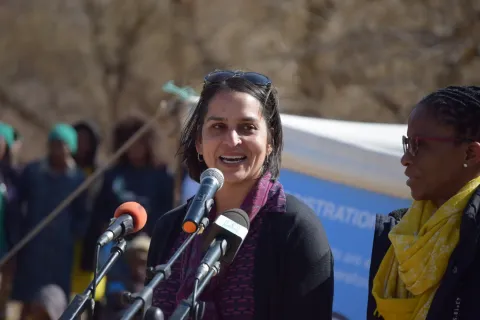
“Today marks a historic milestone for children across the region, with the signing of the first-ever Children on the Move Declaration at MIDSA 2025,” said UNICEF Regional Director for Eastern and Southern Africa, Etleva Kadilli. “Through this declaration, SADC member states are reaffirming their commitment to protect and uphold the rights of children who are forced to migrate due to poverty, conflict, or climate change. UNICEF stands ready to continue working with SADC, IOM and our partners to strengthen cross-border protection and build resilient systems that support children at every stage of their journey.”
The joint outcome statement adopted at the ministerial session outlines six key commitments:
- Accelerating labour mobility: Governments committed to fast-tracking mutual recognition agreements (MRAs) and ratifying key SADC protocols to unlock safe and fair labour mobility.
- Advancing climate mobility governance: Ministers endorsed a regional programme on forced displacement and climate resilience, aligned with KDMECC-Africa and national adaptation strategies.
- Improving migration and displacement data: Delegates agreed to harmonize displacement data systems, align with international standards, and integrate data into early warning and response platforms.
- Sustaining the MIDSA Platform: A task team will be established to mobilize resources and ensure MIDSA’s continued role as a cornerstone for regional migration dialogue.
- Preparing for IMRF 2026: Member states will present a unified regional position at the International Migration Review Forum, showcasing Southern Africa’s leadership in implementing the Global Compact for Migration.
- Protecting children on the move: Member states pledged to strengthen child-sensitive migration governance, including legal identity, cross-border protection, and alternatives to detention. Additionally, the ministers adopted the Victoria Falls Declaration on Children on the Move, committing to collective action and regional collaboration to protect children on the move, ensure universal access to essential services, and align migration governance with global child protection standards.
The adopted outcome statement outlines priority actions to enhance regional migration governance, strengthen cross-border collaboration, and promote inclusive, rights-based migration policies across Southern Africa. These efforts are aligned with Africa Union’s Agenda 2063, Global Compact for Migration (GCM) and SADC Migration Policy Framework and will inform preparations for the 2026 International Migration Review Forum (IMRF).