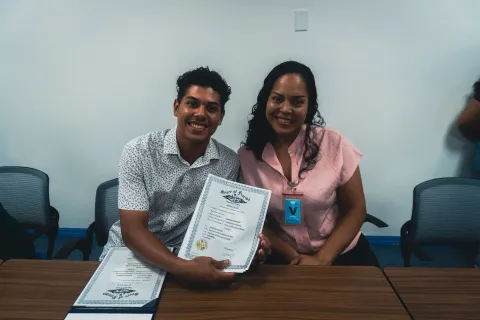
Securing every child’s right to legal identity in Trinidad and Tobago.
UNICEF and WINAD support Venezuelan migrant families
PORT OF SPAIN - A joint initiative by UNICEF and the Women’s Institute for Alternative Development (WINAD) has helped 149 Venezuelan children born in Trinidad and Tobago receive their birth certificates, giving them legal identity and access to essential services such as healthcare, education, and protection.
The partnership supported 67 boys and 82 girls, exceeding its initial targets ahead of schedule. The initiative focused on addressing barriers that migrant families face in the birth registration process, including financial hardship, lack of documentation, administrative complexities, and language barriers.
Birth registration is a legal requirement under Trinidad and Tobago’s Births and Deaths Registration Act, which mandates that births be registered within three months. However, for undocumented Venezuelan families, the process is particularly difficult, especially as a Registro Consular from the Venezuelan Embassy is required before registration can proceed.
Many parents cited financial constraints, including the cost of transportation and documentation, as key obstacles. Others were unaware of the registration process or lacked the necessary paperwork.
UNICEF and WINAD responded with a multi-faceted support strategy that included community outreach, bi-lingual assistance, legal guidance, and financial support to cover key expenses. Strategic partnerships with the Venezuelan Embassy and legal service providers also helped streamline the process.
Parents shared their appreciation for the support they received. One said: “Thank you for your dedication and kindness. From the time we arrived to when we left, everything was explained step by step. We are grateful for all the support in getting our babies’ birth certificates.”
Another added: “Excellent customer service. [The Case worker] spoke to us with kindness and care. Everything was quick. Thank you for all the help.”
A third parent expressed: “From the bottom of my heart, thank you for helping us. Half an hour ago, I received my child’s birth certificate at my doorstep.”
UNICEF’s Child Protection Officer, Candice Wallace, highlighted the broader consequences of inaction: “Failing to ensure birth registration has severe consequences—not only for the child but for the wider community and country.”
Without a birth certificate, children may be denied access to education and healthcare, face greater risks of poverty and exploitation, and become vulnerable to statelessness. At the community level, unregistered children are often excluded from formal schooling and healthcare services, while at the national level, gaps in registration data can hinder effective planning and social service delivery.
UNICEF has called for long-term solutions, including simplifying administrative procedures, strengthening coordination among stakeholders, increasing public awareness, and aligning national policies with international child rights standards.
The right to identity is fundamental, and through UNICEF’s partnership with WINAD, real progress is being made. But there is still much work to do. Every child deserves a name, nationality, and the opportunities that come with legal recognition. UNICEF remains committed to ensuring that no child in Trinidad and Tobago is left invisible.