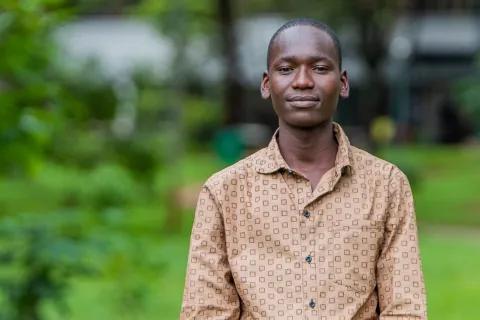
Melissa, the hope of a new life
In Southern Chad, vocational education gives young people hope for the future

In the classroom, everyone is quiet. Only the noise of the machines, the scissors, the crumpling of the fabrics can be heard. Everyone is focused on their task. Melissa Oussoumri, 15, from Moissala in the Mandoul province in southern Chad, is one of the 23 students in the centre that trains young people in sewing and carpentry. "I never knew my mother and I lost my father when I was 10," says Melissa. Since then, Melissa has been taken in by an aunt of the family who raised her. At 15, the family told her that they could no longer afford to keep her in school. After a few months of despair, an offer gave her hope:
When I was contacted to go to the sewing school, I was really happy. This is a new chance for me to learn. I will be able to sew clothes, earn money and hopefully enroll in school again.

The Moissala Trade Training Centre welcomes vulnerable youths, adolescents and young women, both refugees and host populations, as part of a socio-professional integration project supported by the Japanese government. At the centre, vocational training is provided as part of child protection support to vulnerable women and girls identified through case management to reduce their vulnerabilities, stigmatization, exposure to violence or increase their resilience.
There are more than 19,000 Central African refugees settled in four sites in Mandoul province. This influx of refugees has exacerbated the issues of unemployment and lack of vocational training among young people. UNICEF is working with the NGO World Vision to implement a programme that aims to find solutions to these pressing issues – including for vulnerable girls like Melissa. .
The students are selected by a steering committee composed of representatives of the Ministry of Gender, UN organisations and NGOs, with vulnerability being the main selection criteria- most students are refugees, orphans, single mothers, or victims of gender-based violence.


Some have left school without a diploma or have not attended school at all. As a result, they have no professional prospects. Learning sewing or carpentry in 6 months gives them the chance to become autonomous and to hope for a new life, as Melissa explains:
If sewing allows me to finance the resumption of my studies, I dream of becoming a defender of children's and women's rights.

After 7 weeks of training, Melissa has already acquired some skills: "I learned how to set up a sewing machine, how to operate it and how to make simple clothes. The blouse I'm wearing, I made it myself!” she says with a broad smile.

"Melissa is a quick learner. She is curious. During the six months of training, each learner should master the basics of sewing for men and women. I particularly appreciate the current strategy of giving the learners end-of-training kits. This will contribute to their autonomy." says Masra Ngueadoumadji, the workshop's main trainer.
Melissa had never thought of becoming a dressmaker, but she hopes that this training will enable her to move forward and fulfil her dreams. Her friend Madjilem Chancella, on the other hand, has always dreamed of becoming a dressmaker. Since she left the Central African Republic a year ago, she has been living on the site of Gon, 35 km from Moissala. A 20 years-old with two children and with no outside support, Chancella sees this training as an opportunity to take charge of her life and work in a field she has always been passionate about.

Melissa and Chancella embody the will of the Chadian authorities and partners to create a symbiosis around development programmes to stimulate the peaceful cohabitation of host populations and refugees. Melissa plans to open a sewing business in Moissala and Chancella in the Gon refugee camp. As part of the project, they will receive a stool, a sewing machine, a table, an iron, scissors, and fabric.
The project supervisor, Gisèle Djimtoidé, now hopes to expand the scope of the training: "We want to add modules in entrepreneurship, marketing and financial management to our training programme.”
With the support of the Japanese government, UNICEF has enabled 80 young people, including 41 vulnerable boys and girls at risk of neglect, abuse, exploitation and violence. from the Mandoul and Moyen Chari provinces, to join these vocational training programmes with the aim to increase their resilience. Through these short training cycles, UNICEF aims to give boys, women and girls the means to take charge of their lives and to reduce their exposure to vulnerability and protection risks. The practice of an income-generating activity, for many, is a guarantee of their autonomy and financial independence.