Unlocking the potential of a digital education at MLE schools
Smart devices are helping to close the digital divide and support ethnic minority students to recover from pandemic learning loss

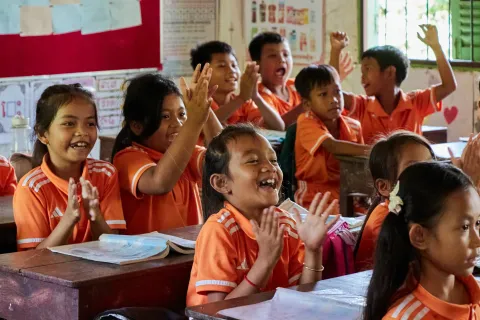
29 March 2023, Kratie – When Anlong Kes Primary School received a smart TV last year to help teachers support digital learning in schools with ethnic minority students, the staff weren’t short on ideas on how to use it. Grade 1 teacher Antoey Vibot said she knew her students would love it.
“My students are happy to learn through the TV,” said Vibot, who teaches Khmer as well as the ethnic minority language Phnong to Grade 1 students as part of the school’s multilingual education (MLE) curriculum.
“They enjoy learning the Khmer alphabet through cartoons with songs or rhymes. I think my Grade 1 students are less stressed when learning in the classroom because they are now having fun with a TV programme. They can watch it in addition to the lessons in the classroom.”
The school has set up a schedule to make sure each class can benefit from the new equipment – and so that every student can access a digital education, from the youngest learners all the way up to Grade 6.
“At the time I received the TV, some ideas popped into my mind,” said the school director, Hong Keabot. “I wanted to use it for students learning Khmer or mathematics when their teacher is absent. I also wanted to use the TV for the Local Life Skills subject for Grades 4 to 6, where students can explore various topics such as cooking, health and nutrition.”
Even the teachers are benefiting, she added.
“Besides student learning, we also use it for meetings and for teachers’ learning. For example, today our school’s technical meeting covers how to create an email account to register on the e-learning platform of the Ministry of Education, Youth and Sport.”
The 4K Android Smart television was delivered along with a mobile television stand, external hard disk and a satellite dish receiver (DTV) to help the school connect to national television coverage. A simple, single-board computer known as a Raspberry Pi was also distributed at the school so that children can access electronic copies of MLE learning materials, and a solar panel was installed on the roof to power the TV and other devices.
The supplies are part of an initiative from the Ministry of Education Youth, and Sport (MoEYS), supported by UNICEF and funded by the Government of Japan, to use technology and digital resources to both modernise and improve teaching and to enhance education for students in remote, ethnic minority areas.
While the distance learning initiatives during COVID-19 school shutdowns gave both teachers and students across the country an introduction to an online education, the pandemic also revealed and widened the division between children who have access to critical services, such as IT services and equipment, versus those who do not. Significant socioeconomic disparities have also been observed in the ability of students in Cambodia to meet educational outcomes. The recent National Learning Assessment (NLA) for Grade 6 students conducted in 2021 revealed that students in northeastern provinces, where the majority of ethnic minority children reside, consistently show lower learning outcomes in all subjects – for instance, the odds of not achieving minimum proficiency in Khmer writing among students who live in the country’s northeastern region are 20 percent higher than their peers residing in the more advantaged Tonle Sap region. The Cambodia Socio-Economic Survey from 2019 also found that primary school completion rates drop from 82 percent for Khmer students to 53 percent for non-Khmer students.
The programme promotes digital education as a tool both to overcome the learning loss and other impacts caused by the almost two years of school closures and to unlock the transformational potential of technology for every child at all levels of education, especially the most hard-to-reach and marginalised ethnic minority children, for many years to come.
In February this year Grade 1 teacher Vibot also attended a two-day training alongside the school director and two other MLE teachers from Grades 1 to 3 to learn how to make the most of the new resources and to improve their digital literacy as a whole. Organised by the Special Education Department (SED) of the MoEYS, the training covered how online platforms and smartphone applications such as Telegram, Messenger and Zoom can be used to enhance lessons. It also re-introduced the online e-learning platforms that were launched by the MoEYS during the pandemic, where teachers can access courses and resources for free.

“Now I know how to connect online learning resources from my smartphone to the TV,” said Vibot.
“The TV can also refresh my knowledge on the courses which can be accessed through the MoEYS YouTube channel. These video lessons introduce teaching methods for Early Grade Mathematics, how to write lesson plans, and how to produce materials for classroom teaching and learning.”
The trainings are a key part of efforts to upskill teachers and facilitators in digital learning and modern teaching pedagogies. A COVID-19 Joint Education Sector Needs Assessment conducted by the MoEYS in collaboration with the Education Sector Working Group (ESWG) revealed that only 13 per cent of teachers felt that they had the skills needed to support distance learning, issues which are felt most prevalently in Cambodia’s north-eastern provinces, and that digital upskilling across all education stakeholders was necessary to plug gaps in efforts to develop, manage and implement effective digital learning initiatives.
So far, 294 MLE teachers and directors from remote MLE schools across Kratie, Stung Treng, Mondulkiri and Ratanakiri provinces, as well as education officials from four Provincial Offices of Education (PoEs), 15 Districts of Education (DoEs) and MoEYS central, have received trainings to strengthen their digital literacy skills and knowledge of ed tech-supported teaching and learning.
With procurement supported by UNICEF, overall the MoEYS has also installed 25 sets of augmented virtual reality (AVR) materials (TVs), including satellite receiver dishes (DTV), across primary schools in the four provinces. Around 5,000 students and 200 teachers will benefit as part of broader efforts of the MoEYS to target ethnic minority students through developing a range of on- and offline multimedia resources, including printed textbooks and bilingual storybooks in Khmer and five indigenous languages (Phnong, Tumpuon, Kavet, Prov and Kreung).
“The pandemic has provided Cambodia with a renewed focus and momentum to unlock the potential of digital transformation at all levels of education,” said Hiroyuki Hattori, UNICEF Cambodia’s Chief of Education. “Yet existing research and evidence indicates that there are significant disparities in the availability and use of digital learning among regions and socioeconomic groups in Cambodia. While significant progress has been made over the past few years, it is clear that financial, connectivity and skill constraints prevent many learners and teachers from accessing and capitalising on the innovation that technology opens the door to. UNICEF will support the MoEYS’s continued investment in developing and expanding effective digital learning platforms while ensuring equity and accessibility to all.”
Anlong Kes Primary School’s school director Hong Keabot says in the future they plan to offer the TV for use during vacations to give students a chance to catch up while they’re away from school – so no one has to fall behind again.