Even in exile, children have the right to dream: theatre as a refuge in the Musenyi camp
To help refugee children and young people at the Musenyi site to flourish, UNICEF has set up child-friendly spaces to promote their mental well-being, education, protection, leisure activities, and cultural expression, particularly through theatre.

- English
- Français
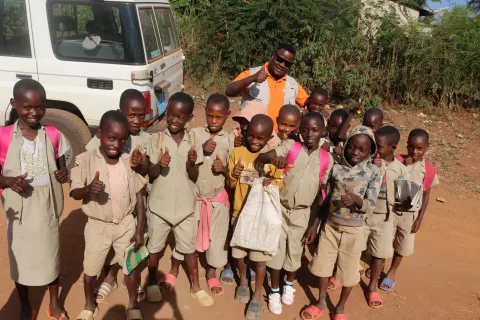
In the heart of the commune of Giharo, some 70 kilometers from the provincial capital of Rutana, lies an unexpected oasis of laughter and artistic expression: the child-friendly space at the Musenyi site. In this Congolese refugee site, where daily life is often synonymous with deprivation, painful memories, and uncertainty, UNICEF — in collaboration with its implementing partner, Social Action for Development (SAD) — has set up a programme that is full of life, humanity, and hope, focusing on education and well-being.
As soon as you cross the fence of metal netting, you are struck by a vibrant, almost unreal atmosphere: a veritable hive of children playing, laughing, and running between swings, skipping ropes, marbles, and ball games. Here, innocence seems to have reclaimed its rights.
Every day, Kazamalwezo Valentin, a volunteer refugee and supervisor, ensures that this haven of peace remains a place where children can breathe, heal, and dream. “Here, we want children to feel safe and protected, free from violence and abuse. Every day, we welcome around 500 children, and each one is entitled to special attention,” he explains, his eyes attentive to the children's every need.

In addition to recreational activities, the centre offers informal educational opportunities such as literacy classes, educational games, a drawing club, and discussion workshops, all of which boost the self-confidence, social skills, and resilience of the young beneficiaries. Adolescent girls also take part in awareness-raising sessions on gender-based violence, dignity, self-esteem, and self-protection, essential topics in a context of fragility and forced displacement.
But it was in one of the tents set up as an activity room that the most moving scene unfolded. The atmosphere is very special: laughter, murmurs, and orchestrated movements - these are refugee children learning about theatre. And as they perform, the pain of the past seems to fade away for a moment.

Among the young actors, Sifa Cheilla, a member of the drama club, stands out for her enthusiasm. “I feel good here. Theatre is my passion. When I'm acting, I forget everything. I come here every day for rehearsals, it's what I love to do.”
The club is run by Mtakolwe Lechoix, another refugee, who used to put on plays in his hometown of Luvunge in the DRC before he was forced to flee.
“Today, I look after more than 60 children. The parents love what we do. They send us their children, even toddlers. Sometimes we have to turn them away because there's no room. Theatre here isn't just a leisure activity, it's a tool for healing.”
The themes addressed are not chosen at random. They speak of their lives, their pain, their hopes: unaccompanied children, gender-based violence, family conflicts, all raw realities that they learn to name, confront, and transform.

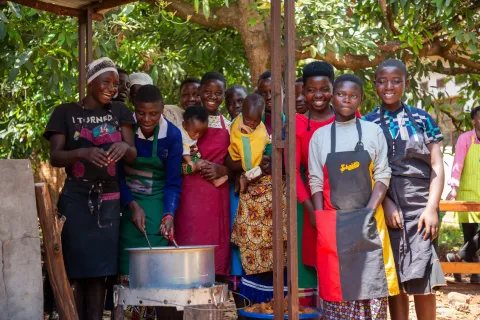
This space is not only beneficial for the children, it also eases the mental and physical burden on their parents. While the children are in good hands, the adults can attend to household needs, access basic services, or simply get some rest.
Karama Kazuri Ahadi, deputy focal point for the programme, explains that mobile spaces also criss-cross the camp to reach even more children.
In the dusty alleys of the Musenyi camp, between the tents and the smiles, theatre has become a beacon, a stage on which displaced children rewrite their own story. They may not yet have found a home, but they have already found a voice.
Life in a refugee site is not easy, especially for children. Deprived of leisure and education, and often forced to work to support their families, children are stripped of their childhood. Thanks to the child-friendly space set up by UNICEF at the Musenyi site, children find a safe place to learn, play, make friends, and simply be children again. Through activities such as theatre, they are writing a new story, one of rediscovered dignity.