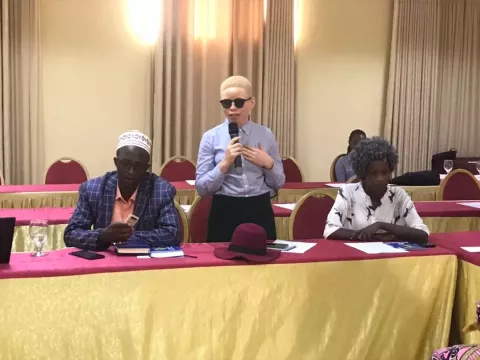
Educational inclusion panel to pledge for a better environment for every child with disabilities
As part of the "NABO NI ABACU" project, which aims to promote the community inclusion of children with disabilities in Muyinga commune, an advocacy panel on the inclusion of children with disabilities in Burundi was held on September 19, 2024.

- English
- Français
This event was organized by a consortium of civil society organizations, including SOJPAE, the Association of Disabled Women "Les Vaillantes," and IADH, with support from UNICEF.
Representatives from the government, associations of people with disabilities, United Nations agencies, national and international NGOs, as well as children and young people with disabilities, participated in the event.
The discussions during the event highlighted the progress, challenges, and future prospects for the inclusion of children with disabilities in Burundi's school system.
Before the panel, an expert in inclusive education presented an overview of the current situation regarding the schooling of children with disabilities in Burundi. Notably, the expert shared alarming statistics, such as the fact that over 32 million children with disabilities worldwide are deprived of education—about one-third of the global out-of-school population (according to a 2022 report by the NGO Humanity & Inclusion). The expert also discussed the legal foundations for inclusive education.
Panelists from the Ministry of National Education and Scientific Research, the Ministry of National Solidarity, Social Affairs, Human Rights, and Gender, UNICEF, and the Association of Disabled Women "Les Vaillantes" presented key achievements as well as future plans to further advance the inclusion of children with disabilities. These achievements include capacity building for teachers, the provision of adapted equipment, support for centers caring for children with disabilities, and improvements in the accessibility of new buildings.

Future efforts to improve access for children with disabilities were also presented, with a particular focus on improving the learning conditions for these children. At the end of the panel, participants were given the opportunity to ask questions and make recommendations, such as enhancing community awareness about the development of children with disabilities.
Hydre Nshimirimana, a 6th-grade student at Muyinga Fundamental School, shared her personal challenges with the audience: "It takes me more than 4 hours to reach school from my home (less than 2 km away). I often miss classes due to delays, and during the rainy season, it's almost impossible to get there." Testimonies like this enriched the discussions by shedding light on the daily difficulties these children face.
The event concluded with the announcement of upcoming projects, including the piloting of new initiatives aimed at providing schools with adapted mobility equipment.