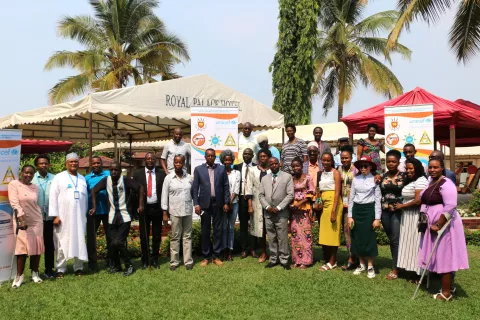
Women with disabilities: Key actors for an Inclusive and Sustainable future
Through their struggles, skills, and resilience, women with disabilities are redefining the contours of an equitable and inclusive society.

- English
- Français

At the intersection of gender inequality and disability, women with disabilities face double marginalization. In many countries, including Burundi, they encounter systemic discrimination, environmental barriers, and limited access to education, employment, and decision-making spheres. Yet, far from being passive victims, they embody resilience and strength, making them essential to any inclusive development project.
Investing in their social, economic, and political inclusion is not just a matter of human rights; it is a strategic choice to build stronger and more resilient communities. These women, through their unique experiences, bring valuable perspectives and innovative solutions to the challenges faced by them and their communities.
In Burundi, the Association of Women with Disabilities, Les Vaillantes, exemplifies how women with disabilities can not only defend their rights but also initiate social change. Founded in 2009, this organization has 273 members and relies on a network of provincial focal points to coordinate its activities across the country.
One of its most notable initiatives is the 2024 community integration project for children with disabilities, “NABO NI ABACU” (They Are Ours Too), in the Muyinga commune. Implemented in collaboration with two other civil society organizations and supported by UNICEF, this project contributed to the schooling of more than 124 children with disabilities.
Additionally, 205 community actors, including local authorities, religious leaders, and members of organizations for people with disabilities, were trained to promote inclusion. These efforts fostered an environment conducive to the integration and active participation of children with disabilities in their communities.
"This project demonstrates how an inclusive approach can transform children’s lives and raise community awareness about the importance of equity and social inclusion," said Vianney Kirajagaraye, Inclusion Specialist at UNICEF-Burundi.
In addition to education-focused initiatives, Les Vaillantes implements essential projects to combat gender-based violence, particularly among adolescent girls and women with disabilities. For instance, the Right Here Right Now 2 program addresses early pregnancies among adolescent girls with disabilities in Bujumbura and Rumonge, while the PRESCIBU TUYATUZE project (2023–2025), supported by the European Union, raises awareness and provides support for women and girls with disabilities in several provinces.
These initiatives do not merely aim to reduce violence; they also promote profound social change by encouraging respect for the rights of women with disabilities and strengthening their active participation in society.
In collaboration with UNICEF and other partners, Les Vaillantes has also played a key role in polio awareness campaigns. Through interactive theater, testimonials, and radio broadcasts, they have mobilized local communities while placing women with disabilities at the heart of change strategies.
Les Vaillantes' efforts demonstrate that investing in women with disabilities protects their rights, strengthens local capacities, and fosters social innovation. When supported, their leadership becomes a powerful engine for transforming communities and building a future where no one is left behind.
On the occasion of the International Day of Persons with Disabilities, it is crucial to recognize the central role played by women with disabilities in building a more equitable society. As France Begin, UNICEF Representative in Burundi, emphasizes: "Investing in the potential of women with disabilities is a commitment to a society where everyone can contribute actively to a fairer and more sustainable future. Women with disabilities, through their resilience and determination, show us that inclusion is not only possible but essential to securing a sustainable future."
This fight for inclusion is not just the responsibility of women with disabilities; it concerns us all. An inclusive society is a fairer society for everyone.