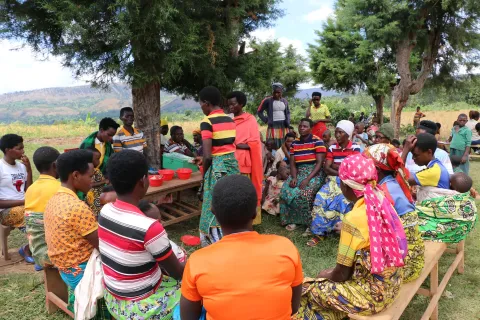
In Bweru, collective mobilization transforms the fight against malnutrition
Funded by the German Development Bank (KfW), an integrated programme led by UNICEF, WFP, and their partners GVC and CONCERN Worldwide is strengthening nutrition and resilience among families in four provinces in Burundi.

- English
- Français
On this late February morning in 2026, the commune of Bweru lies under a capricious sky, where the sun appears briefly before giving way to light showers. The agricultural season is in full swing. Everywhere, families are busy planting beans.
Along the slippery paths, Jeannine Ininahazwe, a “Light Mother” (Maman Lumière) for ten years, is returning from the fields with her hoe resting on her shoulder. In her courtyard, she sets the hoe down, wipes her hands still marked with damp soil, and welcomes us warmly: “I’m just coming back from the field, I was planting beans... but you are most welcome here,” she says, inviting us in.
Over the years, her home has become a familiar place for many families. It is in this simple yet lively courtyard that many children in Bweru have regained their health thanks to the Nutrition Learning and Rehabilitation Center (FARN). It is also here that little Christa Bella, daughter of Espérance Nsengiyumva, was supported and rehabilitated from moderate acute malnutrition just a few months ago.
Espérance remembers the worry that once consumed her when her daughter, then only a few months old, refused to eat and frequently fell ill. “Since birth, she has not always been in good health,” she recalls. “She often got sick, diarrhea, fever… She was always weak. And at six months, when she was supposed to start eating, she refused much food, especially beans.”
Every quarter, Community Health Workers visit households to screen for malnutrition. One day, a CHW, accompanied by a Light Mother, came to her home, measured the child's MUAC, and found she was in the yellow zone. They explained that she was suffering from moderate acute malnutrition. “They referred me to the FARN and asked me to complete the full twelve-day session. I came every single day, without missing once,” she says.
During the FARN sessions, Espérance discovered essential new practices: she learned how to prepare diversified and balanced meals, enrich food with micronutrient powders, and maintain proper hygiene. The cooking demonstrations were especially helpful, showing her how to combine different food groups so that her daughter would accept them. The results quickly became visible. “After the twelve days, my daughter had gained weight and was eating foods she used to refuse. The micronutrient powders helped her a lot. Today, I thank God she is healthy and developing normally,” Espérance explains.
This experience transformed the way she feeds her family. More confident and better equipped, she now encourages other mothers to seek support from health workers or Mother Leaders as soon as a child shows signs of not developing as they should.


When families receive the support they need
For Jeannine, a Light Mother, supporting mothers like Espérance has been part of her daily commitment since 2016. When a child is identified as having moderate acute malnutrition, Jeannine works alongside Community Health Workers to organize FARN sessions. Each session brings together eight to twelve children, who are regularly weighed, fed, and monitored, while their parents receive key messages and learn how to reproduce these practices at home.
“For me, the greatest success is seeing families pass on this knowledge: mothers who complete the FARN become sources of information and support for other parents.” She recalls a case that particularly marked her: a child from a well-off family who was nonetheless malnourished due to poor feeding practices. “I showed the father how to prepare meals using what he already had at home. The child quickly recovered. Today, she’s a beautiful sixth-grader. Sometimes it’s not the lack of food, but the lack of information.”
This momentum is also carried by Community Health Workers like Serges Ndikumagenge, who explains their essential role: “We are on the front line in the fight against malnutrition because we support families every day,” says Serges, a Community Health Worker in Bweru. Each month, he walks across the hills to screen children using MUAC and, together with the Light Mother, immediately refers those who need follow-up: moderate acute malnutrition cases are enrolled in FARN sessions, while severe cases are transferred to the health center for Outpatient Therapeutic Care. “We work hand in hand with health structures,” he explains.
During FARN sessions, he guides parents through practical skills, including preparing balanced meals, maintaining proper kitchen hygiene, using micronutrient powders correctly, and setting up small home gardens to diversify diets. Serges admits that some days are more challenging, especially during the lean season when the foods needed for cooking demonstrations are scarce. But the commitment of hill leaders and community volunteers to collect food for the FARN is a tremendous support.
For him, this work carries value far beyond any financial compensation. “As a parent, I feel responsible for the well-being of all the children around me. It’s this conviction that fuels my daily commitment to the families of Bweru,” he confides.

The continuum of care established in health centers and at the hospital is a critical component of the programme. At Ruyigi Hospital, the Therapeutic Stabilization Unit treats children with severe acute malnutrition and complications. Its head, Jean Marie Itangishaka, explains the protocol: “We admit the most fragile children and stabilize them with therapeutic milk F-75, followed by F-100. Once their condition improves, they continue treatment at the health center.”
Across all health facilities, UNICEF supports the management of severe acute malnutrition cases at both the Outpatient Therapeutic Care and Therapeutic Stabilization Unit levels, while strengthening nutrition sector coordination at the provincial level.
Vitamin A supplementation, deworming with albendazole, home fortification with micronutrient powders, and support for integrated community case management of childhood illnesses all reinforce this approach.
At the same time, the organization is improving water, hygiene, and sanitation by installing water points and establishing community committees to manage them.
This continuum of care, reinforced by community-level efforts, is already showing results: families are adopting better feeding practices, children are recovering more quickly, and severe cases are decreasing. Village savings and loan associations, as well as the development of individual and collective income-generating activities, also help strengthen households’ resilience during periods of food insecurity. As Jeannine notes, since October 2025, no new FARN has needed to open: families are better prepared, and children are healthier.
These advances are part of a broader approach to preventing malnutrition and strengthening resilience, jointly led by UNICEF and WFP, together with CONCERN Worldwide and WeWorld GVC. For several years, this programme has supported families in the provinces of Karusi, Kirundo, Ruyigi, and Rutana through a combination of interventions in nutrition, food security, health, hygiene, and behavior change. The ambition goes beyond treating children who are already malnourished: it aims to sustainably prevent malnutrition and strengthen household capacities at the very heart of communities.