Burundi organised the first national forum for girls' and women's education
Organised by the Ministry of National Education and Scientific Research, with the support of partners including UNICEF, the forum is part of the official launch of the continental campaign ‘’Africa educates its girls’’

- English
- Français
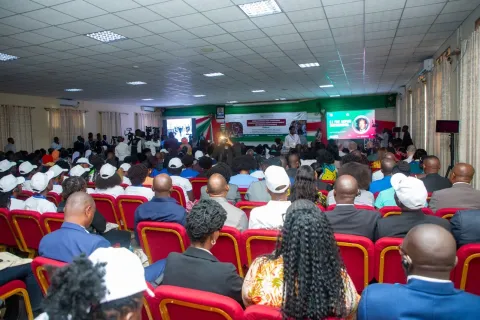
This first forum for girls‘and women's education took place in Bujumbura from 3 to 5 December 2024, under the theme “Promoting girls” and women's education: a strategy to ensure equitable and inclusive access throughout life’. Its launch, under the patronage of HE the First Lady of Burundi, Angeline Ndayishimiye, also marked the launch in Burundi of the ‘Africa educates its girls and women’ campaign, launched by the African Union (AU) in September 2020 to promote school education for girls and women and the fight against gender-based violence (GBV).


In her opening speech, the First Lady of Burundi, Angeline Ndayishimiye, welcomed the progress made in girls' access to education. ‘’Today, girls and women have their place in all sectors of the country's life, including areas traditionally reserved for men’’ , she said, citing in particular their presence in the national defence forces and the police, in technical fields such as civil engineering, and in key positions in government and parliament.
The First Lady, nevertheless, drew attention to the fact that discrimination against girls remains a reality in certain communities, for reasons linked in particular to religion or ancestral customs. She, therefore, called on all those involved in the education sector to redouble their efforts to promote girls' education. ‘’If girls have the same opportunities as their brothers in terms of access to education and can contribute to the development of their country, this will contribute to the achievement of the ‘Vision of Burundi as an Emerging Country in 2040 and a Developed Country in 2060’’, she stressed.
According to the Minister of National Education and Scientific Research, François Havyarimana, the statistics at their disposal reveal that the majority of girls and women tend to underestimate their abilities, particularly at the 1st, 2nd and 3rd cycles of higher education (baccalaureate, master's degree, doctorate). Statistics gathered by the Ministry in 2021 show, for example, that out of 10,607 students taking their baccalauréat, only 2,656 were girls. At Master's level, only 40 girls out of a total of 522 attended this course.
One of the measures taken by the Ministry of Education to meet this challenge was to receive the state examination winners for the 2022-2023 academic year at the University of Burundi, at the same time as those from the previous year. According to Minister François Havyarimana, the long waiting period before being enrolled at the University of Burundi was a real handicap for girls, some of whom were no longer returning to continue their higher education for various reasons.
For 3 days, more than 300 participants involved in the education and gender sector, including representatives of the government, parliament, development partners, UN agencies, young people, local associations, trade unions and religious denominations, discussed and made recommendations on crucial issues relating to girls' and women's education. They mainly discussed the right to education for all, gender-sensitive financing in education, the fight against GBV, the development of women's and girls' skills, the development of female leadership, etc.

Speaking at a round-table discussion on the priorities of the ‘'Burundi educates its girls'’ campaign, the head of UNICEF's Education Section, Beatrice Wakimunu, called on the Ministry of National Education and Scientific Research and the Ministry of Finance to do their utmost to ensure that the budget allocated to the education sector devotes a significant share to areas aimed at promoting the education of girls and women. She drew attention to the fact that more than 80% of this budget, which is the largest in comparison with that allocated to other social services, is used for current expenditure and less for investment and more problematic areas.
Among the main recommendations to emerge from the forum were the need to raise awareness in communities, with the support of women leaders, so that girls have the same opportunities as their brothers in terms of access to education; to revise curricula so that the ‘gender’ concept is integrated into them ; to map the different interventions of the various partners and harmonise intervention methods; organising fast-track training for children outside school so that they can return to school; curbing the problem of girls' financial dependence by setting up income-generating activities and encouraging innovation; incorporating compulsory education into Burundian law; banning gender-based violence in the school environment and putting in place a text enabling girls to return to school in real time in the event of unwanted pregnancies, and so on.


According to the Permanent Secretary at the Ministry of Education, Frédéric Bangirinama, a roadmap will be drawn up to give more details on the actions expected in relation to each recommendation, establish responsibilities and set deadlines. ‘’‘’This will enable each partner to make his contribution’’, added Frédéric Bigirimana. He recalled that this first national forum for girls‘ and women's education was organised as a follow-up to the first African Union pan-African conference on girls’ and women's education in Africa, which was held in Addis Ababa in July 2024 and will be organised every two years. ‘’Each country will have to show its contribution to the ‘'Africa educates its girls’’, he stressed.
‘’I renew the commitment of UNICEF and our partners to continue to support the government of Burundi in all its efforts to improve and transform the lives of young girls,’’ said Mame Selbee Diouf, UNICEF Deputy Representative in Burundi, during the forum's closing ceremonies.