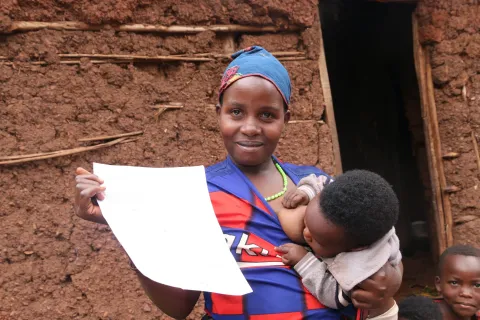
Birth registration: a prerequisite for lifelong protection
On the occasion of civil status registration day, UNICEF reiterates its unwavering support for the Government of Burundi to ensure that every child has a legal identity.

- English
- Français
10 August 2024. Of the 164 million unregistered children in the world, more than half, or around 91 million, live in Africa, and around 6 out of 10, or 116 million, do not have a birth certificate[i].
With 84% of children under five and 73% of children under one registered at birth, Burundi has one of the highest rates of registered children on the African continent. The continental averages are 51% for children under one and 55% for children under five.[ii]
This good score nevertheless hides huge disparities between regions, with Kirundo province recording the lowest rates, with only 54% of children under five registered at birth. Added to this is the difficulty for children registered at birth to obtain their birth certificates, as only 66% of children under the age of five have one.
Other factors hindering birth registration and the collection of birth certificates include (1) the short legal timeframe of 15 calendar days for registering a child, otherwise families have to follow a complex and costly procedure for late registration; (2) the cost of obtaining a birth certificate, which remains high for vulnerable families; (3) the long distances to reach civil registry offices, with the additional transport costs that this entails; etc.
To support the Government of Burundi in its efforts to find solutions to these challenges and contribute to achieving Sustainable Development Goal 16.9 of universal birth registration, UNICEF has been supporting, since 2023, the implementation of an interoperability approach between the civil registry and health systems for birth registration in the province of Kirundo.
The approach advocates the regular presence of civil registry services in health facilities to ensure that children are registered at the time of their birth or during their first vaccination.
This approach has already proven effective in facilitating access to local civil registration services. This has led to a marked increase in the rate of births registered within the legal timeframe, and has given parents access to registration, vaccination and postnatal health care at the same time.
"Birth registration, which is a fundamental right enshrined in the Convention on the Rights of the Child, gives access to the fulfilment of many other socio-economic rights, such as the right to health, education and protection. Denying a child this right exposes him or her to serious violations such as early marriage, exploitation, trafficking, etc.", says France Bégin, UNICEF Representative in Burundi.
For several years, UNICEF Burundi has been supporting the organization of late birth registration campaigns across the country, focusing on the most vulnerable families, such as those from the Batwa community, those affected by emergencies, returnees and displaced persons. In this context, from 1 June 2023 to 15 June 2024, UNICEF supported the province of Kirundo with interventions that made it possible to issue birth certificates to 268,691 children, including 83,192 repatriated children, thus improving their access to essential social services, such as free healthcare for children under the age of 5 and free schooling for those of school age.
In line with the Sustainable Development Goals, UNICEF intends to keep the promise of universal birth registration and guarantee a legal identity for every child in Burundi by 2030.
[i] Une mise à jour statistique sur l’enregistrement des naissances en Afrique. UNICEF, New York, 2022
[ii] Africa-Birth-Registration-Brochure-Oct-2022_Final-LR.pdf
Media contacts
About UNICEF
UNICEF promotes the rights and wellbeing of every child, in everything we do. Together with our partners, we work in 190 countries and territories to translate that commitment into practical action, focusing special effort on reaching the most vulnerable and excluded children, to the benefit of all children, everywhere.
For more information about UNICEF and its work for children, visit www.unicef.org.