Interoperability between civil registry and health services for birth registration in Kirundo
After more than a year of implementing this approach, access to civil registry services for birth registration within the legal timeframe has been strengthened in this province.

- English
- Français
At around 10 a.m. on a Tuesday morning, several mothers holding their mother-child health booklets line up at the Vumbi Health Center (CDS) to access birth registration and vaccination services for their children.
UNICEF is supporting the Ministry of the Interior, Community Development and Public Security, and the Ministry of Public Health and AIDS Control, in the implementation and monitoring of interoperability between civil registry and health services in Kirundo province.
The interoperability approach aims to strengthen children's access to birth registration services within the legal timeframe by making civil registry services available in health facilities. This ensures that children are registered immediately after birth, or when they receive their first vaccination.
We are greeted by Thomas Nsengiyumva, a local registrar. “Before, we were overwhelmed by the number of parents coming to register their children. This interoperability approach has really transformed our work,” explains Thomas as he completes the birth register.
"On any given day, we can receive between 15 and 20 parents, representing around 600 registrations per month in the health centers. Parents take advantage of vaccination days to register their children. All they need to do is bring their mother-child booklets to obtain their child’s birth certificate on the same day. This approach is highly beneficial, as unregistered children face many obstacles in accessing basic social services that are their fundamental rights. Thanks to this initiative, we have significantly reduced the stress and travel burden for parents while ensuring the realization of children's essential rights," he adds with a smile of satisfaction.

The registrars and parents we met emphasized the relevance and effectiveness of this approach.
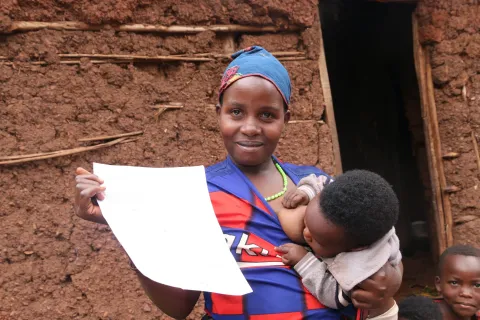
Jeanine Kamariza, 30, mother of Itangishaka Joel (8), Niyoyitungira Mevin (5), and Dushime Bella, just two weeks old, is delighted to be returning home with her newborn’s birth certificate.
"I spent a week in hospital because I gave birth by caesarean section. I had already planned to go and register Bella the following week, but when I arrived at the CDS for vaccination and postnatal care, I learned that the Vumbi CDS now offers a birth registration service. This was very good news for me, as it spared me a long trip to the registry office, the transport costs, and the trouble of motivating a witness — not to mention how time-consuming the process used to be," she confides.
This approach has enabled many children, including those from vulnerable families, to fully enjoy their fundamental rights, such as access to education, vaccination, and free healthcare. It has also been a key factor in increasing the rate of timely birth registration in the province.
The interoperability approach has been implemented since mid-October 2023, in 52 health facilities across Kirundo Province. It has brought civil registry services closer to the people, at the grassroots level. Health facilities now play a dual role: providing healthcare services — including vaccination and consultations — and hosting civil registry offices that systematically register births and issue birth certificates.