The radio education program: children in the commune of Pama rediscover the taste for studies.
Thanks to funding from ECHO, UNICEF is supporting communes in emergencies in the Eastern region through education programs that enable children to learn to read and write

- Français
- English
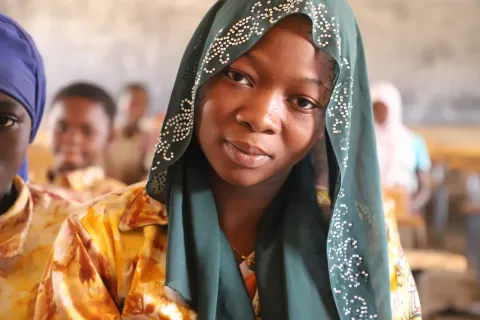
Originally from a village in Eastern Burkina Faso, Madina is now an internally displaced person. Three years ago, she and her family were forced to flee by armed men bursting into their village, leaving everything behind to seek refuge in the nearby city of Pama. In her hometown, Madina used to attend school daily. Suddenly becoming an out-of-school child, she finally found solace in the radio education program set up in the commune where she was displaced.
"I used to go to school and enjoyed it. I am happy to be able to participate in the listening club because it helps me remember everything I have already learned and learn new things,” explains Madina.
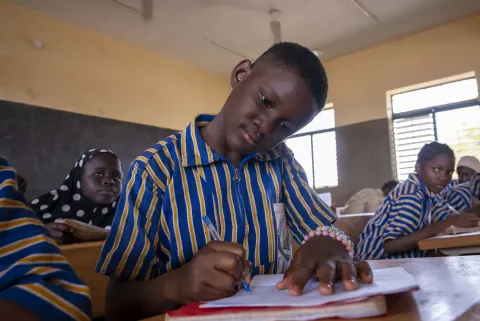
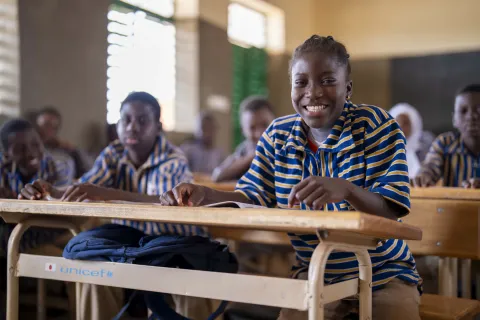
To address this education crisis, UNICEF has set up the Education Radio Program (PER) to ensure that children fleeing conflict have continued access to education. PER is, indeed, an emergency response for the education of the most vulnerable children in the most hard-to-reach areas. The program consists of the broadcasting of lessons for children aged 10 to 17 to ensure basic literacy and numeracy, both in French and in local languages (Tamachek, Sonrai, Fulfulde, Koronfe, Moore, Gourumachema and Dioula). The children are welcomed in listening clubs of 40 children and supported by a facilitator or at home with the support of their family members and/or the 1,000 community relays. Sessions on life skills, protection, hygiene, and sanitation are also broadcast.
"I'm learning to read, write and count. I've been coming here on Wednesdays, Saturdays, and Sundays for about two years. I'll keep coming because I'd like to become a midwife when I grow up," says Madina.
In the Eastern region of Burkina Faso, where attacks against schools and teachers are still regular, UNICEF is working in five localities (Pama, Matiacoali, Kompienga, and Foutouri) with the support of the ECHO. For example, in Pama, the security situation is deteriorating, while the latest humanitarian overview and displacement data published by the Conseil National de Secours d'Urgence et de Réhabilitation (CONASUR) as of October 31, 2022, indicates that the town was already welcoming 13,750 IDPs, including 8,535 children and 2,930 women.

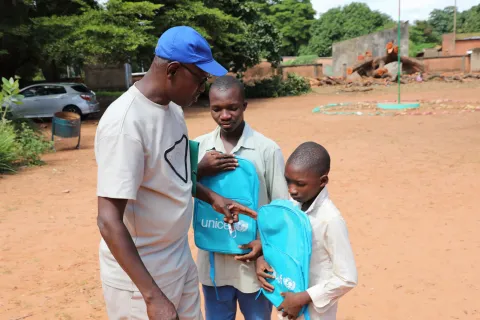
In this context, access to education is complex, and Education through Radio is a solution to preserve the link to school for vulnerable children. In addition to providing radios and USB keys, out-of-school children between 10 and 17 benefit from Temporary Learning Spaces built to shelter listening clubs. Facilitators are trained in Safe School protocol and child protection. In Pama, a total of 1,306 children benefit from the Education through Radio program thanks to ECHO financial support.

Like Madina, Jean Baptiste is an internally displaced child. The security situation led him to seek refuge in Pama with his family, and for the past three years, he has been participating in his local listening club.
"With my classmates, we meet under a tree or in a classroom. Our facilitator makes us review what we’ve learned during the previous lessons, and then we turn on the radio. We listen to the day's lesson. This is the basis on which our facilitator explains things to us. It's very interesting, and for me, it means I don't forget all I learned when I was at school," explains Jean Baptiste.