Education is vital for all children whatever their situation
Here at Secteur 1 C Primary School, 662 students including 323 girls and 339 boys are crowded into 10 classrooms among which stands 3-classroom building

- Français
- English
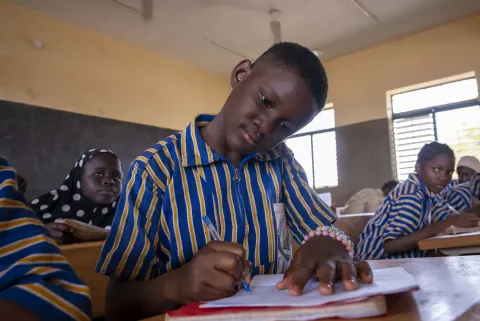
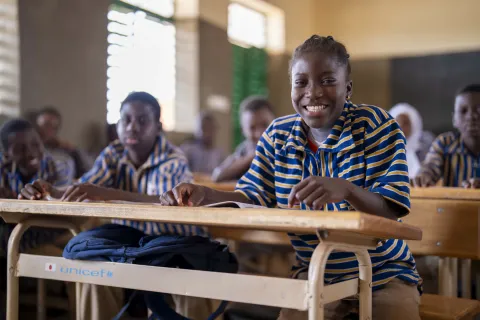
Here at Secteur 1 C Primary School, 662 students including 323 girls and 339 boys are crowded into 10 classrooms among which stands 3-classroom building. This one has been built by UNICEF thanks to support from the Japan Committee for UNICEF to relieve the overcrowded classrooms, thus bringing great relief to both students and teachers. “We started school under the straw huts. We were exposed to wind and rain. When it rained, classes would stop and everyone would run home. Today I am happy to be in a beautiful building and sitting on a nice wooden bench desk ", rejoices 12-year old Ouoba Alice, a student in grade 6.
Alice lives in sector 1 C of Fada, a town located in Burkina Faso's Est region. Like most of her schoolmates, she has experienced the harsh conditions of school life since her first school year. Every year she had her schooling brutally interrupted for almost five months due to the rainy season.
Located in the southern outskirts of the town of Fada, Secteur 1 C primary school had welcomed its first students under straw huts as classrooms. There were no sanitation facilities for girls and boys. The makeshift classrooms were constantly subjected to inclement weather such as rain and wind. “Each year, the straw classrooms had to be rehabilitated because they could no longer be used after the rainy season. Despite the efforts of the Parents Association to support the purchase of straw huts, the school program started late and ended early because of the rainy seasons”, deplores Lompo Jean, president of the Parents Association.
In the straw classrooms, the students were sitting closely together, sometimes six of them on the same wooden bench desk for those who were lucky enough to have one, while most of them were sitting on the dusty floor. They were hardly able to focus on what the teacher is writing on the blackboard. “It was not easy to concentrate, but we were doing our best”, says Alice.
Worse, during the hot weather the snakes would crawl into the straw classrooms to find shade. The slightest suspicious movement caused panic so that the students were no longer focused for class.
UNICEF's intervention thanks to the financial support of the Japan Committee for UNICEF has been beneficial. In 2019, a 3-classroom building was built and equipped with school furniture including bench desks, chairs and desks for teachers. Moreover, separate latrines for girls and boys were built on the school grounds.
According to Serge Yougbare, the school principal, the new building is of great value and is welcome. Working conditions are better and the access rate has improved significantly.
Today, Secteur 1 C Primary School in Fada is among the schools with the highest success rates in the Eastern region. It has 21 teachers for 10 classes in total. Formerly at 59% while all the classes were in straw huts, the success rate is now estimated at 73% with the construction of the modern classrooms which has suddenly helped to positively shape the image of the school. “Before, our school was called 'Ecole Gwangwandji', which means school under straw huts, a very pejorative nickname. Today the name has changed. The school is called ‘Secteur 1 C Primary School’, says wryly Alice.
Since 2017 the number of students has also increased because of attacks by armed groups in the neighboring areas of the region. The school also welcomes internally displaced students who fled their villages due to insecurity. Near the modern 3-classroom building stand 7 additional classrooms made of improved straw huts erected to absorb the plethora of students. “Out of an enrollment of 662 students, including 323 girls and 339 boys, there are 358 internally displaced students. It is time for more classrooms to be built before the situation becomes more critical. Education cannot wait for peace", challenges the school principal.
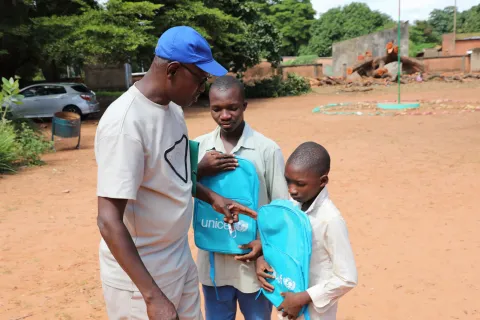
In the Eastern region, UNICEF, thanks to Japanese funds, has furthermore built other educational infrastructures, including a general education center for post-primary education and a pre-school awareness and education center, all equipped with latrines with water points in prospect of implantation.
UNICEF is supporting the MENAPLN in developing a new school model based on the principles of UNICEF’s quality child-friendly school (QCFS) approach, which provides quality education to children. Secteur 1 C Primary School in Fada is experimenting with this approach through the construction of this new 3-classroom building with separate latrines for girls and boys. The ultimate objective is the standardization of the school in the image of quality child-friendly school whose components dealing with school infrastructure, teachers training, school management and student clubs aim to improve children’s learning, health and safety.
Since 2014, 2,008 primary schools have been converted to QCFS thanks to the School for Africa (SFA) programme and this represents 13 per cent of all primary schools in Burkina Faso. Also, School for Africa supported the construction of over 50 schools since 2014. As of 31 December 2020, the QCFS programme contributed to providing quality education and creating a better learning environment for 460,560 children (222,935 girls) in Sahel, Centre-Nord, Plateau-Central and Est regions.