Education through radio for a resilient education system in crisis contexts
Education in emergency

- Français
- English
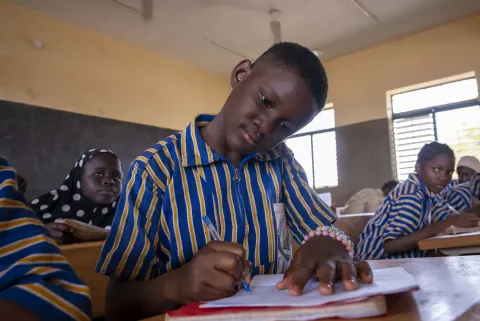
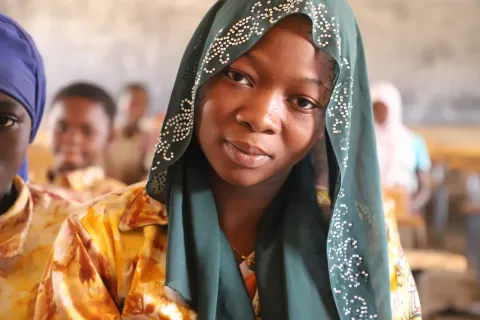
Bamogo Naomie is a 14-year-old girl in the third grade. She is originally from Bouroum, a village located about 100 km from Kaya in the Centre-North region of Burkina Faso. For the past two and a half years, Naomie has been living in sector 04 of Kaya, a site that was initially built to house the Kaya market and was eventually made available to the internally displaced populations. She and her family had to flee the village to escape attacks.
"Due to the attacks we were forced to flee from Bouroum, and we found refuge here in Kaya. I am here with my parents, my brother and my four sisters. When the gunmen arrived, we were in the field. Our neighbour who was in the village informed us of their presence and suggested that we stay in the field until they left. They forced our community to convert to Islam. A few days later, they came back to the village to let us know that they would kill those who refused to convert. So we had to leave immediately, bringing just a few clothes with us. When we arrived here, we had nothing; it was very difficult to find food," confides Naomie.
Due to the prevailing security situation in Burkina Faso, thousand of children are currently out of school; to address this education crisis UNICEF has introduced the PER to ensure that children fleeing from conflict have continued access to education. The PER is thus an emergency response for the education of these children.
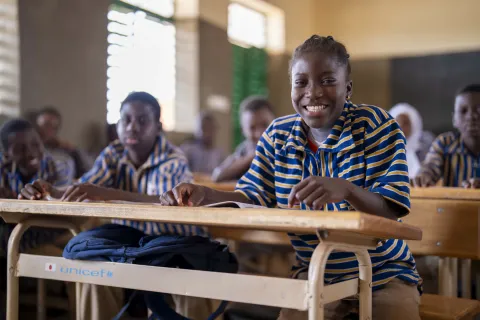
Every Wednesday and Friday between 7:30 a.m. and 9 a.m., Naomie and 39 other children take classes on the site. It is a way for them to preserve their school knowledge and not to remain idle.
"Recently, I had almost forgotten everything from the courses I took while at school in Bouroum. But now, with the listening club, I can revise and acquire new knowledge. Also, I have new friends, and we get along well. Beyond the classes, it is a full-time activity for us. I would like to also have books to read and notebooks to practice my writing. My wish is to become a teacher in order to also supervise children" she adds.
Kaboré Soumaila, tutor of the listening club, underlines that "the parents quickly joined the project. They appreciate this initiative very much. Also, during classes, we cover life lessons, then reading and finally calculations".
The listening club led by Soumaila has 40 students including 20 girls and 20 boys between the ages of 6 and 17. Each session consists of an hour of listening and an hour of questions and answers intended to ensure that the children develop a proper understanding. Naomie is identified as a student who participates the most in the classes.
The populations living on the site come mainly from the villages of Barsalogho, Dablo and Pinsa in the north central part of Burkina. More than 110 households live there, with a total population estimated at more than 1,000 people.
Eleutère Ouedraogo, representative of the Diocesan Communication Center (CDC) for the project, is responsible for ensuring that the various clubs are well-run as well as for broadcasting the programs on the partner radios and for follow-up.
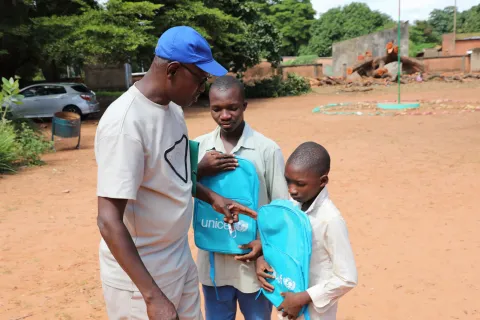
"Thanks to UNICEF, we have been able to provide more than 200 households with radio devices, without distinction, that is to say, both the host population and the internally displaced population. For us, the most important thing is that every child is able to have access to education, regardless of where they come from," says Mr. Ouedraogo.
Thanks to this project, ten listening clubs are in operation in the area, with 40 children per club; a total of 400 children are mobilized, supervised and mentored, not counting those who listen classes from their homes. Some of them have even been able to obtain the Certificate of Primary Education (CEP) as a result of this intervention.
For Mr. Ouedraogo, "the idea is not to replace the teacher, but to ensure that every child who arrives in the middle of the year following a crisis does not lose his or her original level, and that they can later integrate harmoniously into a normal school curriculum".
"We are very grateful to UNICEF for its trust and commitment to our work; however, some challenges still exist. In the rainy season, for example, we are disturbed by the rain and wind. This makes it difficult for us to run the clubs given that we usually do so under trees. So we ask UNICEF to provide us with tents so that we can cope with this. In addition, there are children whose age does not allow them to be reoriented in the normal curriculum. Some of them are attracted by professional apprenticeships "small trades". It would be good to make sure that the "Education by Radio Project (PER) is a gateway where we have apprenticeships in small trades on the side for those who are really gifted and interested in that," he concluded.
The PER was implemented with financial support from the Education Cannot Wait global fund and thanks to the technical support of UNICEF and the Ministry of National Education and Literacy and Promotion of National Languages (MENAPLN). It covers the provinces of Bam and Sanmatenga and allows children temporarily separated from school due to the health and security situation to benefit, through radio, from lessons outside their school environment.