Displaced twin sisters Fadilatou and Neimata return to school
In Burkina Faso, transition courses are organized to facilitate the return to normal education for thousands of displaced and out-of-school children

- Français
- English
When Assèta Sawadogo, 52, was fleeing the violence that gripped her village of Damesma, in north-central Burkina Faso, she certainly cared about the lives of her children, but she was very concerned about the interruption of their education. Upon arrival in Kaya, the regional capital, she wanted to enroll them in school straight away, but she could not.
“When we fled to come here, we were not able to re-enroll the children here because the classrooms were full,” she relates, turning in her hands the flashlights that her daughters use when they learn their lessons in the evening.
The house that Assèta and his family live in on the outskirts of Kaya has no electricity. But the mother of seven is keen on education and always has flashlights fully powered for her twin daughters Fadilatou and Neimata, aged 14, to revise their lessons in the evening.

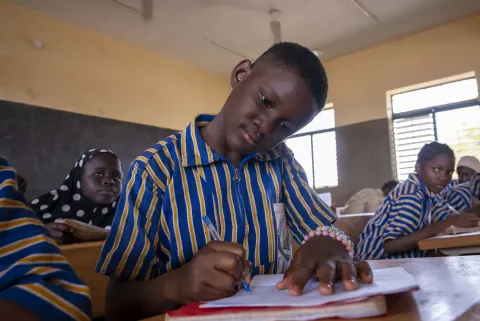
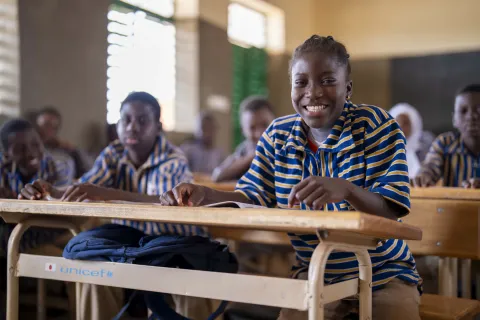
In Burkina Faso, displaced children whose education was interrupted were able to join catch-up classes during school holidays to get prepared for the next school year. So Assèta quickly enrolled her daughters in these courses.
“We didn’t like the fact that the girls were no longer going to school. Now that they’re going again, we’re happy. These remedial classes are a good thing because children won’t forget what they learnt,” she explains.
Significant efforts are made to reintegrate displaced children into school
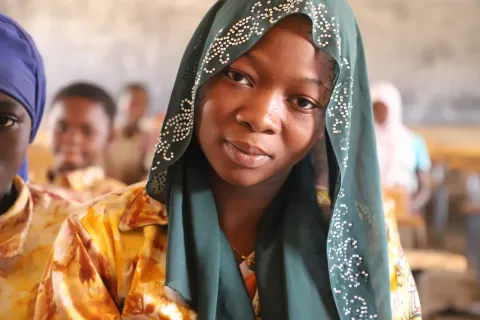
“In my class, I’ve got two twin sisters, Fadilatou and Neimata. They left their village Damesma to stay here in Kaya with their parents. At first it wasn’t easy, but now they’re interested. They’re active. They participate a lot,” said teacher Youssapha Ouedraogo, satisfied with the motivation of Assèta’s girls.

Burkina Faso faces an unprecedented crisis that has forced 2 million people to flee their homes, more than half of whom are children. Thanks to Government’s efforts, more than 1,000 schools were reopened in 2024, but before the crisis, 1 in 2 children was out of school.
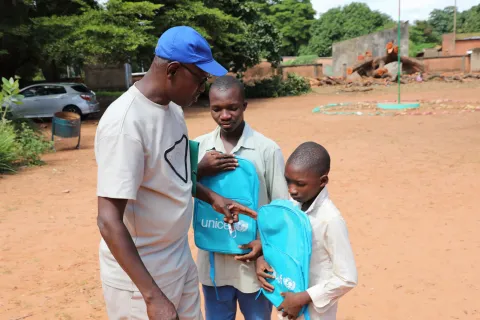
UNICEF is supporting the Government of Burkina Faso to restore the right to education for thousands of children. For transition classes, students and teachers are equipped with school and teaching materials.
“After organizing an assessment, we equip children with school materials and tools so that they can follow the lessons, develop skills and join the formal education system,”, UNICEF Education Specialist Sidney Vasconcelos explains.

With funding from the European Union, Japan and Education Cannot Wait, UNICEF supports transition courses for 15,000 displaced and out-of-school children.
“We teach students who were unable to join classes due to the displacements of some parents. We recruit them, assess their level, and if it is good, we put them into higher classes,” explains Fatimata Sawadogo, primary teacher in Kaya.
Ensuring all children continue their education
In 2024, thanks to programs supported by UNICEF, around 300,000 children have got direct access to formal or non-formal basic education opportunities, with the availability of temporary learning spaces in the five most insecurity-stricken regions. In areas where schools are closed or hard-to-reach, UNICEF has supported the national radio education programme targeting more than 460,000 children.
UNICEF helped some 355,000 children receive psychosocial support in areas most affected by insecurity, including the provision of solar or hand-crank radios and school materials. To ensure a positive learning environment, more than 230,000 children have received individual school kits, thanks to the 2023 Back-to-School campaign in 12 of the 13 regions of the country.

Thanks to transition courses, displaced children like Fadilatou and Neimata will be able to resume their education, develop their full potential and achieve their dreams for the future.
“When we didn’t go to school, we didn’t have knowledge. Now we have some. We want to become teachers to help our little brothers and other children,” envisions Fadilatou.