Orphan and Displaced Soré Finds Her Way Back to School
Funded by UNICEF Japan, the Schools for Africa project in Burkina Faso aims to provide an integrated response for inclusive and equitable access to quality protection and education for host and displaced children in urban areas.
- Français
- English
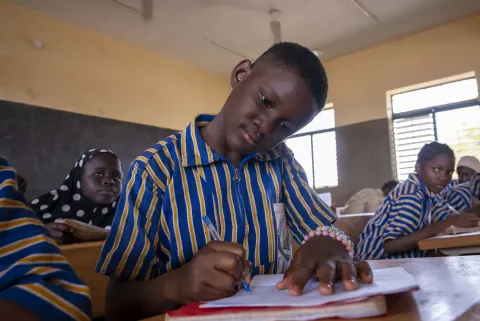
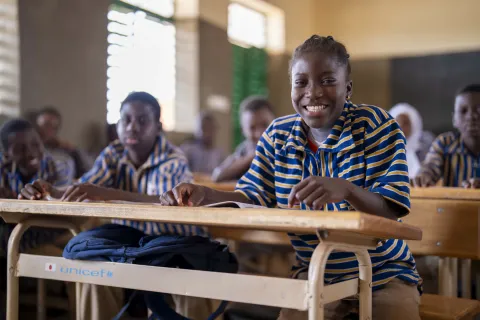
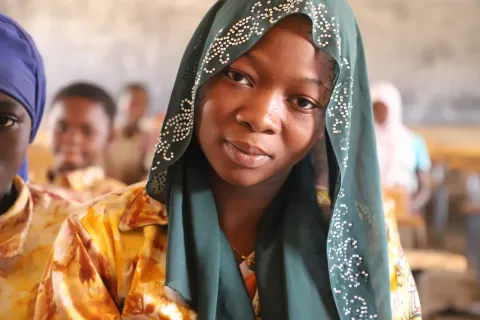
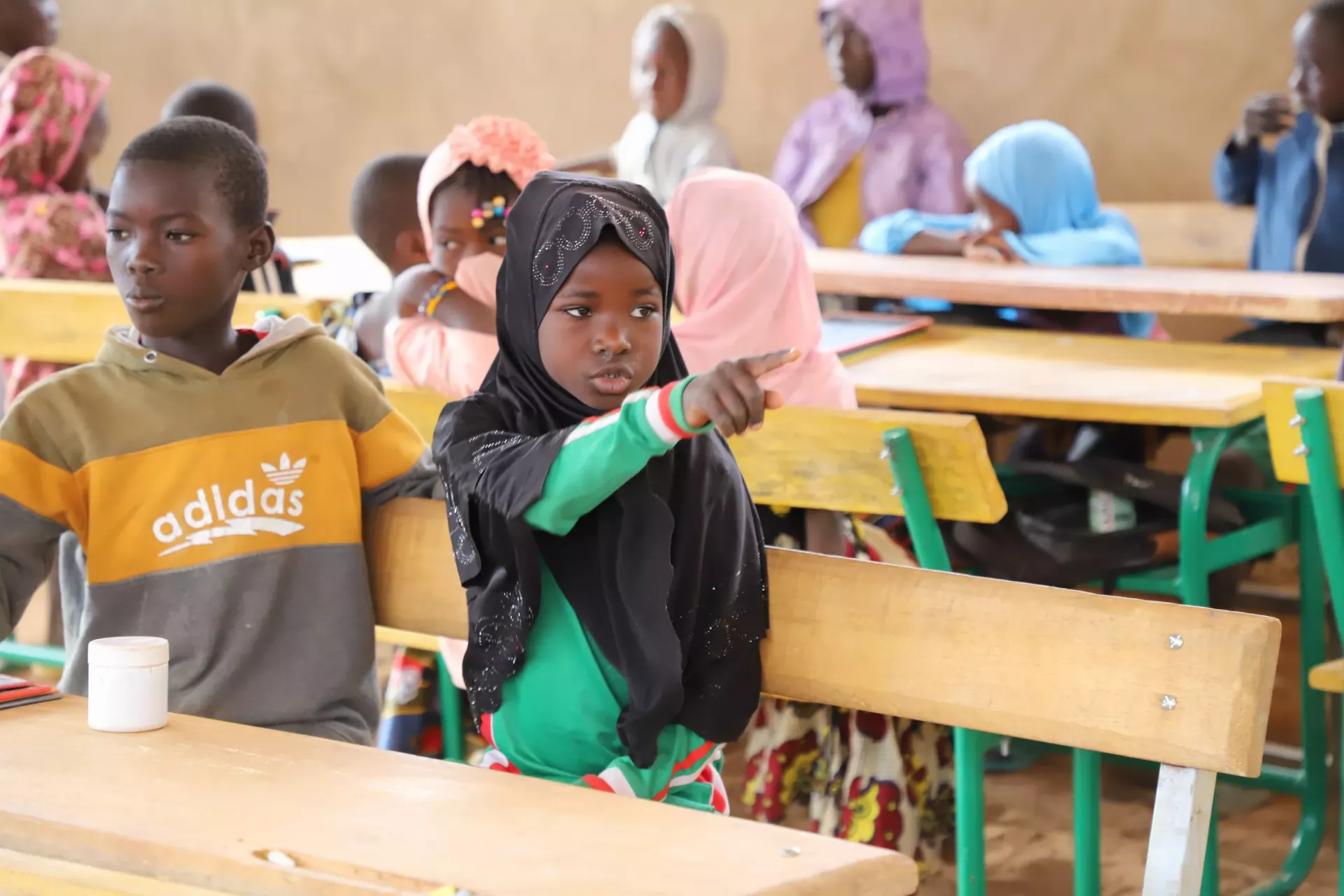
7-year-old Soré Habibou, is diligent and curious CP1 student at Sibiougou B Primary in Kaya, the capital city of the Centre North region in Burkina Faso. But her journey could have taken a very different path. Orphaned by her father, she was forced to flee with her mother and her three siblings from their village of Tampelga, some 40 km from Kaya due to insecurity.
"When we arrived in Kaya, I felt it was necessary to enroll Soré in school because I want her to be able to take care of our family in the future. Thank God, she is doing well in school and always gets good grades," says Soré’s mother Gumini Aïra, 30, who has been raising her children alone since her husband died two years ago.

Soré was initially reluctant to attend school. "At first, she refused to come, but through awareness raising and with her mother involved, she eventually accepted. Today, she is thriving," says her teacher, Sawadogo Reine Pélagie.

Reinventing Education for Internally Displaced Children
Soré Habibou's story is part of a broader effort to bring education back to thousands of internally displaced children in Burkina Faso's Centre-North region. Thanks to a partnership between UNICEF and the Ministry of education, 50 temporary learning spaces (TLS) have been built in the provinces of Bam, Namentenga, and Sanmatenga. These facilities have enabled more than 6,000 children, the majority of whom are internally displaced, to benefit from a secure environment conducive to learning.

At Sibiougou B Primary School, where Soré studies, learning conditions have improved significantly. Before the TLS were built, students attended classes under trees due to the lack of classrooms. Shelters were built in 2023 and corrugate sheet roofs and a fence, in 2024. Today, these temporary structures accommodate around 60 displaced and host children each.
Comprehensive Support for Inclusive Education
Funded by UNICEF Japan, the Schools for Africa project in Burkina Faso aims to provide an integrated response for inclusive and equitable access to quality protection and education for host and displaced children in urban areas. This is to ensure continuous education for 283,800 children and adolescents aged 3 to 17, from both displaced and host communities, in five regions of Burkina Faso.
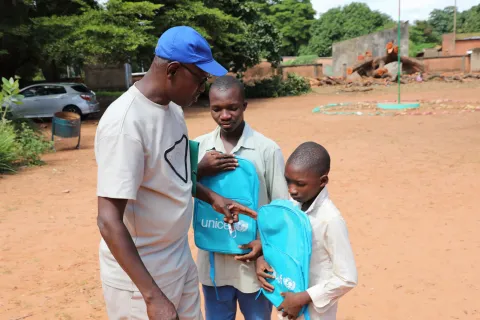
Beyond infrastructure development, 205 teachers have been trained in teaching approaches tailored to the needs of displaced children. These include the double-shift approach that applies alternating classes to manage high numbers of students, and the quality child-friendly schools (EQAmE) approach, centered on an inclusive and secured learning environment. Teachers, like Sawadogo Reine Pélagie, have also received training in psychosocial support and the Safe School methodology.

"Through games and sports, we manage to create bonds and support newly arrived students," says the Director of Sibiougou B School, Sawadogo Saïdou, highlighting the importance of psychosocial activities in helping displaced children integrate.
Education: A Source of Hope
"I am happy to go to school and learn how to write 'i', 'o', and 'a'. My dream is to become a teacher one day," says Soré.
Soré’s story is a testimony of the resilience of children and their families in times of crisis. Thanks to UNICEF Japan, the combined efforts of local authorities and educators give these children hope for a better future.
"We thank UNICEF Japan for their invaluable support in ensuring education for the children of Burkina Faso," said Ouédraogo Moussa Évariste, Regional Director of Preschool, Primary and Non-Formal Education in the Centre-North region.

To date, more than 15,000 out-of-school children have directly benefited from the project, while over 88,000 children attending the EQAmEs have been positively impacted.